
Stochastic Linear Bandits with Parameter Noise
Abstract
Lay Summary
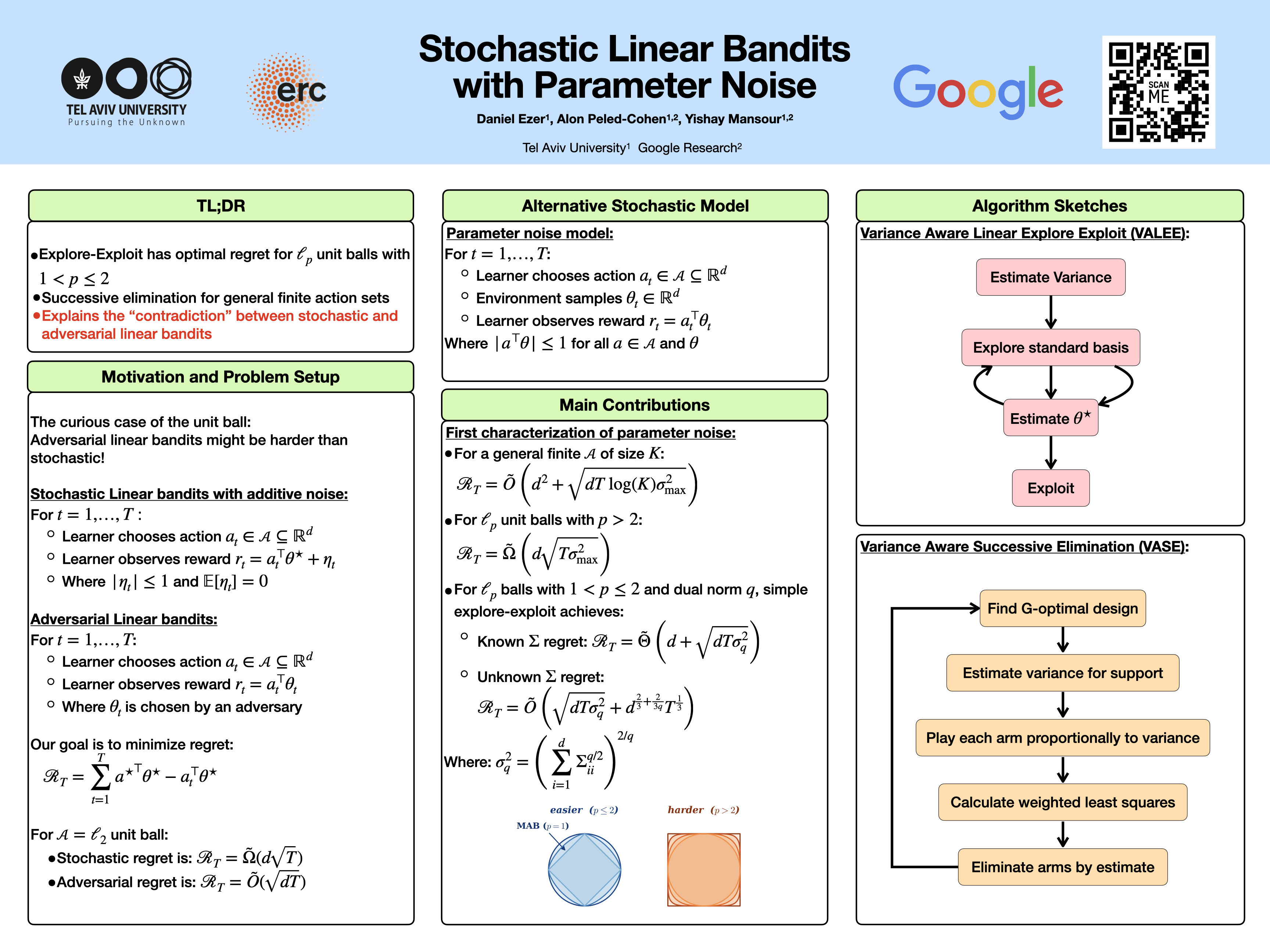
Many modern AI systems must learn by trial and error while making decisions under uncertainty. Examples include recommendation systems, online advertising, and adaptive medical treatments. A common mathematical framework for studying this problem is called a “linear bandit,” where the system repeatedly chooses actions and learns from feedback. Most previous research assumes that the world stays essentially fixed, and that uncertainty comes only from noisy or imperfect observations. In our work, we study a different and often more realistic situation: the world itself may vary from one interaction to the next. For example, a user’s preferences, interests, or mood may naturally fluctuate over time. We develop new theoretical guarantees that characterize how difficult learning becomes under this type of variability. For several important classes of decision problems, we show that learning can actually be significantly easier than in the standard setting. We also show that a surprisingly simple algorithm is enough to achieve near-optimal performance. Our results improve the theoretical understanding of learning under changing environments and may help guide the design of more reliable adaptive decision-making systems.