
$\texttt{FHAIM}$: Fully Homomorphic AIM for Private Tabular Synthetic Data Generation
Abstract
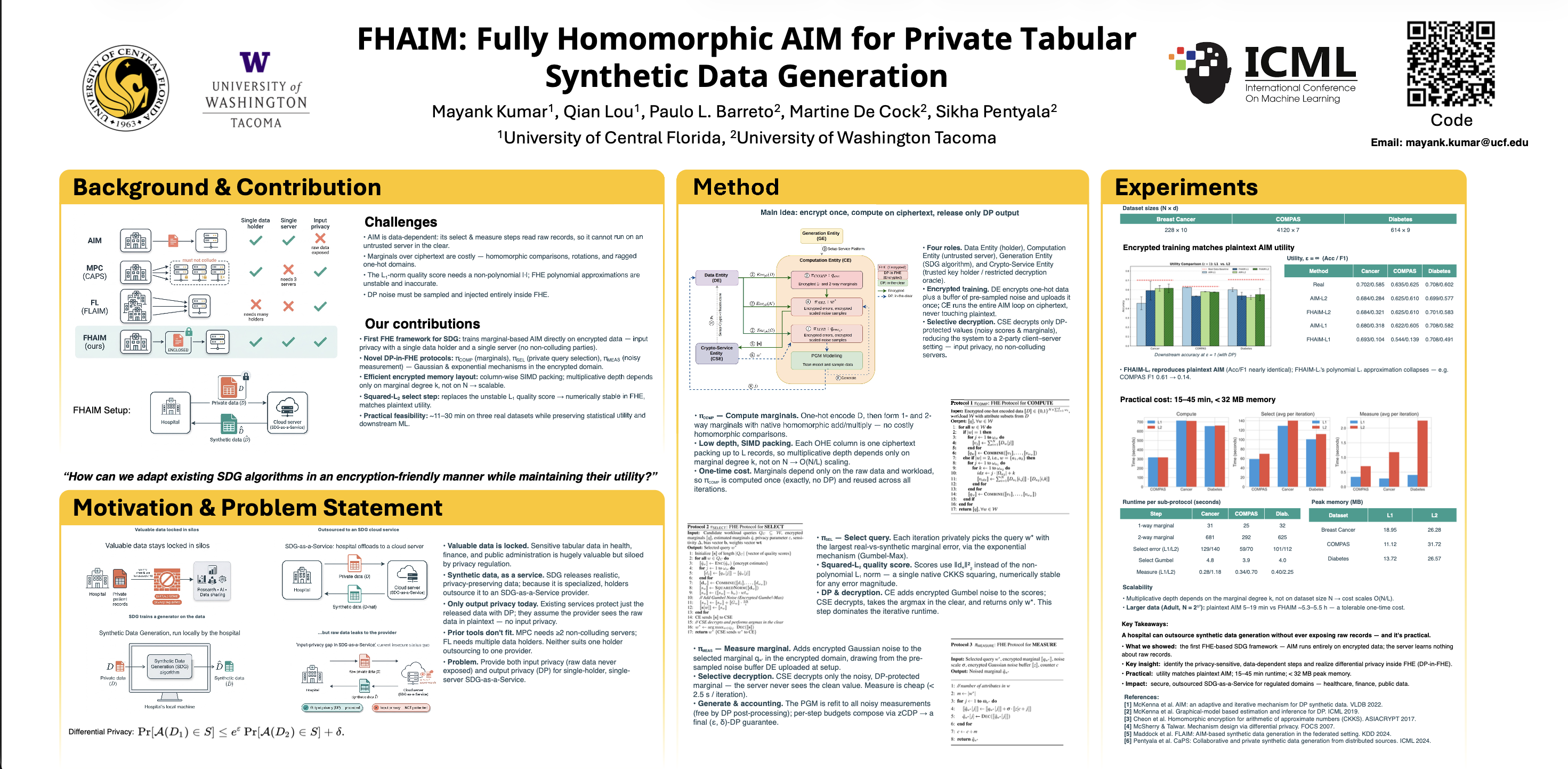
Data is the lifeblood of AI, yet much of the most valuable data remains locked in silos due to privacy and regulations. As a result, AI remains heavily underutilized in many of the most important domains, including healthcare, education, and finance. Synthetic data generation (SDG), i.e. the generation of artificial datawith a synthesizer trained on real data, offers an appealing solution to make data available while mitigating p rivacy concerns, however existing SDG-as-a-service workflow require data holders to trust providers with access to private data. We propose FHAIM, the first fully homomorphic encryption (FHE) framework for training a marginal-based synthetic data generator on encrypted tabular data. FHAIM adapts the widely used AIM algorithm to the FHE setting using novel FHE protocols, ensuring that the private data remains encrypted throughout and is released only with differential privacy guarantees. Our empirical analysis show that FHAIM preserves the performance of AIM while maintaining feasible runtimes.
Lay Summary
Many entities, such as hospitals, possess vast amounts of privacy-sensitive data such as patients' healthcare data. They want to perform analytics and inference on this data utilizing state-of-the-art machine learning models. However, because of strict privacy regulations, this raw data cannot be easily shared with model vendors. An alternative is to create synthetic data, which looks and feels like the real data but contains no actual patient information. While there are several algorithms to generate synthetic data (SDG), modern high-quality SDG algorithms require massive compute power due to their iterative nature. This compute burden is often prohibitive for hospitals. To solve this, SDG-as-a-Service providers have emerged, allowing hospitals (hereafter clients) to send their data to cloud providers (hereafter vendors) and get back synthetic data, often with "output privacy" guarantees via Differential Privacy. However, a core flaw in this service model is that the client must trust the vendor's server with its sensitive, raw data. If there is a security breach on the vendor's end, client data is compromised i.e., there is no "input privacy". We address this using Fully Homomorphic Encryption (FHE), a cryptographic technique that allows computations to be performed directly on encrypted data. Our main contribution is FHAIM, the first framework that enables a vendor to train a synthetic data generator on encrypted client data without ever accessing the raw data. We demonstrate that FHAIM achieves practical efficiency without sacrificing the utility of the resulting synthetic data.