
Exploring Accurate and Transparent Domain Adaptation in Predictive Healthcare via Concept-Grounded Orthogonal Inference
Abstract
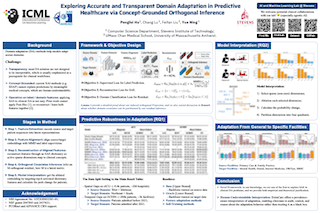
Deep learning models for clinical event prediction on electronic health records (EHR) often suffer performance degradation when deployed under different data distributions. While domain adaptation (DA) methods can mitigate such shifts, their "black-box" nature prevents widespread adoption in clinical practice where transparency is essential for trust and safety. We propose ExtraCare to decompose patient representations into invariant and covariant components. By supervising these two components and enforcing their orthogonality during training, our model preserves label information while exposing domain-specific variation at the same time for more accurate predictions than most feature alignment models. More importantly, it offers human-understandable explanations by mapping sparse latent dimensions to medical concepts and quantifying their contributions via targeted ablations. ExtraCare is evaluated on two real-world EHR datasets across multiple domain partition settings, demonstrating superior performance along with enhanced transparency, as evidenced by its accurate predictions and explanations from extensive case studies.
Lay Summary
Clinical AI models are often trained on electronic health records from particular hospitals or time periods. When the same model is used in a new hospital, clinic type, region, or year, differences in patients, coding habits, and care patterns can make its predictions less reliable. This is especially problematic because clinicians also need to understand why a model makes a prediction before trusting it. We developed ExtraCare to make clinical prediction models both more reliable across healthcare settings and easier to inspect. Our paper separates information that is useful for predicting future diagnoses from information that reflects differences between healthcare settings. It then links important parts of the model to recognizable medical codes and checks whether those codes are patient-relevant, setting-specific, or both. We tested our model on two real-world clinical datasets, including shifts across regions, years, and facility types. The model produced more accurate predictions than existing methods designed for changing data settings and provided clearer explanations than common explanation tools. This matters because safer clinical AI should not only work after being moved to new settings, but also show clinicians what medical patterns support its predictions.