
Fully Zero-Shot Image Dehazing
Abstract
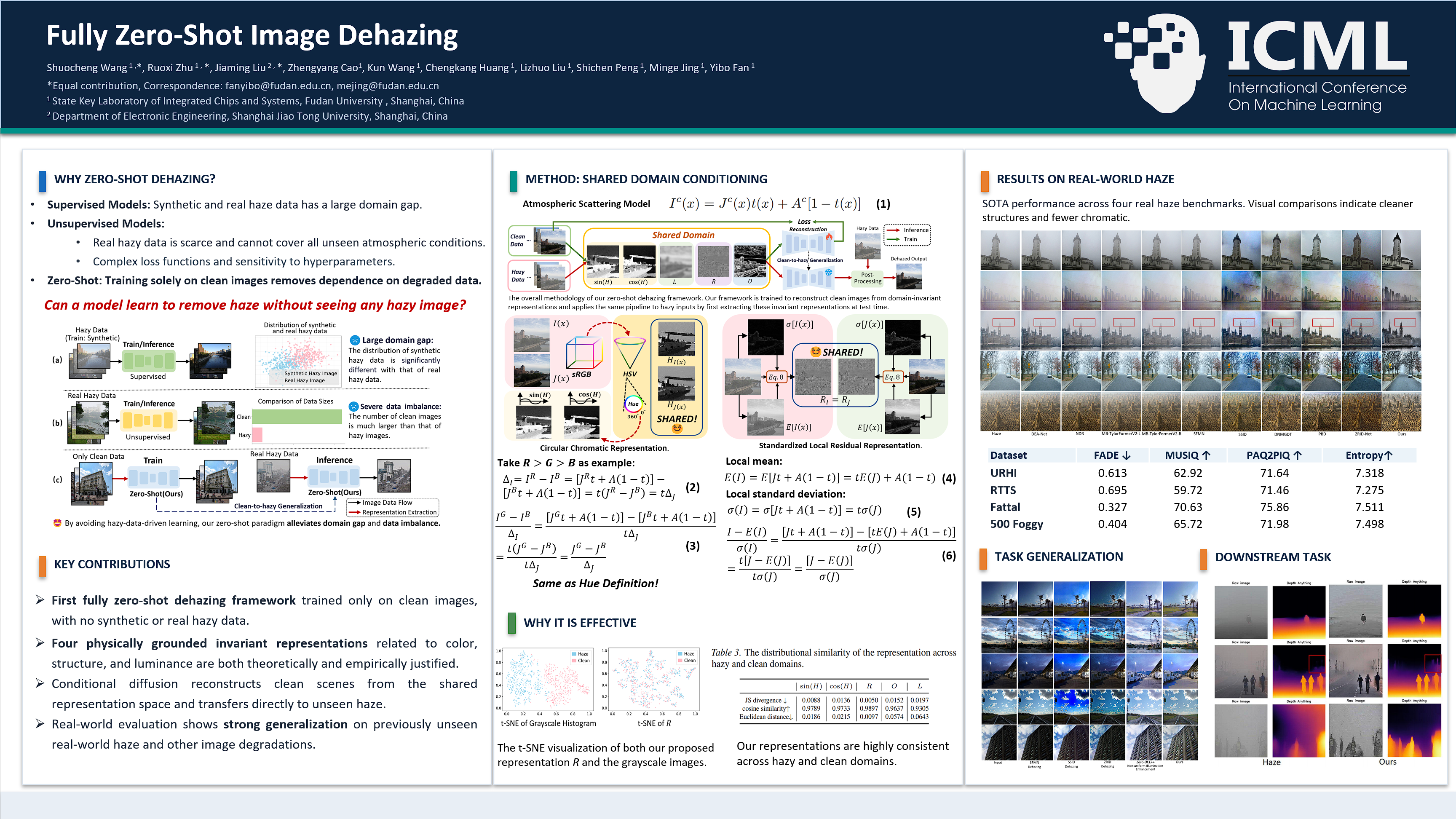
Image dehazing, an important image restoration problem, aims to recover clear scene content from images degraded by atmospheric haze. Existing dehazing methods rely on observing the distribution of hazy images during training: supervised approaches typically depend on synthetic datasets, leading to poor generalization in real-world scenarios; unsupervised methods are constrained by the limited diversity of observed haze conditions due to the difficulty of collecting real hazy images, and fail to generalize to unseen haze types. To address these challenges, we propose the first fully zero-shot dehazing framework that is trained without any hazy images. The framework is built upon a set of representations that remain invariant across clean and hazy images to bridge the two domains, which is both theoretically derived and experimentally validated. Consequently, we formulate dehazing as a conditional generative modeling problem and train a diffusion model solely with the invariant representations of the abundant and readily available clean images. During testing, the same representations extracted from hazy images serve as the conditional input to guide the diffusion process toward the clean image distribution. Quantitative analyses verify the effectiveness of the proposed representations, and extensive experiments across various real-world hazy datasets demonstrate our framework’s remarkable generalization ability, significantly outperforming existing methods. Our code will be available after the review process.
Lay Summary
Image dehazing is a key image restoration task that tries to restore clear and sharp scenes from photos blurred and degraded by natural atmospheric haze, but current dehazing methods all require hazy images for model training: supervised methods mostly rely on artificially made hazy image datasets, so they do not work well on real-world hazy images, while unsupervised methods are limited because real hazy photos are hard to collect and only cover a small range of haze situations, making them unable to handle new and unseen haze types; to solve these problems, we put forward the first complete zero-shot image dehazing framework that requires no hazy images at all for training, and this framework is based on a group of stable feature representations that stay consistent in both clean and hazy images to connect the two image domains, with this design proven both theoretically and through real tests, we further treat image dehazing as a conditional image generation task and train a diffusion model only using these stable representations extracted from plenty of easy-to-obtain clean images, and in the testing stage, we extract the same stable representations from input hazy images as conditional guidance to direct the diffusion model to generate natural clear images, and numerical tests confirm the reliability of our designed features while comprehensive experiments on multiple real hazy image datasets show that our framework has strong generalization performance.