
Test-Time Learning of Causal Structure from Interventional Data
Abstract
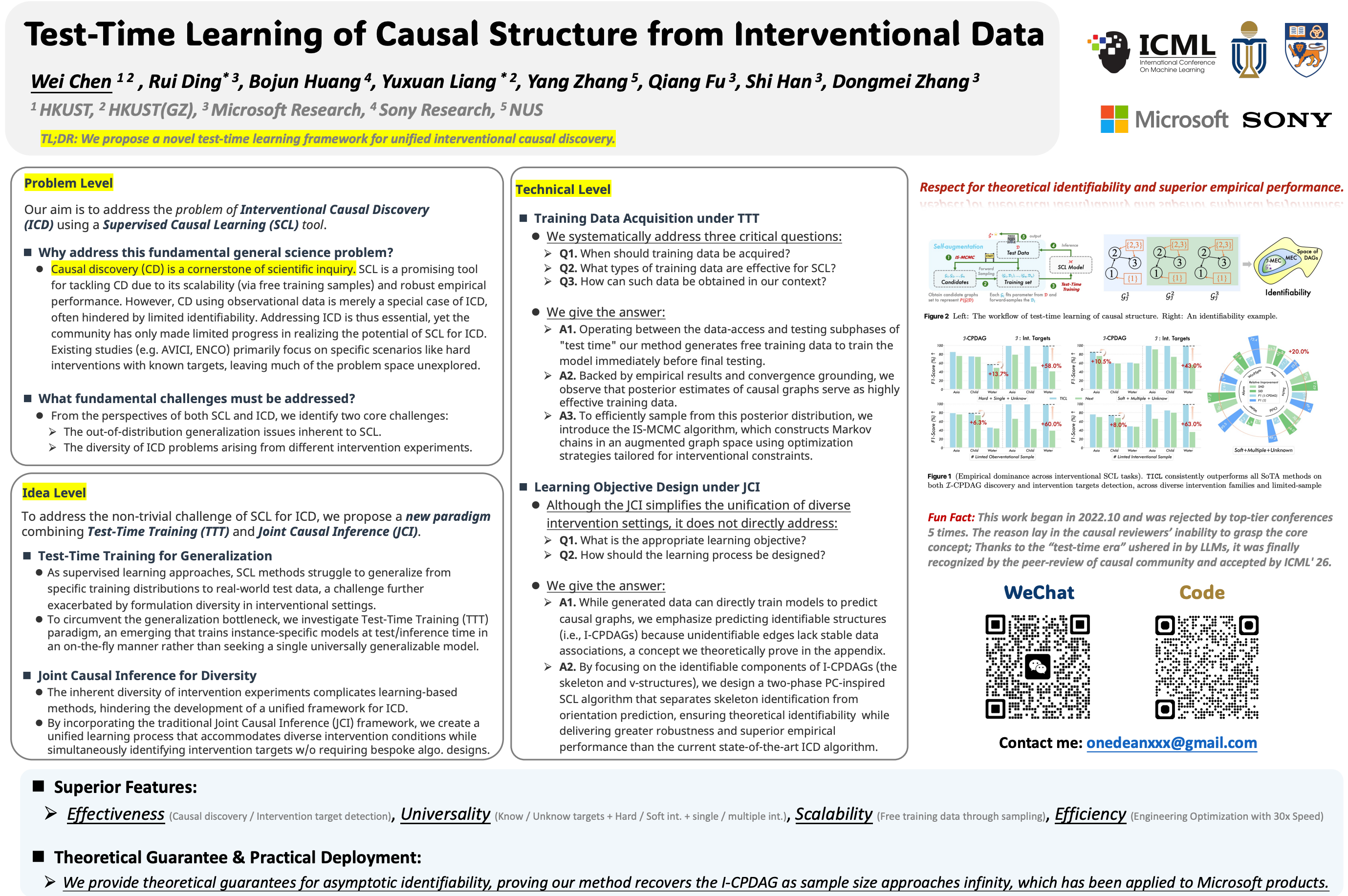
Supervised Causal Learning has shown promise in causal discovery, yet it often struggles with generalization across diverse interventional settings, particularly when intervention targets are unknown. To address this, we propose TICL (Test-time Interventional Causal Learning), a novel method that synergizes Test-Time Training with Joint Causal Inference (JCI). Specifically, we design a self-augmentation strategy to generate instance-specific training data at test time, effectively avoiding distribution shifts. Furthermore, by integrating JCI, we developed a PC-inspired two-phase supervised learning scheme, which effectively leverages self-augmented data while ensuring theoretical identifiability. Extensive experiments on bnlearn benchmarks demonstrate TICL's superiority in multiple aspects of causal discovery and intervention target detection.
Lay Summary
To make AI systems reliable and capable of true reasoning, they need to understand causal relations—like figuring out which switch turns on a light. Recently, researchers have trained AI models to discover these relationships from data. However, these models usually fail when applied to new, unfamiliar situations, especially when they don't know which parts of the system are currently being disrupted or changed. To solve this, we propose TICL (Test-time Interventional Causal Learning). Instead of relying blindly on its past training, TICL allows the AI to adapt "on the fly." When faced with a new problem, the AI uses a self-augmented strategy to practice on data tailored to that exact moment, ensuring its logic remains mathematically sound. Testing shows that TICL significantly outperforms existing methods. It not only maps out cause-and-effect networks more accurately but also successfully figures out exactly where the system was disrupted, even when that information was completely hidden. This brings us closer to AI that can truly understand how the world works in real-world, unpredictable scenarios.