
Why Tree-Style Branching Matters for Thought Advantage Estimation in GRPO
Abstract
Lay Summary
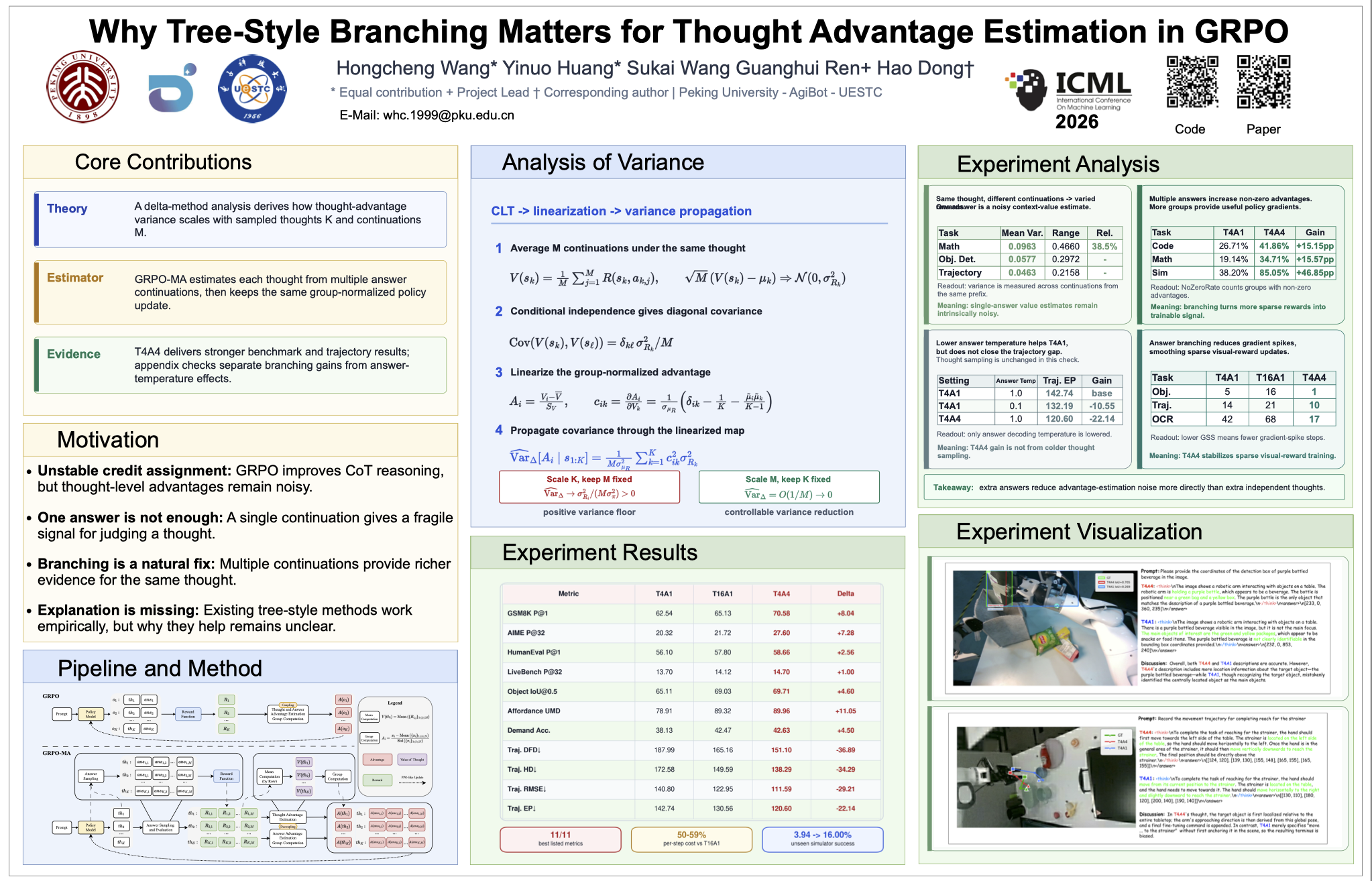
Modern AI systems are increasingly trained to "think out loud" — writing a chain of reasoning before answering — and improve by trial and error: try a chain, get a reward for whether the answer was right, update. The catch is that each chain is judged by only one answer, so the credit assigned to that reasoning is noisy: a good chain can get a wrong answer by chance, and a bad chain can get lucky. We prove mathematically that sampling more reasoning chains alone cannot remove this noise — there is a permanent uncertainty floor — but sampling several answers from the same chain drives the noise toward zero in proportion to the number of answers drawn. We turn this into a minimal change to the standard training recipe: once the model finishes thinking, branch the answer a few times. No new components, no new hyperparameters. Across mathematics, code, vision, and robot-manipulation tasks, the branched recipe reaches the same accuracy as brute-force "sample more chains" at roughly half the compute, and trains more stably. The analysis also explains why several recent tree-search training methods all work for the same underlying statistical reason.