
LABO: LLM-Accelerated Bayesian Optimization through Broad Exploration and Selective Experimentation
Abstract
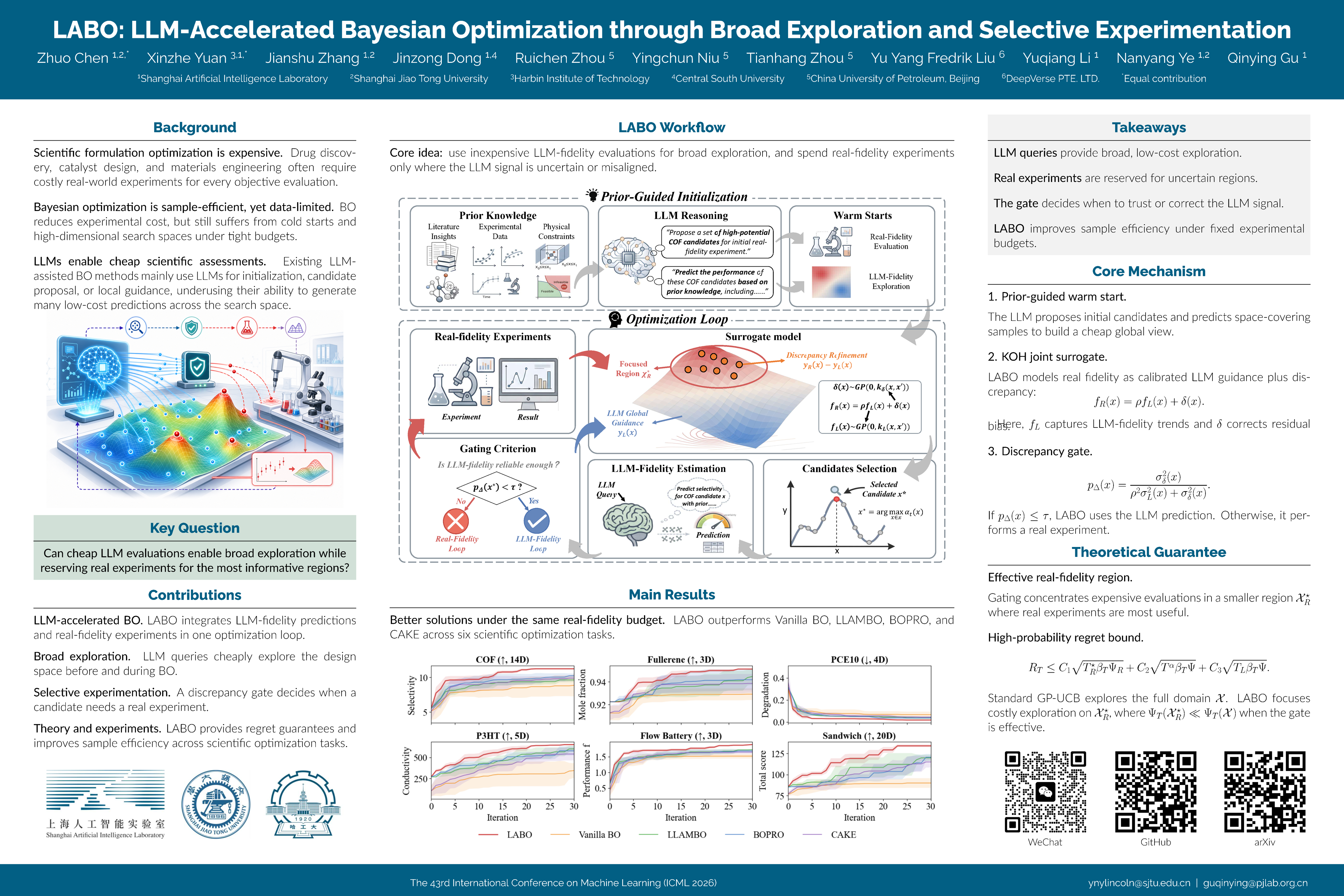
The high cost and data scarcity in scientific exploration have motivated the use of large language models (LLMs) as knowledge-driven components in Bayesian optimization (BO). However, existing approaches typically embed LLMs directly into the sampling or surrogate modeling pipeline, without fully leveraging their significantly lower evaluation cost compared to real-world experiments. To address this limitation, we propose LLM-Accelerated Bayesian Optimization (LABO), a framework that combines LLM predictions with experimental observations within a single BO loop. LABO employs a gating mechanism to dynamically balance reliance on LLM predictions versus actual experiments. By leveraging inexpensive LLM evaluations to broadly explore the search space and reserving costly real experiments only for regions with high uncertainty, LABO achieves more sample-efficient optimization. We provide a theoretical analysis with a cumulative regret bound that formalizes this efficiency gain. Empirical results across diverse scientific tasks demonstrate that LABO consistently outperforms existing methods under identical experimental budgets. Our results suggest that LABO offers a practical and theoretically grounded approach for integrating LLMs into scientific discovery workflows.
Lay Summary
Recent advances in artificial intelligence have made it possible for large language models (LLMs) to assist scientists in designing new materials, chemicals, and formulations. However, most optimization methods still rely heavily on costly real-world experiments, while using LLMs only in limited supporting roles. In this work, we introduce LABO (LLM-Accelerated Bayesian Optimization), a framework that treats LLMs as a low-cost “virtual scientist” capable of rapidly exploring large design spaces using prior scientific knowledge and historical observations. LABO combines inexpensive LLM predictions with a smaller number of real experiments inside a unified optimization loop. The method first uses LLMs to broadly estimate promising regions of the search space, then selectively performs physical experiments only in areas where the model is uncertain or potentially unreliable. To achieve this, LABO builds a probabilistic model that explicitly measures the disagreement between LLM predictions and experimental outcomes, allowing the system to decide when expensive experiments are truly necessary. We evaluate LABO across six scientific optimization tasks spanning materials science, chemistry, energy systems, and nutrition, including covalent organic framework design, fullerene synthesis, photovoltaic blend optimization, polymer conductivity optimization, redox flow batteries, and dietary formulation. Across nearly all tasks, LABO identifies higher-performing solutions using the same experimental budget while also converging faster than standard Bayesian optimization and existing LLM-assisted baselines. The broader implication of this work is that LLMs can serve not only as assistants for generating ideas, but also as scalable, knowledge-driven exploratory engines for scientific discovery. By reserving costly laboratory experiments for only the most informative regions, LABO offers a practical path toward faster and more resource-efficient scientific optimization workflows.