
$R^3$DAO: Reactive Recovery and Reconstruction for Long-horizon Data Agent Orchestration
Quanxin Liu ⋅ Rui Hao ⋅ Ruida Xu ⋅ Jianwei Zhong ⋅ Changhu Chen ⋅ Yijun Mo
Abstract
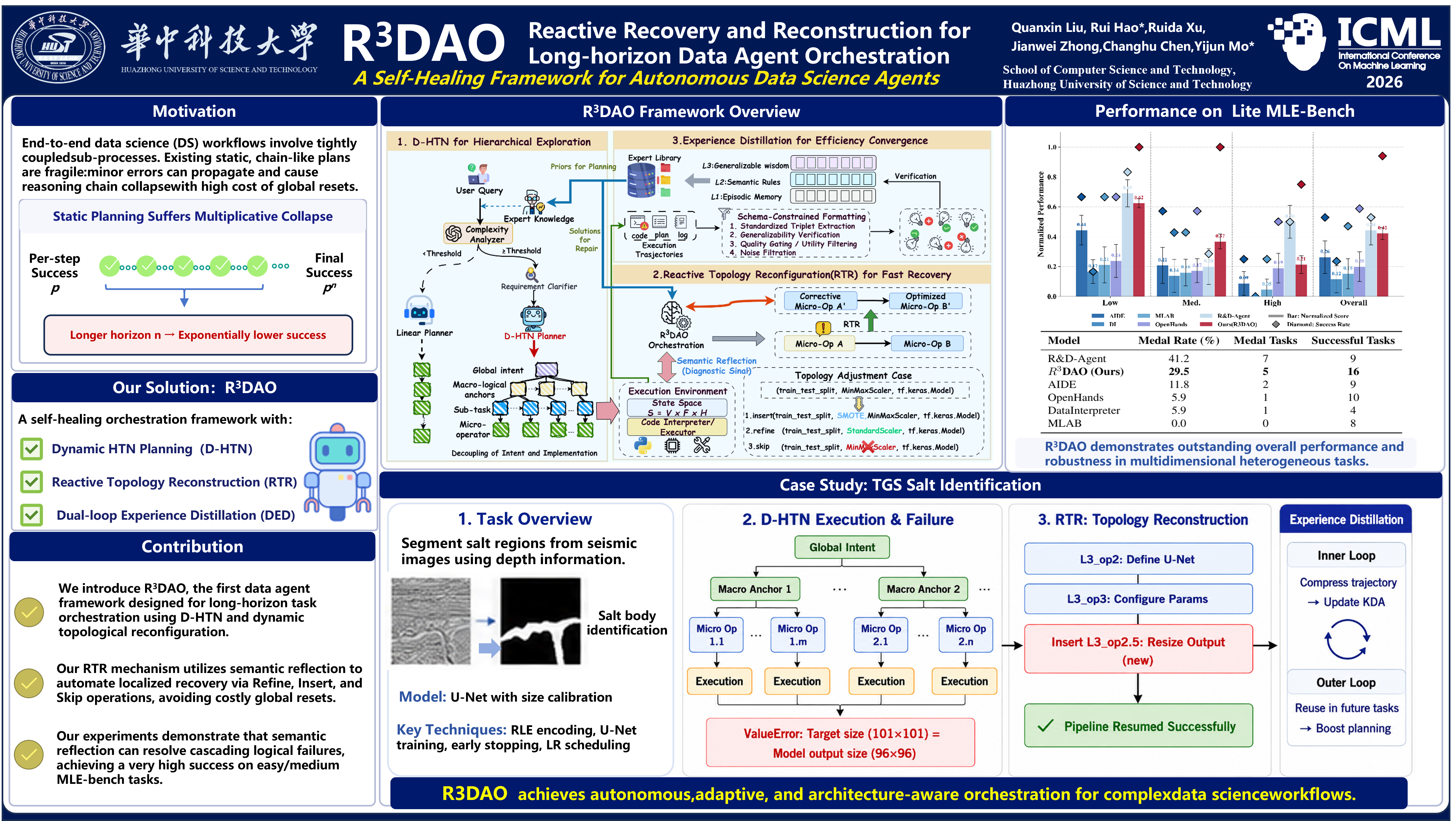
End-to-end data science agent workflows involve tightly coupled sub-processes with strong dynamic dependencies, posing a challenging long-horizon orchestration problem. Existing frameworks primarily rely on static, chain-like execution plans, which are prone to error propagation from early stages—often causing reasoning chain collapse and task failure, resulting in fragile inference and poor cost-effectiveness. To address these issues, we propose $\text{R}^3$DAO, a reactive data agent orchestration framework based on feedback-driven topology evolution, aiming to build a dynamic evolutionary closed-loop of "hierarchical exploration, iterative recovery, and empirical convergence." First, we introduce a dynamic hierarchical task network that recursively decomposes global intent into macro-logical anchors and micro-operators, enabling low-cost exploration through dimensionality reduction in the logical space. Second, we establish a reactive topology reconfiguration mechanism that leverages semantic reflection to map execution anomalies into diagnostic signals, replacing costly global resets with localized topological optimization for resilient self-healing. Finally, semantic experience distillation implements a dual-loop accumulation that compresses long-horizon trajectories into structured prior, steering execution efficiency toward the optimal regime. Evaluations on the MLE-bench show that $\text{R}^3$DAO achieves a 77.36\% improvement in success rate over advanced R\&D-Agent while maintaining competitive task scores. Notably, $\text{R}^3$DAO compresses the average execution time by 36$\times$ and limits token consumption to just 104k per task, showcasing superior reliability, efficiency, and cost-effectiveness.
Lay Summary
Automated AI agents can help process complex data science tasks. However, these tasks involve dozens of highly connected steps, meaning a minor error—like a data format mismatch—can trigger a chain reaction that crashes the entire workflow. Existing AI systems are fragile and often have to restart from scratch when they fail, making them too slow and expensive for real-world use. To fix this, we created $R^{3}DAO$, a system that acts like an experienced and adaptable project manager for AI. When an execution fails, instead of blindly starting over, it reflects on the error to diagnose the root cause and performs localized "self-healing" on the fly—such as automatically inserting a missing data-cleaning step or refining the code. Furthermore, it learns from these corrections, compressing them into reusable experience to avoid similar pitfalls in the future. This dynamic self-healing mechanism dramatically boosts the AI's success rate in complex, long-horizon tasks by 77%. Crucially, it shrinks average execution time by 36 times and drastically cuts computational costs, making highly reliable, automated data science accessible even on standard consumer-grade computers.
Video
Chat is not available.
Successful Page Load