
Diffusion Models Are Statistically Optimal for Learning Low-Dimensional Multi-Modal Distributions
Jingda Wu ⋅ Changxiao Cai
Abstract
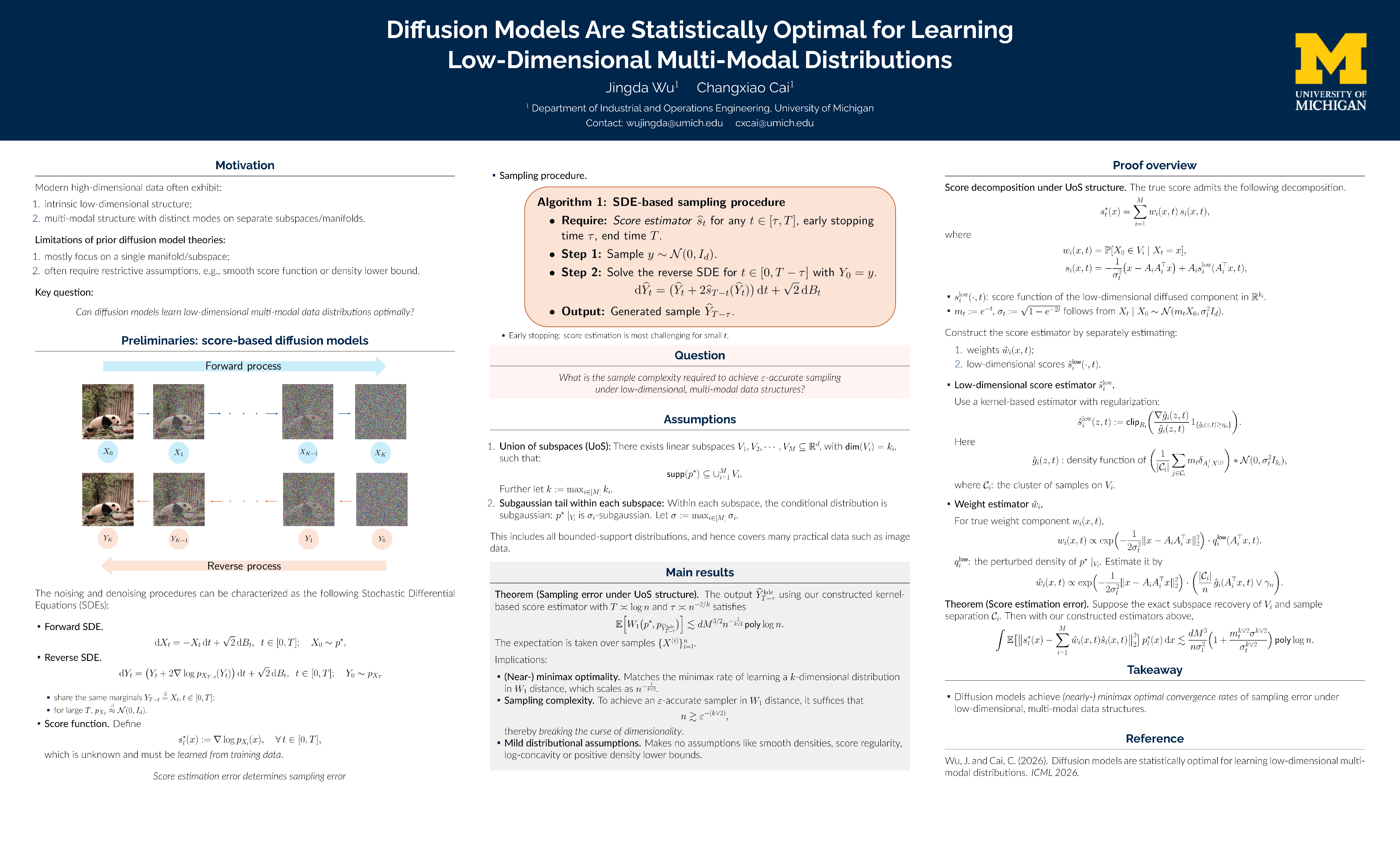
Score-based diffusion models have demonstrated remarkable empirical success in learning high-dimensional distributions, particularly those exhibiting low-dimensional and multi-modal structures. However, theoretical understanding of their statistical efficiency remains limited. Existing theories typically rely on strong regularity assumptions, such as uniformly bounded densities or globally smooth score functions, which fail to capture such intrinsic structures. In this work, we study the sample complexity of diffusion models for learning distributions supported on a union of low-dimensional subspaces. Assuming that the data distribution within each subspace is subgaussian, we show that diffusion models require at most the order of $\widetilde{O}(\varepsilon^{-k \vee 2})$ (up to some logarithmic factor) samples to achieve $\varepsilon$ sampling error in 1-Wasserstein distance, where $k$ is the intrinsic dimension. This near-optimal convergence rate depends only on the intrinsic dimension and significantly improves upon prior theoretical guarantees that suffer from the curse of dimensionality. Notably, our analysis applies to a broad collection of distributions without imposing smoothness, bounded-density, or log-concavity assumptions. Overall, our results show that diffusion models can statistically adapt to intrinsic low-dimensional structure while naturally accommodating multi-modal data, offering a rigorous theoretical justification for their success in complex high-dimensional learning tasks.
Lay Summary
Score-based diffusion models have demonstrated remarkable empirical success in learning high-dimensional distributions, particularly those exhibiting low-dimensional and multi-modal structures. However, theoretical understanding of their statistical efficiency remains limited. Existing theories typically rely on strong regularity assumptions, such as uniformly bounded densities or globally smooth score functions, which fail to capture such intrinsic structures. In this work, we study the sample complexity of diffusion models for learning distributions supported on a union of low-dimensional subspaces. Assuming that the data distribution within each subspace is subgaussian, we show that diffusion models require at most the order of $\widetilde{O}(\varepsilon^{-k \vee 2})$ (up to some logarithmic factor) samples to achieve $\varepsilon$ sampling error in 1-Wasserstein distance, where $k$ is the intrinsic dimension. This near-optimal convergence rate depends only on the intrinsic dimension and significantly improves upon prior theoretical guarantees that suffer from the curse of dimensionality. Notably, our analysis applies to a broad collection of distributions without imposing smoothness, bounded-density, or log-concavity assumptions. Overall, our results show that diffusion models can statistically adapt to intrinsic low-dimensional structure while naturally accommodating multi-modal data, offering a rigorous theoretical justification for their success in complex high-dimensional learning tasks.
Video
Chat is not available.
Successful Page Load