
Dynamic Fractal Mamba: A Neural Renormalization Group Flow for Scale-Invariant Sequence Modeling
Abstract
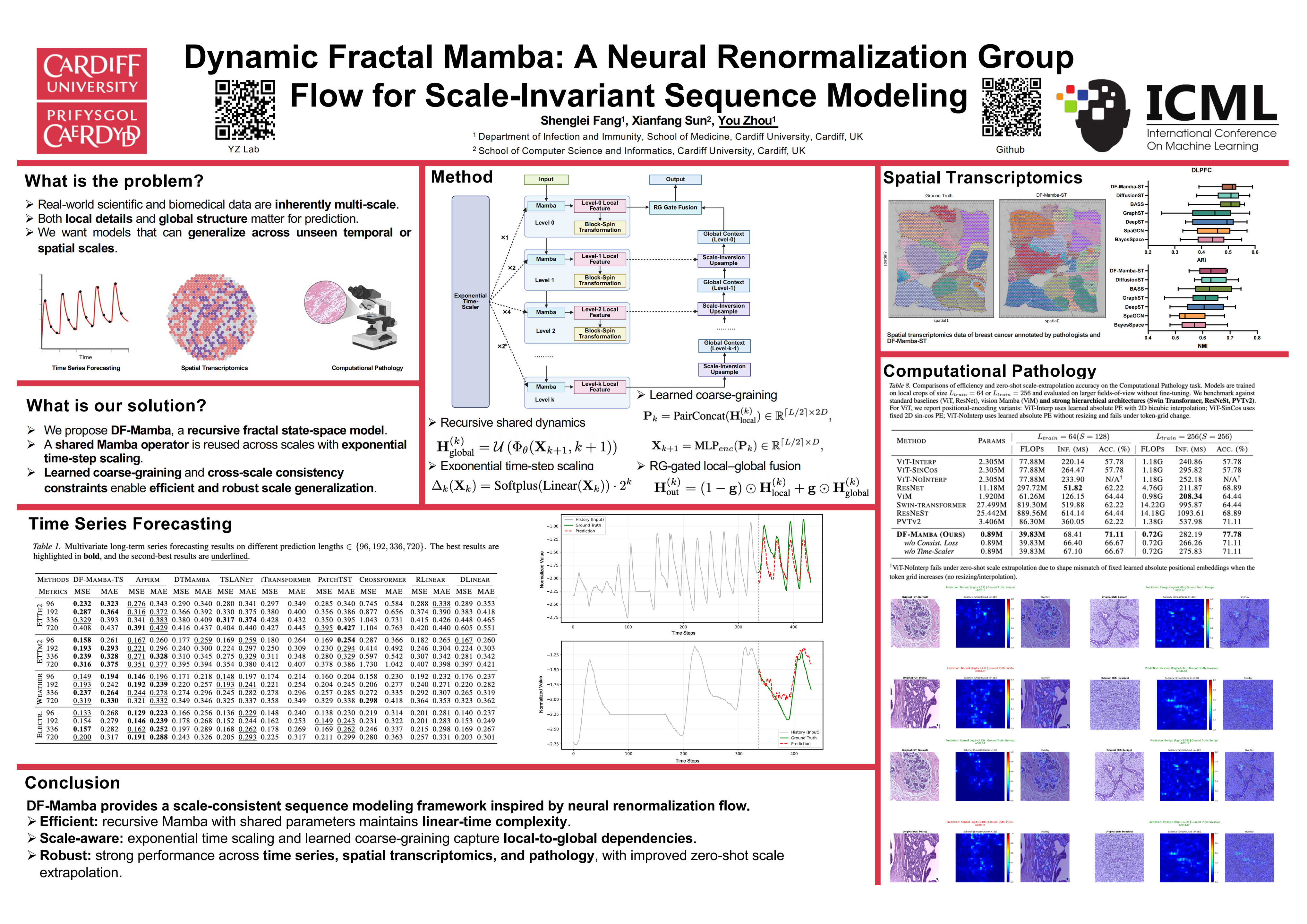
Sequence models typically operate at a fixed temporal or spatial scale and struggle to generalize to substantially longer horizons or higher resolutions without retraining. Existing hierarchical architectures expand receptive fields but rely on scale-specific parameters and lack mechanisms to enforce consistent dynamics across scales. We propose Dynamic Fractal Mamba (DF-Mamba), a recursive state-space model that applies a single shared operator across multiple scales. By sharing parameters across recursion depths and exponentially scaling the effective time step, DF-Mamba achieves an exponentially expanding receptive field while preserving linear computational complexity. A learned content-aware coarse-graining module aggregates representations across scales. Auxiliary reconstruction and cross-scale consistency objectives stabilize recursive training. We evaluate DF-Mamba on long-range time-series forecasting, spatial transcriptomics, and computational pathology. Across all tasks, DF-Mamba consistently outperforms Transformers and flat Mamba baselines while using fewer parameters and maintaining linear-time scalability. Importantly, models trained on short sequences or low-resolution inputs generalize in a zero-shot manner to substantially larger temporal and spatial scales unseen during training. These results demonstrate that recursive parameter sharing provides an effective inductive bias for learning scale-consistent and efficient sequence representations.
Lay Summary
Many real-world data problems involve patterns that appear at different levels of detail. For example, weather can change hour by hour but also follow longer seasonal trends; medical images may contain both small local structures and larger tissue-level patterns. Most machine learning models are trained to work at one fixed level of detail, so their performance can drop when the input is viewed at a different resolution. In this paper, we introduce DF-Mamba, a new model designed to learn from data across multiple levels of detail. The key idea is to let the model reuse the same learned rules when looking at both fine and coarse versions of the data, rather than learning separate rules for each scale. This encourages the model to capture stable patterns that remain meaningful even when the data is compressed, enlarged, or viewed at a different resolution. We test DF-Mamba on several types of data, including time-series forecasting, spatial biological data, and medical image classification. Across these tasks, the model performs well not only at the original training scale but also when evaluated at coarser scales without additional training. These results suggest that building scale-aware structure into machine learning models can make them more reliable and efficient for real-world applications where data resolution often varies.