
Autoregression with Self-Token Prediction
Abstract
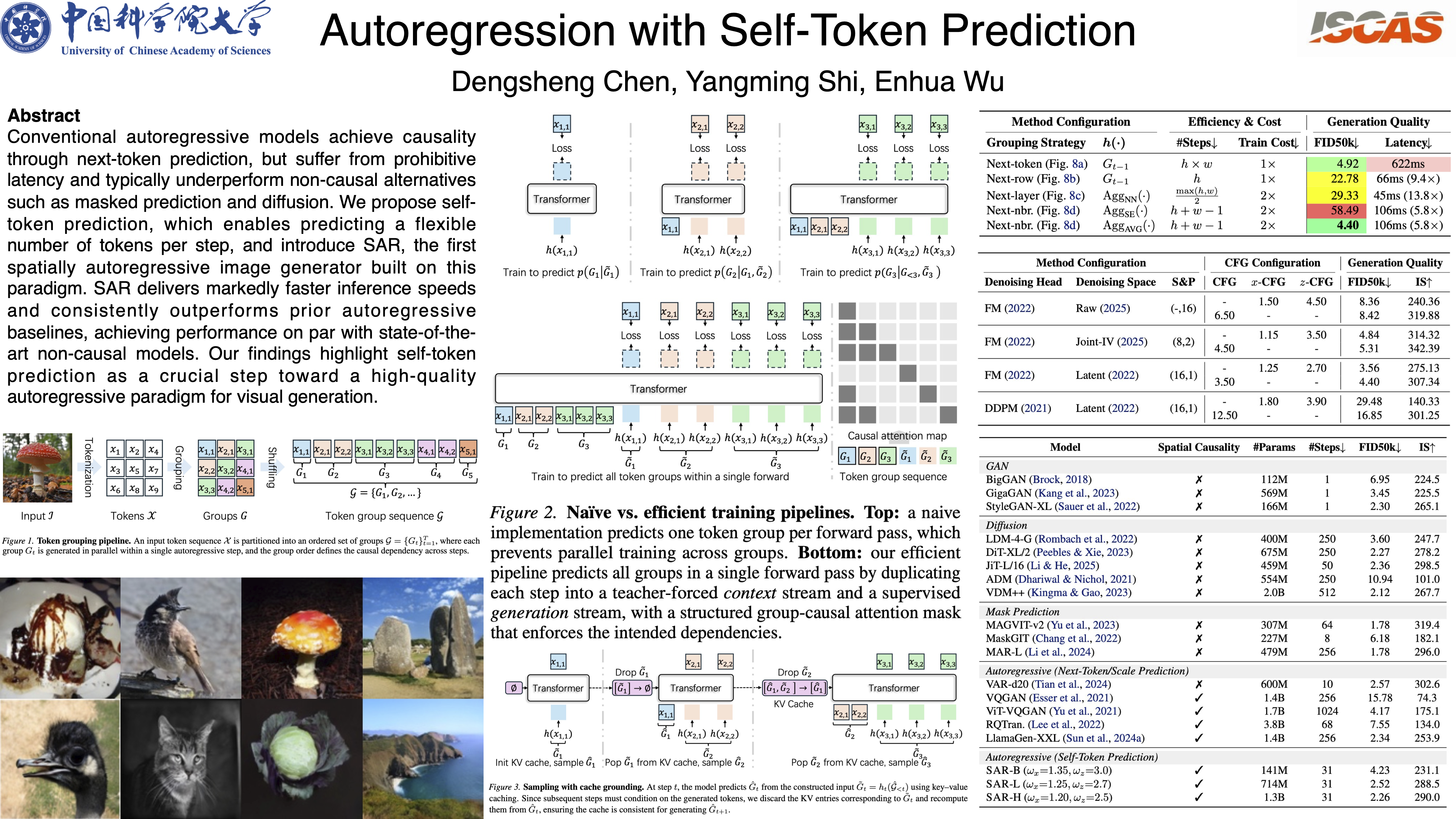
Conventional autoregressive models achieve causality through next-token prediction, but suffer from prohibitive latency and typically underperform non-causal alternatives such as masked prediction and diffusion. We propose self-token prediction, which enables predicting a flexible number of tokens per step, and introduce SAR, the first spatially autoregressive image generator built on this paradigm. SAR delivers markedly faster inference speeds and consistently outperforms prior autoregressive baselines, achieving performance on par with state-of-the-art non-causal models. Our findings highlight self-token prediction as a crucial step toward a high-quality autoregressive paradigm for visual generation.
Lay Summary
Conventional autoregressive models achieve causality through next-token prediction, but suffer from prohibitive latency and typically underperform non-causal alternatives such as masked prediction and diffusion. We propose self-token prediction, which enables predicting a flexible number of tokens per step, and introduce SAR, the first spatially autoregressive image generator built on this paradigm. SAR delivers markedly faster inference speeds and consistently outperforms prior autoregressive baselines, achieving performance on par with state-of-the-art non-causal models. Our findings highlight self-token prediction as a crucial step toward a high-quality autoregressive paradigm for visual generation.