
Conditional Clifford-Steerable CNNs for PDE Modeling
Abstract
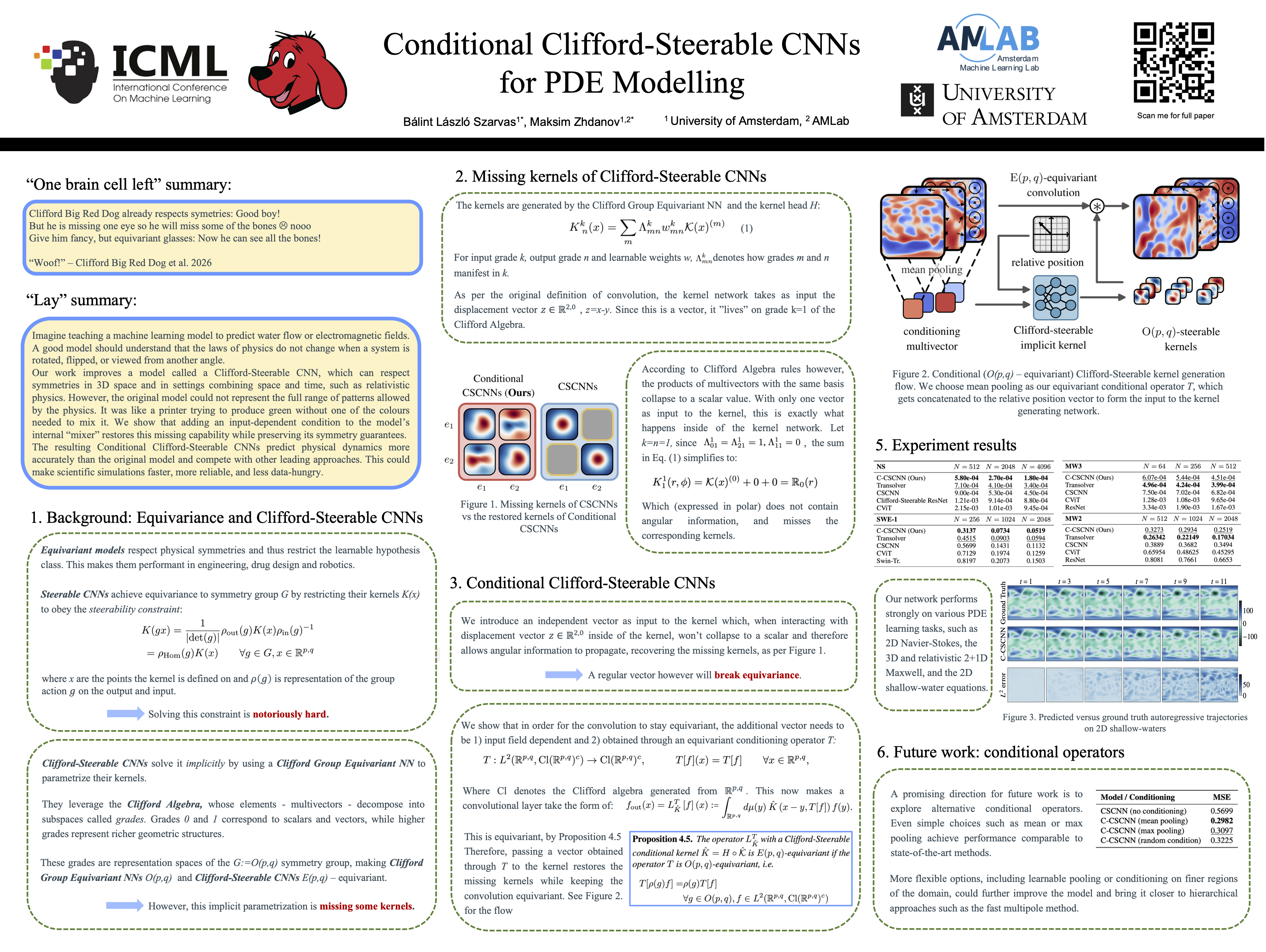
We introduce Conditional Clifford-Steerable CNNs (C-CSCNNs), a unified framework that incorporates equivariance to arbitrary pseudo-Euclidean groups and significantly improves the expressivity of standard CSCNNs. We show that the kernel basis of the standard formulation is incomplete, limiting model capacity. To address this, we augment the kernels with equivariant representations of the input feature field. We derive the equivariance constraint for these input-dependent kernels and show how it can be solved efficiently via implicit parameterization. We empirically validate on multiple PDE forecasting tasks, including fluid dynamics and relativistic electrodynamics, where our method consistently outperforms standard CSCNNs and performs on par with state-of-the-art baselines.
Lay Summary
Imagine teaching a machine learning model to predict how water flows or how electromagnetic fields move. A good model should understand that the laws of physics do not change just because we rotate, flip, or view the system from a different angle. Our work improves one such model, called a Clifford-Steerable CNN. These models are useful because they can respect symmetries not only in ordinary 3D space, but also in settings that involve space and time together, such as relativistic physics. However, the previous version had a limitation in what it could represent internally. Imagine a printer trying to print a green image without having yellow ink. Even if the input digital image contains green, the printed output would not reproduce it correctly, because the printer is missing one of the base colours needed to mix green. Similarly, the original Clifford-Steerable CNN’s internal rule-maker was missing one of the ingredients needed to represent the full range of patterns allowed by the physics. We show that giving its “mixer” an extra condition derived from the input restores this missing ingredient while preserving the same symmetry guarantees as the original version. The resulting Conditional Clifford-Steerable CNNs predict physical dynamics more accurately than the original version and compete with other strong modern models. This could help make scientific simulations faster, more reliable, and less data-hungry.