
Sinkhorn Normalization of Diffusion Kernels
Abstract
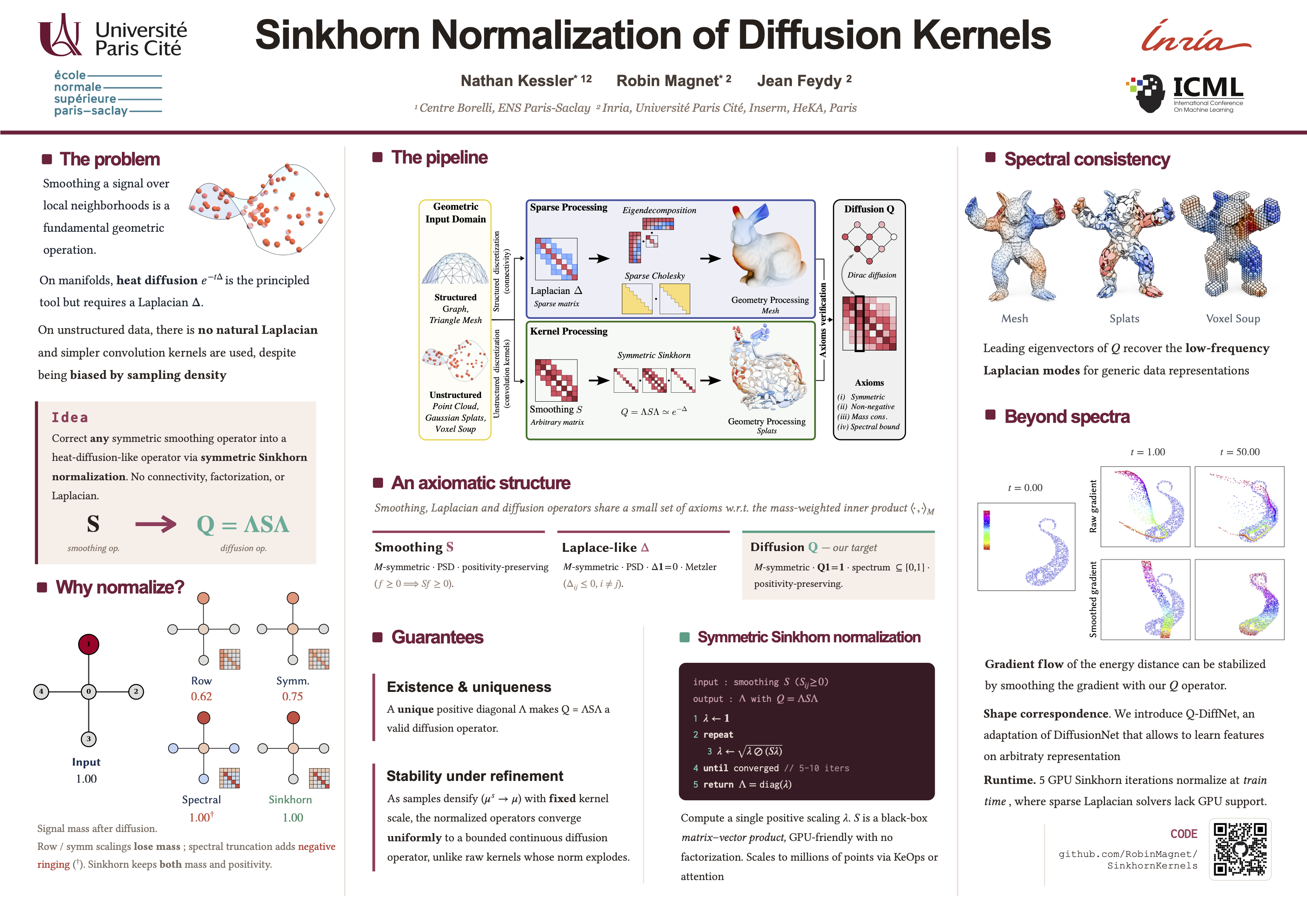
Smoothing a signal based on local neighborhoods is a core operation in machine learning and geometry processing. On well-structured domains such as vector spaces and manifolds, the Laplace operator derived from differential geometry offers a principled approach to smoothing via heat diffusion, with strong theoretical guarantees. However, constructing such Laplacians requires a carefully defined domain structure, which is not always available. Most practitioners thus rely on simple convolution kernels and message-passing layers, which are biased against the boundaries of the domain. We bridge this gap by introducing a broad class of smoothing operators, derived from general similarity or adjacency matrices, and demonstrate that they can be normalized into diffusion-like operators that inherit desirable properties from Laplacians. Our approach relies on a symmetric variant of the Sinkhorn algorithm, which rescales positive smoothing operators to match the structural behavior of heat diffusion. This construction enables Laplacian-like smoothing and processing of irregular data such as point clouds, sparse voxel grids or mixture of Gaussians. We show that the resulting operators not only approximate heat diffusion but also retain spectral information from the Laplacian itself, with applications to shape analysis and matching.
Lay Summary
To analyze 3D data, researchers rely almost exclusively on "smoothing" information across its surface. This operation aggregates and spreads signals on an object according to its geometry. Mathematically, the cleanest version is called heat diffusion, which spreads a signal like heat flowing across a surface. Heat diffusion comes with strong guarantees and can be estimated well on tidy, carefully built 3D models. However, most real 3D data is messy: laser-scanned point clouds, voxel grids from medical scanners, or the now-popular "Gaussian splats" used in computer graphics. On such data, practitioners fall back on simpler smoothing operations whose results degrade with the quality of the scan. This work introduces a simple way to repair almost any such smoothing operation, turning it into one that imitates true heat diffusion. Our method repeatedly rescales the smoothing operation, until it conserves the total signal. We show that the resulting operation satisfies four practical properties of heat diffusion. Our method works on any kind of 3D data with no expensive preprocessing. As a result, researchers can now apply geometry-aware analysis directly to raw 3D data that previously required cleanup. We highlight strong results on real tasks such as comparing and matching 3D shapes.