
Resolving Blind Inverse Problems under Dynamic Range Compression via Structured Forward Operator Modeling
Abstract
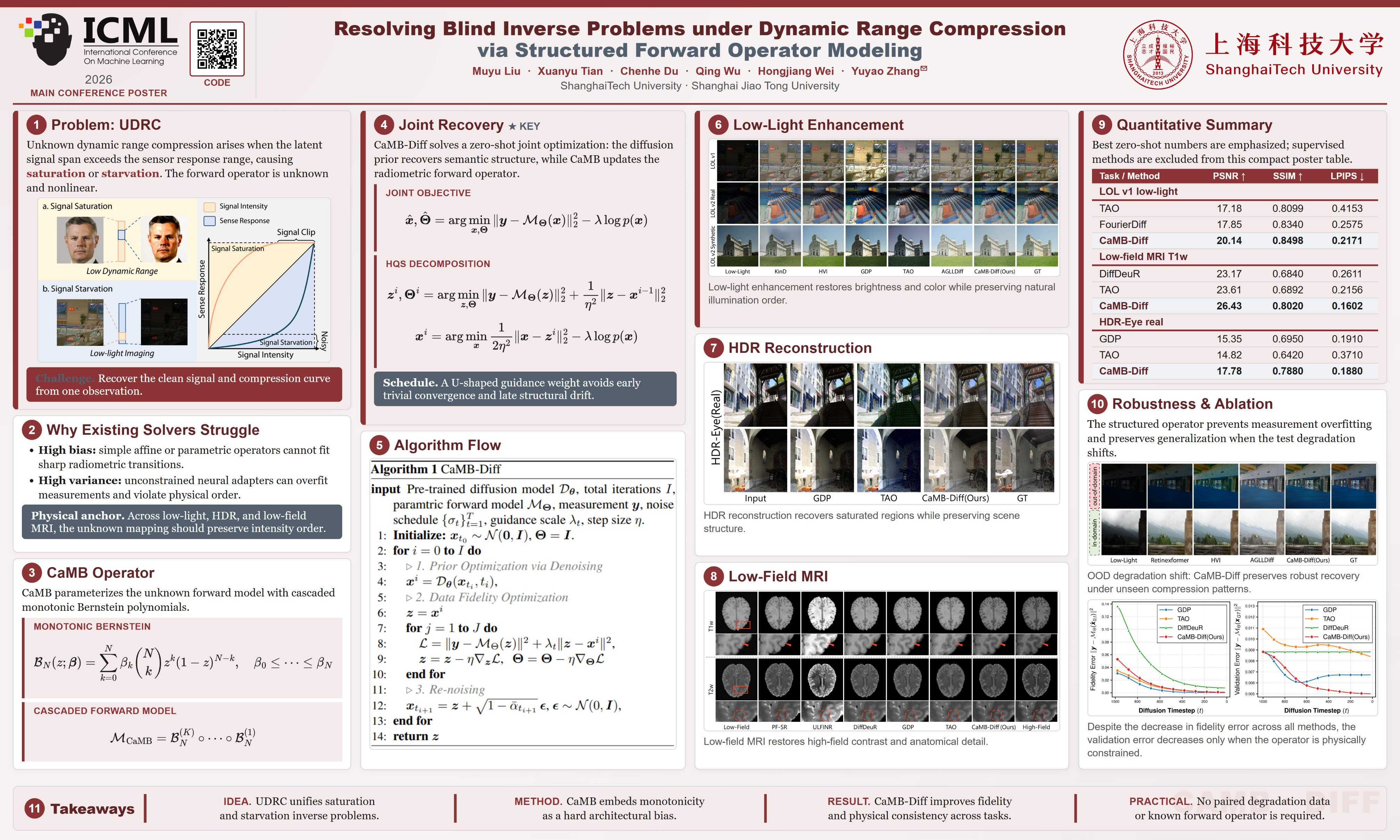
Recovering radiometric fidelity from unknown dynamic range compression (UDRC), such as low-light enhancement and HDR reconstruction, is a challenging blind inverse problem, due to the unknown forward model and irreversible information loss introduced by compression. To address this challenge, we first identify monotonicity as the fundamental physical invariant shared across UDRC tasks. Leveraging this insight, we introduce the cascaded monotonic Bernstein (CaMB) operator to parameterize the unknown forward model. CaMB enforces monotonicity as a hard architectural inductive bias, constraining optimization to physically consistent mappings and enabling robust and stable operator estimation. We further integrate CaMB with a plug-and-play diffusion framework, proposing CaMB-Diff. Within this framework, the diffusion model serves as a powerful geometric prior for structural and semantic recovery, while CaMB explicitly models and corrects radiometric distortions through a physically grounded forward operator. Extensive experiments on a variety of zero-shot UDRC tasks, including low-light enhancement, low-field MRI enhancement, and HDR reconstruction, demonstrate that CaMB-Diff significantly outperforms state-of-the-art zero-shot baselines in terms of both signal fidelity and physical consistency. Moreover, we empirically validate the effectiveness of the proposed CaMB parameterization in accurately modeling the unknown forward operator.
Lay Summary
Digital cameras and medical scanners often lose vital details in low light or extreme brightness because they "compress" image information in unknown ways. Our research introduces a new AI framework called CaMB-Diff to fix these distorted images. We discovered a universal physical rule: while different devices distort images in unique ways, they almost always preserve the relative order of brightness—meaning a brighter object in reality remains brighter in the distorted scan. By building this "rule of brightness" directly into the AI’s architecture as a physical guardrail, we prevent the model from making unrealistic guesses or creating unnatural artifacts. Our method is "zero-shot," allowing it to fix distortions from any camera or scanner on the fly without needing to see millions of previous examples from that specific device. Experiments demonstrate that our approach significantly improves the clarity of nighttime photography, low-cost medical MRI scans, and low-contrast images where details are typically lost in shadows or highlights.