
CoGenCast: A Coupled Autoregressive–Flow Generative Framework for Time Series Forecasting
Abstract
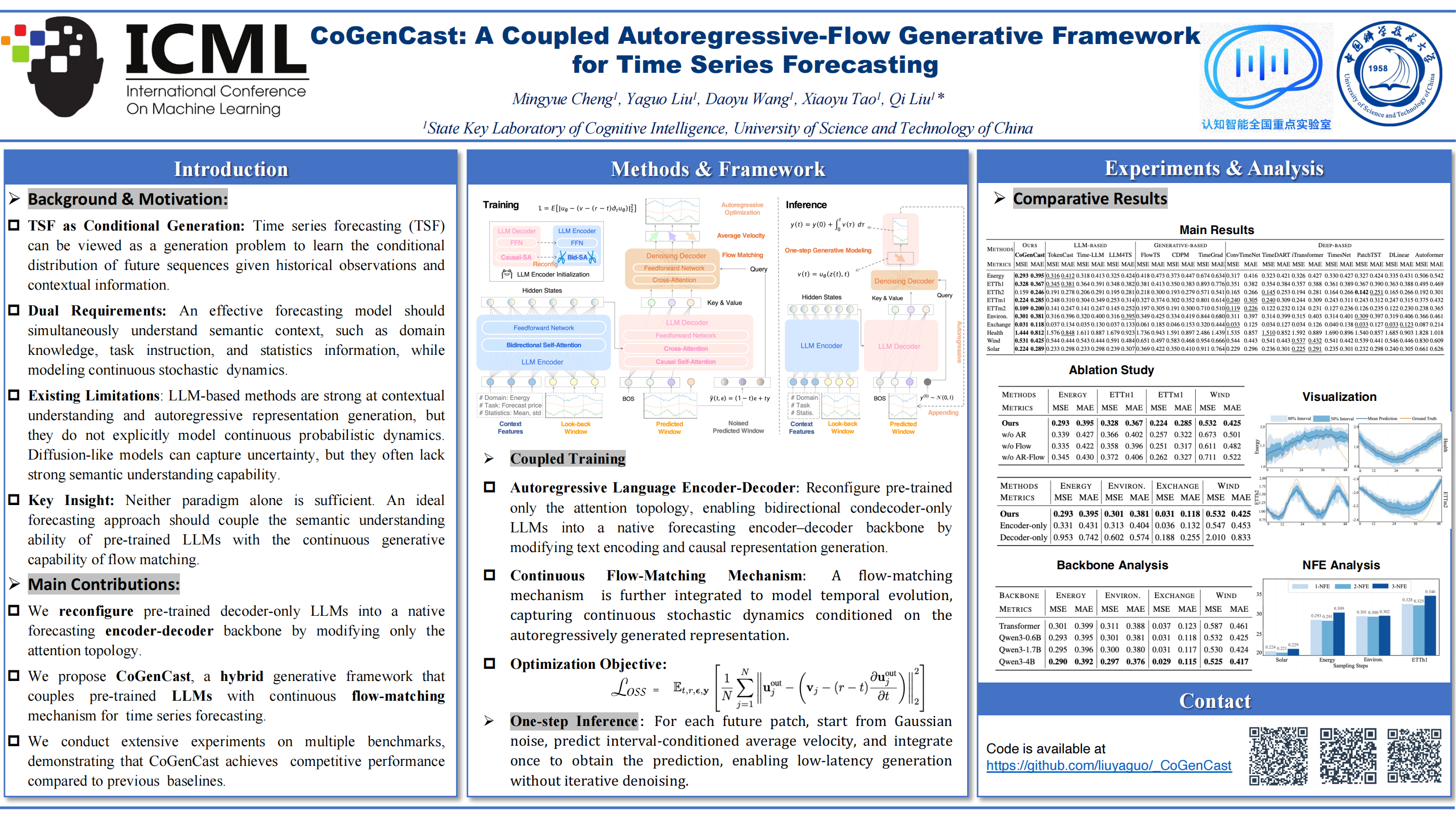
Time series forecasting can be viewed as a generative problem that requires both semantic understanding over contextual conditions and stochastic modeling of continuous temporal dynamics. Existing approaches typically rely on either autoregressive large language models (LLMs) for semantic context modeling or diffusion-like models for continuous probabilistic generation. However, neither method alone can adequately model both aspects simultaneously. In this work, we propose CoGenCast, a hybrid generative framework that couples pre-trained LLMs with flow-matching mechanism for effective time series forecasting. Specifically, we reconfigure pre-trained decoder-only LLMs into a native forecasting encoder–decoder backbone by modifying only the attention topology, enabling bidirectional context encoding and causal representation generation. Building on this, a flow-matching mechanism is further integrated to model temporal evolution, capturing continuous stochastic dynamics conditioned on the autoregressively generated representation. Notably, CoGenCast naturally supports multimodal forecasting and cross-domain unified training. Extensive experiments on multiple benchmarks show that CoGenCast achieves competitive performance compared to previous baselines. Code is available at \url{https://github.com/liuyaguo/_CoGenCast}.
Lay Summary
Time series forecasting predicts future values from past observations, such as energy usage, exchange rates, weather data, or health signals. This is important for planning and decision-making, but real-world time series are often complex and uncertain. We propose CoGenCast, a forecasting framework that combines numerical time series with useful textual context, such as task descriptions and domain knowledge. By using both past observations and contextual information, CoGenCast can better understand the forecasting task and generate accurate future predictions. Experiments on multiple public benchmark datasets show that CoGenCast achieves strong performance compared with existing forecasting methods, suggesting that combining numerical data with textual context is a promising direction for more flexible and accurate time series forecasting.