
MePo: Meta Post-Refinement for Rehearsal-Free General Continual Learning
Abstract
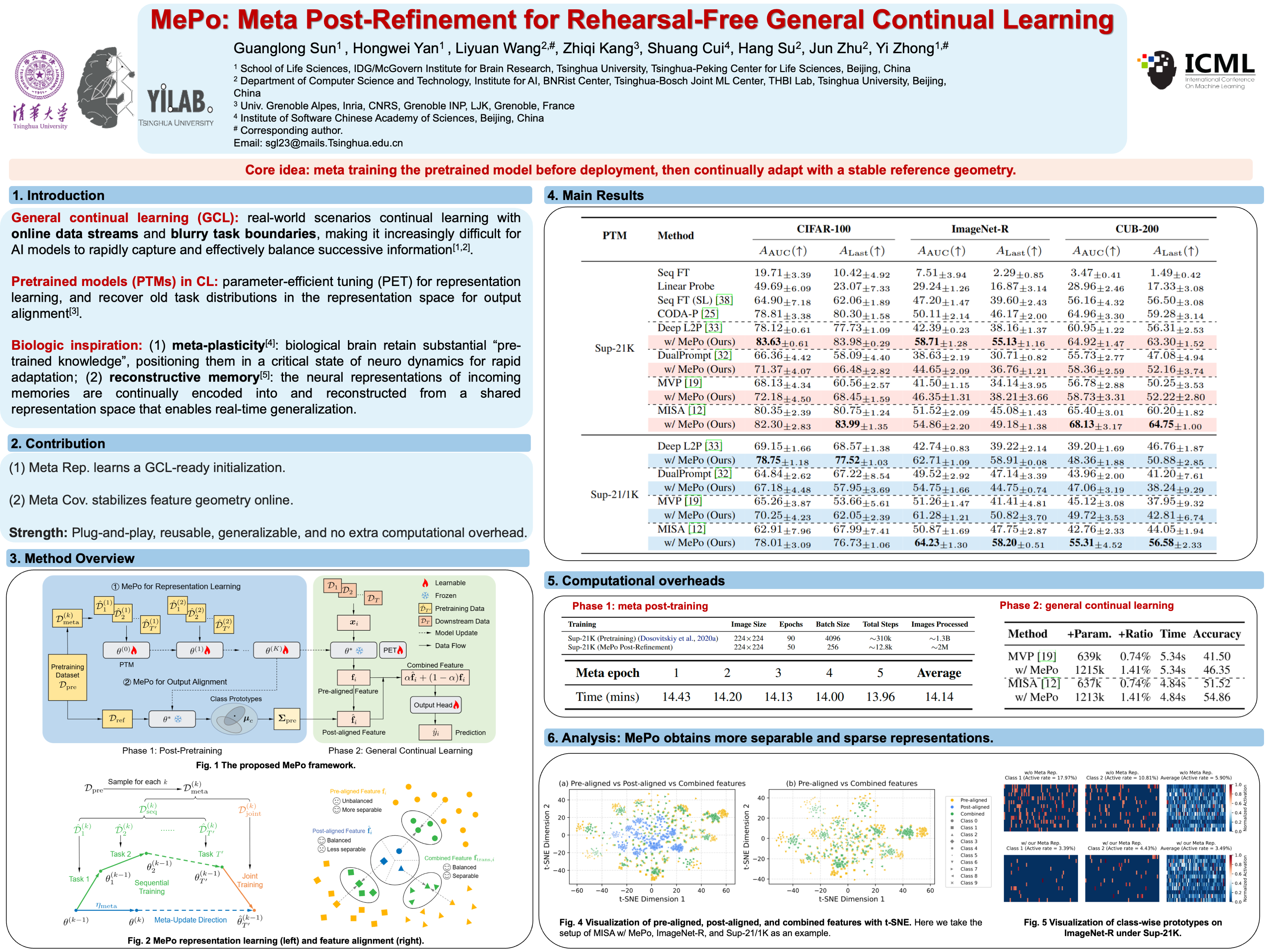
To cope with uncertain changes of the external world, intelligent systems must continually learn from complex, evolving environments and respond in real time. This ability, collectively known as general continual learning (GCL), encapsulates practical challenges such as online datastreams and blurry task boundaries. Although leveraging pretrained models (PTMs) has greatly advanced conventional continual learning (CL), these methods remain limited in reconciling the diverse and temporally mixed information along a single pass, resulting in sub-optimal GCL performance. Inspired by meta-plasticity and reconstructive memory in neuroscience, we introduce here an innovative approach named Meta Post-Refinement (MePo) for PTMs-based GCL. This approach constructs pseudo task sequences from pretraining data and develops a bi-level meta-learning paradigm to refine the pretrained backbone, which serves as a prolonged pretraining phase but greatly facilitates rapid adaptation of representation learning to downstream GCL tasks. MePo further initializes a meta covariance matrix as the reference geometry of pretrained representation space, enabling GCL to exploit second-order statistics for robust output alignment. MePo serves as a plug-in strategy that achieves significant performance gains across a variety of GCL benchmarks and pretrained checkpoints in a rehearsal-free manner (e.g., 15.10%, 13.36%, and 12.56% on CIFAR-100, ImageNet-R, and CUB-200 under Sup-21/1K). Our source code is available at \href{https://github.com/SunGL001/MePo}{MePo}.
Lay Summary
To thrive in a changing world, artificial intelligence (AI) must learn continuously from a stream of unpredictable information without forgetting past knowledge—a major struggle for current systems. When existing models learn new tasks, they tend to clumsily overwrite what they already know. Inspired by the human brain's ability to adapt and reconstruct memories, we introduce Meta Post-Refinement (MePo). Think of MePo as a specialized "warm-up" exercise for AI. Before the AI is deployed into real-world scenarios, MePo uses simulated practice tasks to teach the model how to learn and adapt rapidly. Additionally, it establishes a mathematical "anchor" that represents the AI's existing knowledge base, ensuring new information is integrated smoothly without destroying foundational memories. Importantly, MePo is an adaptable framework that achieves this without needing to store and constantly review massive amounts of historical data—a process that is usually costly and slow. In our testing, this brain-inspired approach significantly boosted the AI's capacity for lifelong learning, improving overall accuracy by 12% to 15% across several standard evaluation benchmarks.