
Thinking in Scales: Accelerating Gigapixel Pathology Image Analysis via Adaptive Continuous Reasoning
Abstract
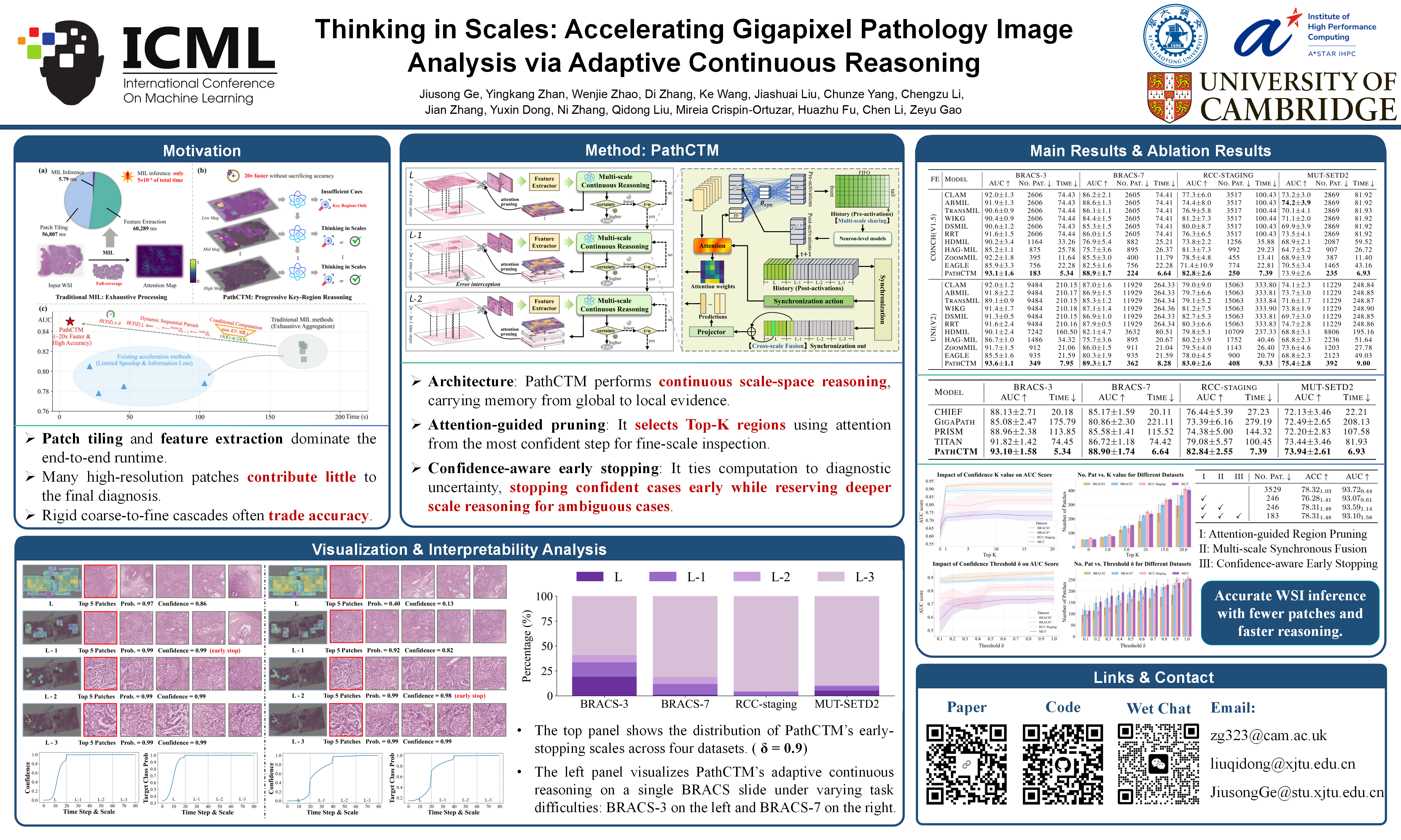
Traditional whole slide image (WSI) analysis methods typically rely on the multiple instance learning (MIL) paradigm, which extracts patch-level features at high magnification and aggregates them for slide-level prediction. However, such exhaustive patch-level processing is computationally expensive, severely limiting the efficiency and scalability of WSI analysis. To address this challenge, we propose PathCTM (a Pathology-oriented Continuous Thought Model) that enables token-efficient scale-space continuous reasoning for gigapixel WSIs. PathCTM formulates diagnostic inference as a dynamic sequential information pursuit. It progressively transitions from low-magnification global to high-magnification local inspection, and adaptively terminates inference when sufficient evidence is gathered to effectively bound decision uncertainty. Specifically, it uses conditional computation for dynamic scale switching with attention-guided region pruning, coupled with confidence-aware early stopping. Extensive experiments demonstrate that, compared with standard MIL-based methods, PathCTM reduces the number of required image patches by 95.95\% and shortens inference time by approximately 95.62\%, while maintaining AUC without degradation. Code is available at https://github.com/JSGe-AI/PathCTM.
Lay Summary
Pathology slides can be scanned into extremely large digital images, sometimes containing billions of pixels. To help doctors analyze these images, AI systems often cut each slide into many small pieces and process almost all of them. This can be very slow and expensive, because most pieces may not contain information needed for the final diagnosis. We introduce PathCTM, an AI method that studies a slide more like a pathologist: it first looks at the whole tissue at low magnification, then zooms in only on the regions that seem most informative. The model keeps track of what it has already seen across different zoom levels and stops once it is confident enough to make a prediction. We tested PathCTM on several pathology tasks, including breast cancer classification, kidney cancer staging, and mutation prediction. It greatly reduced the number of image pieces that needed to be processed and shortened analysis time while maintaining diagnostic accuracy. This could make AI-based pathology faster, more scalable, and more practical for clinical research and future decision support.