
Foresee-to-Ground: From Predictive Temporal Perception to Evidence-Driven Reasoning for Video Temporal Grounding
Abstract
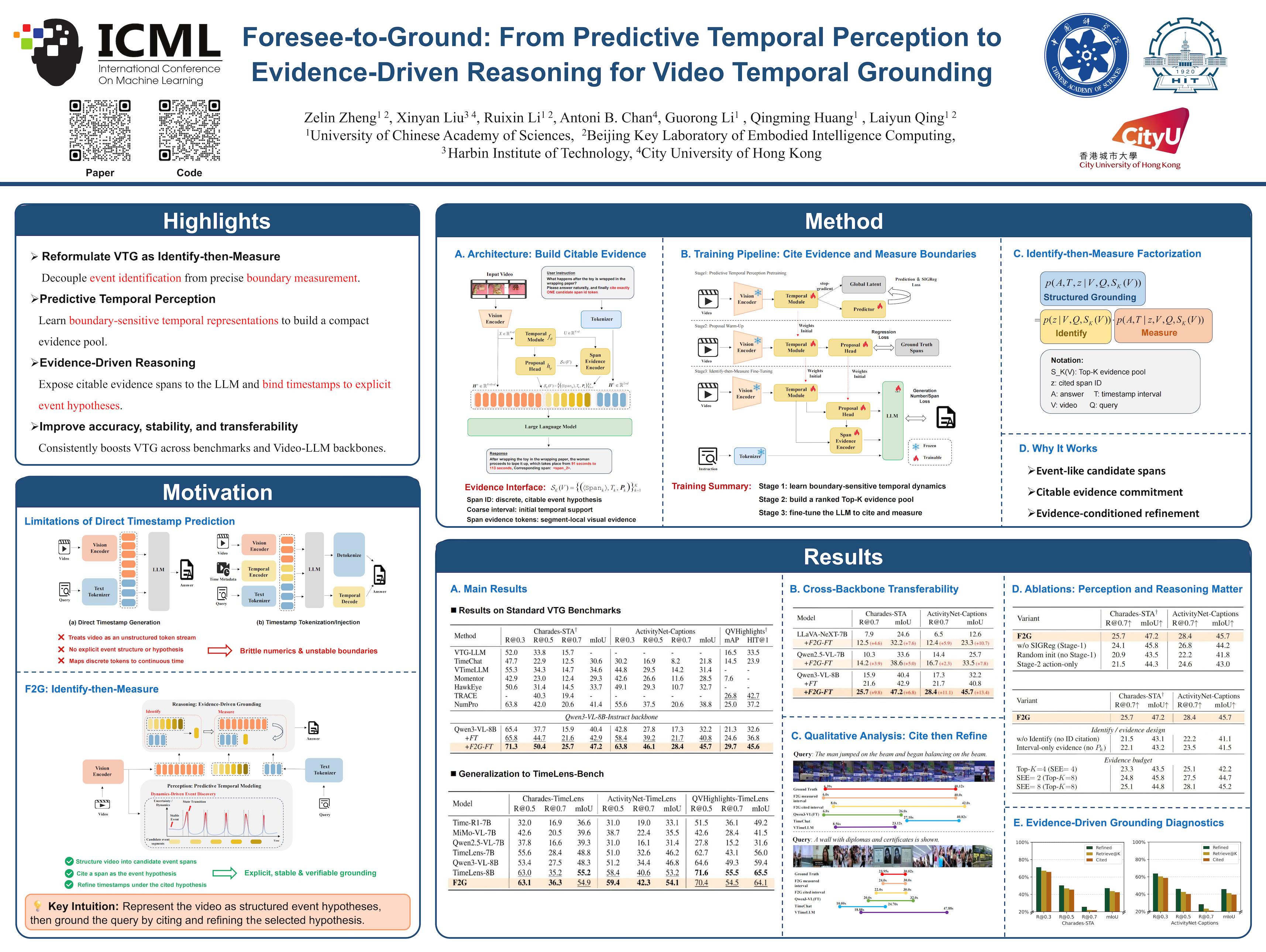
Current Video-LLM approaches for Video Temporal Grounding (VTG) typically rely on direct timestamp generation from an unstructured visual-token stream, often leading to brittle numerics and inconsistent boundaries. To address this, we propose Foresee-to-Ground (F2G), a framework that reformulates VTG as a verifiable Identify-then-Measure problem. F2G integrates Predictive Temporal Perception with Evidence-Driven Reasoning: it learns boundary-sensitive temporal representations to build a video-wide evidence pool of candidate event segments, and exposes these segments to the LLM as citable evidence units that bind boundary prediction to explicit event hypotheses. By decoupling event identification from precise boundary measurement, F2G stabilizes grounding and makes predictions verifiable. Extensive experiments demonstrate that F2G consistently improves grounding accuracy across diverse benchmarks, transfers robustly across different Video-LLM backbones, and preserves general video understanding capabilities. Our project is available at https://github.com/zelion2003/Foresee-to-Ground.
Lay Summary
Many AI systems can answer questions about videos, but they often struggle to point to the exact time when an event happens. They may give unstable or inconsistent timestamps, especially in long videos. This paper proposes Foresee-to-Ground, a method that makes video grounding more reliable by asking the model to first choose a relevant video segment as evidence and then refine the exact start and end times. Instead of directly predicting timestamps from the whole video, the system builds a small set of possible event segments and connects each final answer to one of them. This makes the result easier to check and reduces random changes in the predicted time boundaries. Experiments show that the method improves temporal accuracy across several video benchmarks and works with different video-understanding models, while still preserving their general ability to answer video questions.