
FlowPET: Physics-Informed Symplectic Flow Matching for Low-Count PET Reconstruction
Abstract
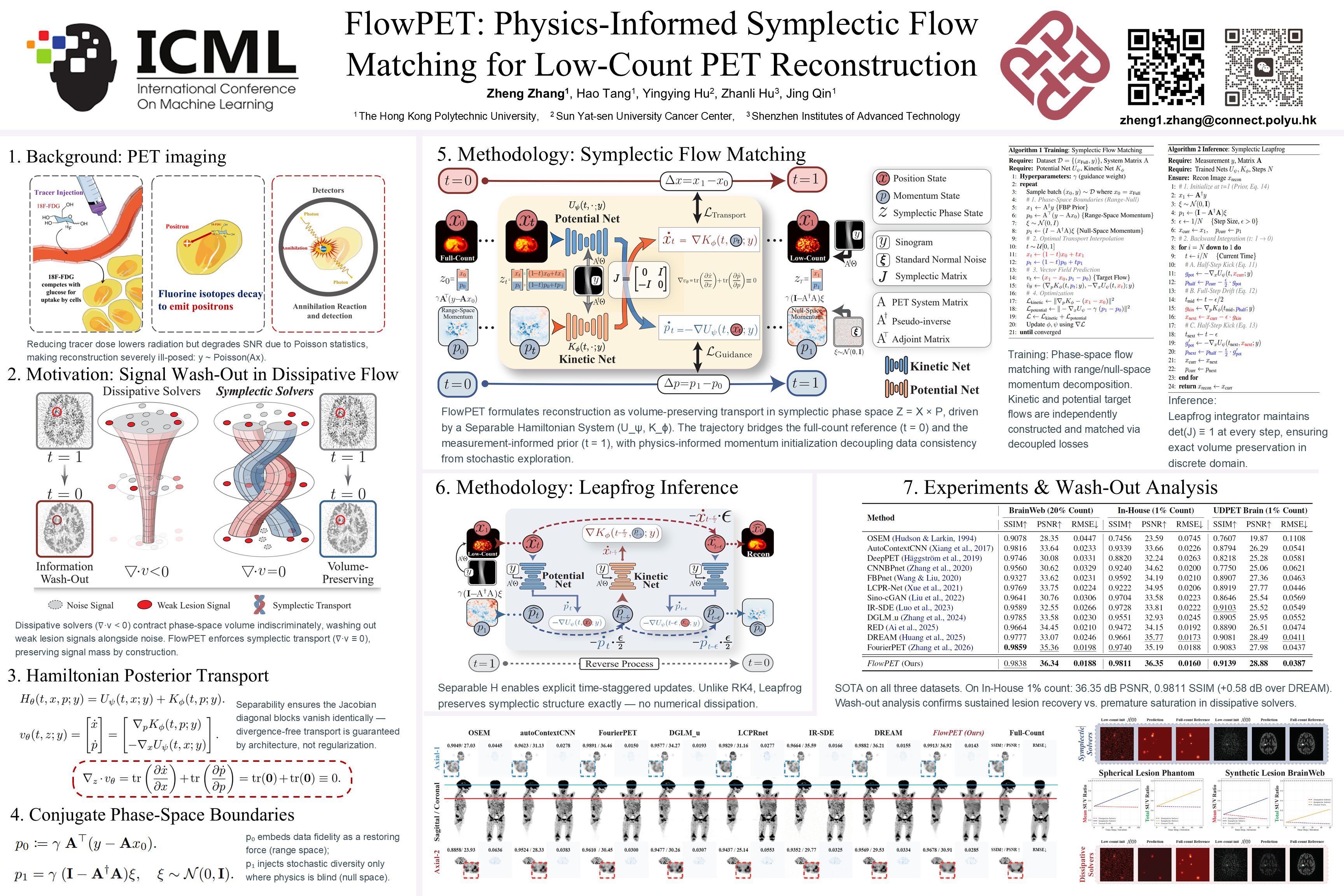
Low-count Positron Emission Tomography (PET) reconstruction is severely hindered by the dissipative nature of prevailing generative models, where the inherent phase-space contraction leads to the numerical extinction (``wash-out'') of weak but diagnostically critical lesion signals. To overcome this geometric limitation, we propose \textbf{FlowPET}, a physics-informed framework that reformulates reconstruction as volume-preserving transport in a symplectic phase space. By parameterizing the posterior dynamics via a Separable Hamiltonian System, our approach guarantees a divergence-free vector field by construction, theoretically immunizing weak signals against probability mass collapse. To steer this conservative flow, we introduce conjugate boundary conditions based on the Range-Null space decomposition of the PET operator; this strictly enforces data consistency in the range space while confining stochastic uncertainty injection to the unobserved null space. We train the model via symplectic flow matching and perform inference using a symplectic leapfrog integrator. Extensive experiments on BrainWeb, clinical pediatric, and UDPET datasets demonstrate that \textbf{FlowPET} not only surpasses state-of-the-art deterministic and stochastic baselines in SSIM and PSNR but, more crucially, exhibits superior recovery of low-contrast lesions. The results confirm that imposing Hamiltonian structural constraints offers a robust geometric safeguard for medical inverse problems in high-noise regimes.
Lay Summary
PET scans are a powerful medical imaging tool for detecting cancers at an early stage, but they require patients to be exposed to radioactive tracers. Reducing the tracer dose makes the procedure safer, but produces extremely noisy images where critical diagnostic details are easily lost. Existing AI-based reconstruction methods rely on a "denoising" mechanism that progressively contracts the image signal — but this process is indiscriminate. It suppresses not only noise, but also the faint signals from small tumors that are diagnostically vital, effectively washing them out before they can be recovered. We take inspiration from classical physics: just as a sealed container preserves the volume of everything inside it, information should be transported, not destroyed. Our method, FlowPET, reformulates image reconstruction as a volume-preserving transport process, ensuring that even the faintest pathological signals are carried intact through the reconstruction. We further exploit the known physics of PET imaging to separate what the scanner can measure directly from what must be inferred, preventing the two from interfering with each other. Experiments on multiple clinical datasets, including pediatric whole-body scans, show that FlowPET significantly outperforms existing methods in recovering low-contrast lesions that other approaches fail to detect. Our results suggest that geometry-preserving AI has the potential to make low-dose PET a reliable tool for early cancer diagnosis, reducing patient radiation exposure without sacrificing diagnostic accuracy.