
On the Limits of Test-Time Compute: Sequential Reward Filtering for Better Inference
Abstract
Lay Summary
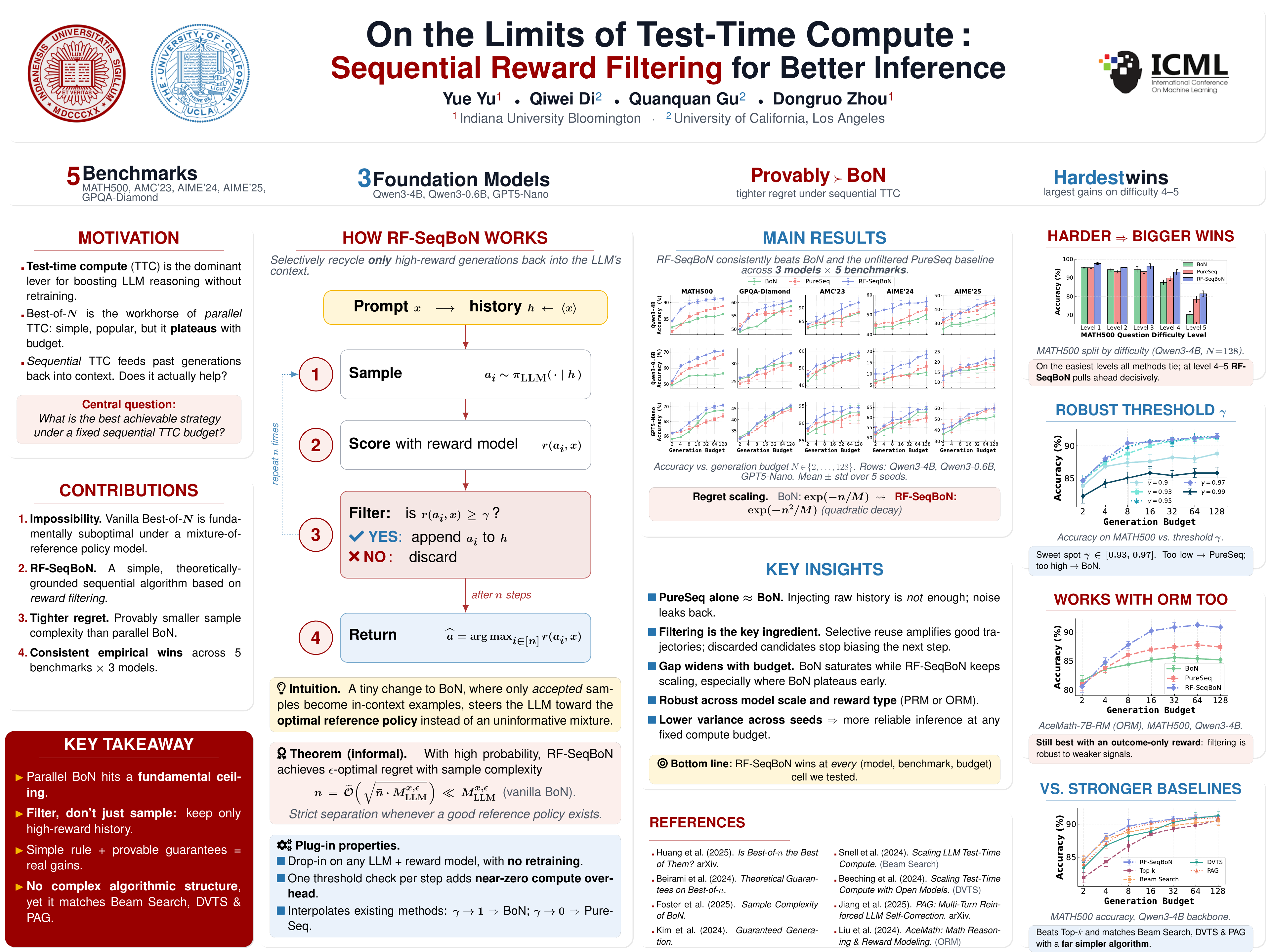
Large language models can often improve their answers when they are allowed to spend more computation at the time of solving a problem. A common strategy is to generate many independent answers and select the best one, but this paper shows that this is not always the most effective use of extra computation. We study a simple alternative in which the model generates answers sequentially, keeps only the high-scoring ones, and uses them to guide later attempts. By discarding low-quality answers and reusing only promising ones, the model can focus on better reasoning paths. Our theoretical analysis and experiments show that this reward-filtered sequential strategy uses computation more efficiently than standard approaches and consistently improves accuracy across reasoning benchmarks and language models, especially on harder problems.