
PINE: Pruning Boosted Tree Ensembles with Conformal In-Distribution Prediction Equivalence
Abstract
Lay Summary
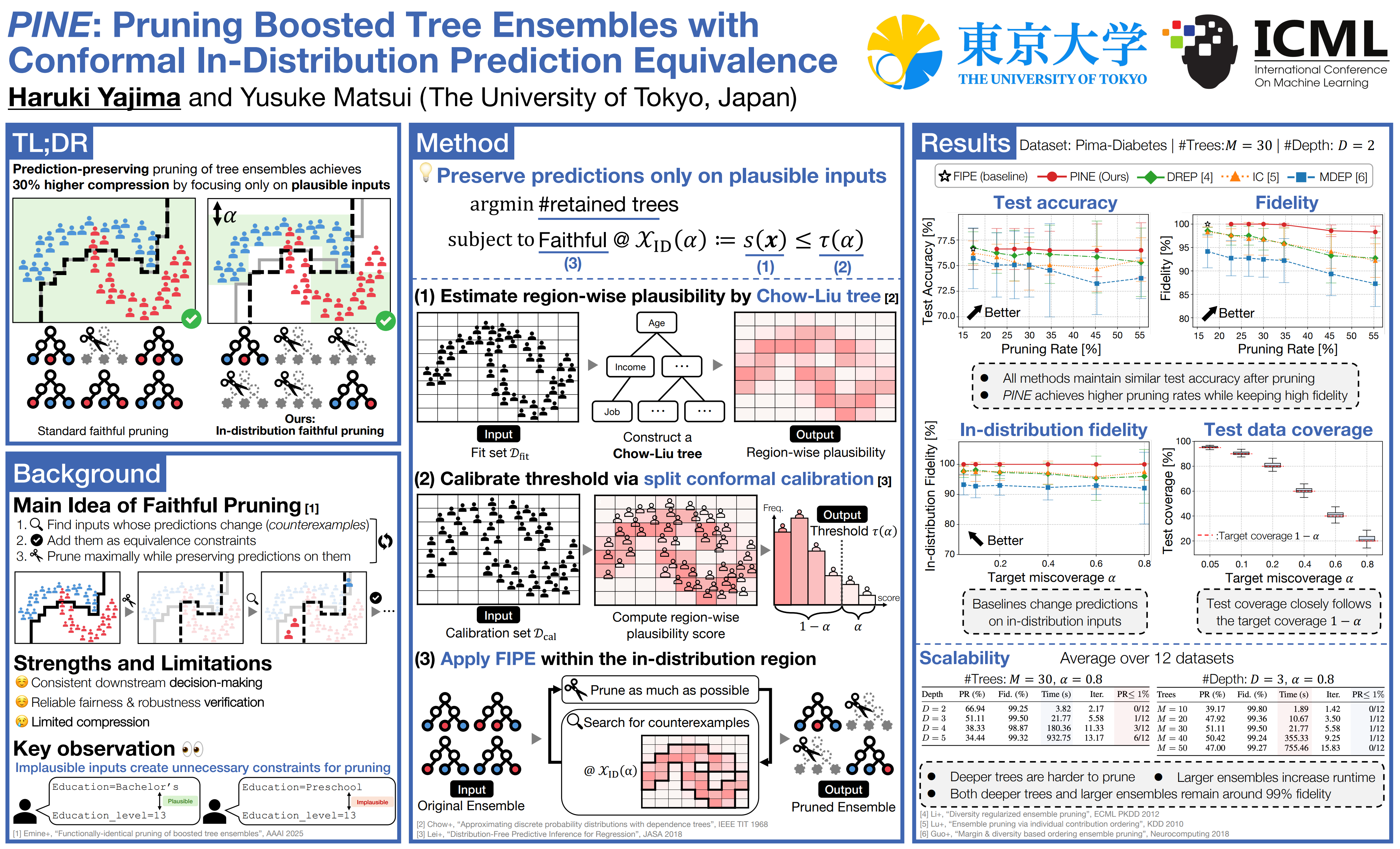
Machine learning models that combine many decision trees are often used for data stored in tables, such as spreadsheets or databases. These models can be accurate and relatively easy to inspect, but using many trees makes them slower, larger, and harder to verify. Removing trees can simplify a model, but it may also change predictions that users rely on. Some methods try to make these models smaller while preserving their predictions. However, they avoid prediction changes for every possible input, including unrealistic ones, so they cannot make the models as small as they could be. We propose PINE, which keeps predictions unchanged for realistic inputs while removing more trees from the model. Across 12 public datasets, PINE made models up to 30% more compact while keeping their predictions nearly unchanged. This can helps make tree-based models smaller while safely preserving predictions on realistic inputs.