
Adaptive Physics Transformer with Fused Global-Local Attention for Subsurface Energy Systems
Abstract
Lay Summary
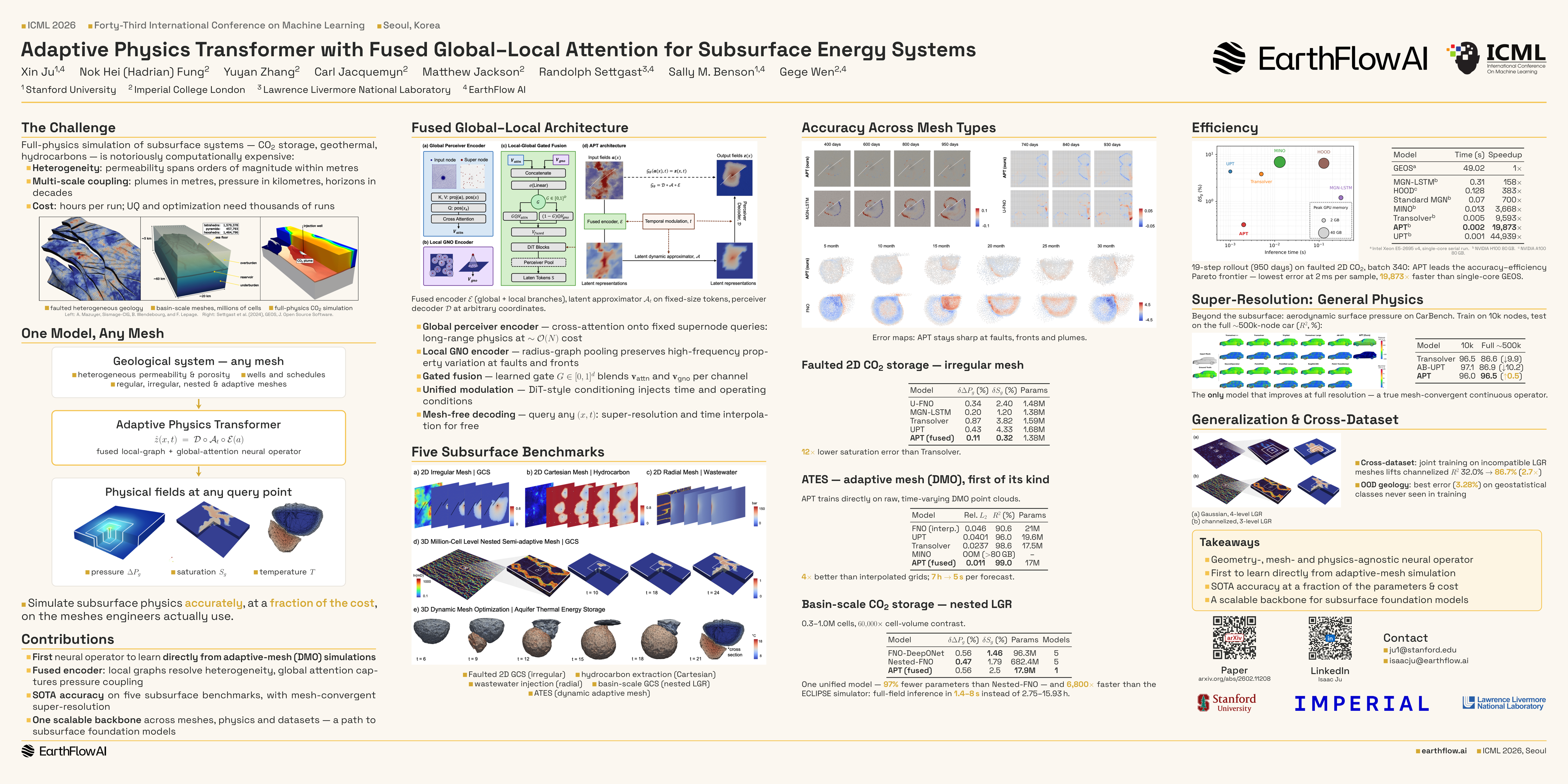
The Earth's subsurface provides essential energy that our modern society runs on, and it is also where we can permanently store carbon dioxide to help mitigate climate change. To do any of this safely, engineers simulate how fluids and heat move through underground rock—but these simulations are very slow and costly. Rock properties very significantly from one point to the next and several physical processes unfold at very different speeds. We developed the Adaptive Physics Transformer (APT), an AI model that reproduces these simulations in a fraction of the simulation time. Unlike earlier methods, it is not tied to a particular underground setting, grid shape, or set of physics: a single model captures both fine local detail and how a change in one location impacts the whole system. It is also the first such model that can learn from "adaptive" simulations, which adjusts computational effort according to the flow complexity. APT outperforms leading methods across diverse subsurface problems and can sharpen coarse predictions into detailed ones. With APT, one model can learn from many datasets at once, it offers a foundation for general-purpose AI tools to study the Earth's subsurface—accelerating progress on carbon storage, geothermal energy, and resource management.