
R$^3$L: Reasoning 3D Layouts from Relative Spatial Relations
Zhifeng Gu ⋅ Yuqi Wang ⋅ Bing WANG
Abstract
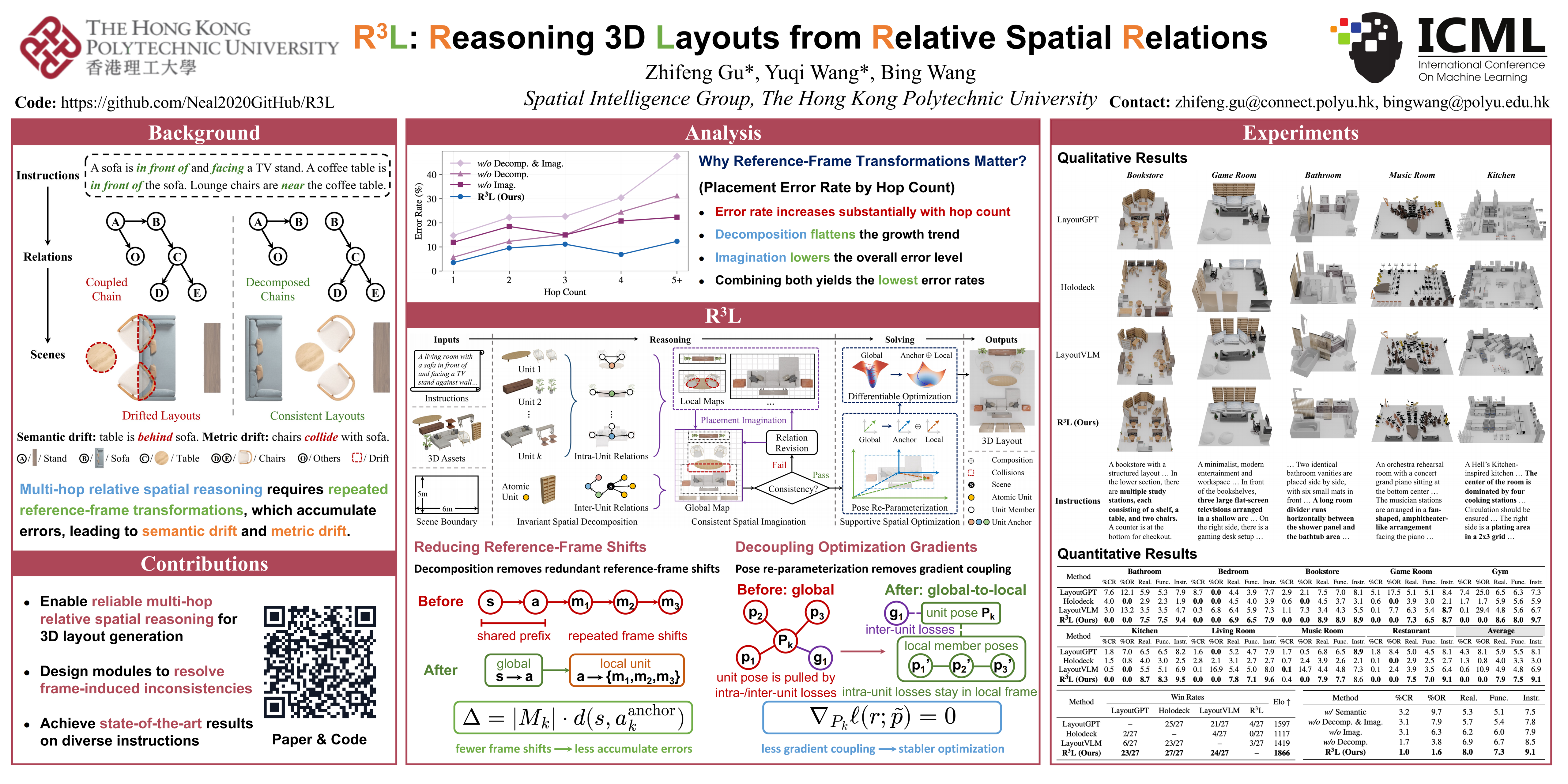
Relative spatial relations provide a compact representation of spatial structure and are fundamental to relative spatial reasoning in 3D layout generation. Recent works leverage Multimodal Large Language Models (MLLMs) to infer such relations, but the inferred relations are often unreliable and are typically handled with post-hoc heuristics. In this paper, we propose R$^3$L, a general framework that improves the reliability and consistency of relative spatial reasoning for 3D layout generation. Our key motivation is that multi-hop reasoning requires repeated reference-frame transformations, which accumulate errors in inferred relations and lead to semantic and metric drift. To mitigate this, we propose invariant spatial decomposition to break coupled relation chains, and consistent spatial imagination to promote self-consistency through an imagine-and-revise loop. We further introduce supportive spatial optimization to ease pose optimization via global-to-local coordinate re-parameterization. Extensive experiments across diverse scene types and instructions demonstrate that R$^3$L produces more physically feasible and semantically consistent layouts. Notably, our analysis shows that resolving frame-induced inconsistencies is crucial for reliable multi-hop relative spatial reasoning. The code is available at https://github.com/Neal2020GitHub/R3L.
Lay Summary
Creating a 3D room from a text description is harder than it may seem. When a user asks for a sofa to face a TV, a coffee table to sit in front of the sofa, and chairs to be placed near the table, an AI system must keep track of how all objects relate to one another. Current methods often lose track of these relationships as the scene becomes more complex, which can lead to misplaced furniture, object collisions, or layouts that no longer match the user‘s intent. We propose R$^3$L, a method that helps AI systems organize and check their spatial reasoning before producing a final 3D layout. Instead of treating the whole scene as one tangled problem, R$^3$L breaks it into smaller, easier-to-understand parts, lets the AI imagine and revise the arrangement, and then places the objects in a stable and consistent way. This makes generated 3D scenes more faithful to user instructions and less likely to contain physically impossible arrangements. It could support future tools for interior design, virtual environments, robotics, and embodied AI.
Video
Chat is not available.
Successful Page Load