
RC-FCL: Combating Asynchronous Concept Drift in Federated Continual Learning via Retrospective Calibration
Abstract
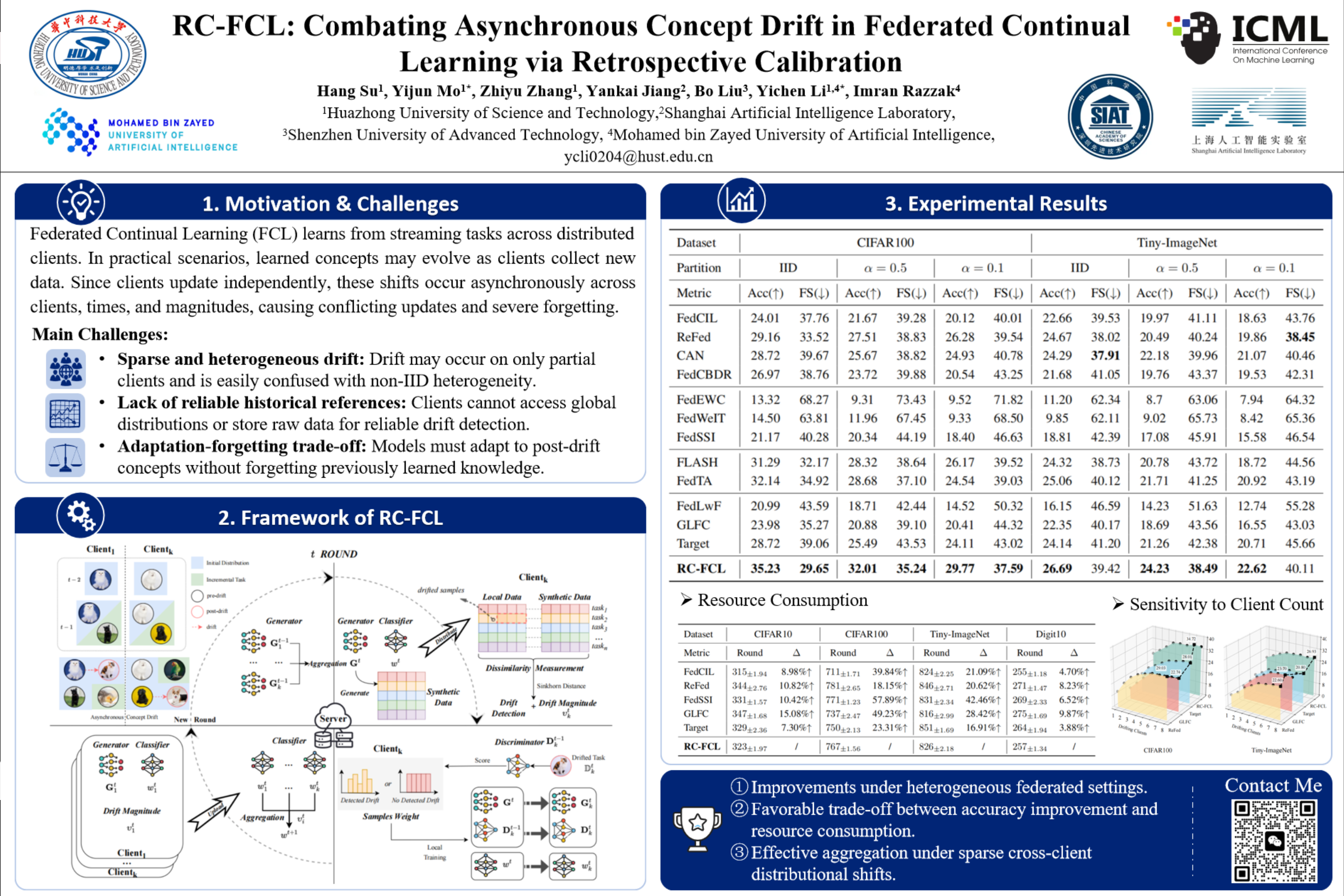
Federated Continual Learning (FCL) enables the continuous acquisition of knowledge from streaming tasks, but inherently struggles with the temporal dynamics of client data distributions. These dynamics naturally induce asynchronous concept drift, where distribution shifts occur independently across clients at unsynchronized times and with varying magnitudes. Such asynchrony generates conflicting updates that destabilize global convergence and exacerbate catastrophic forgetting. However, existing FCL research focuses on static or incremental settings, typically treating all incoming updates uniformly, which obscures concept drift under divergent distributions and fails to adapt to the evolution of learned concepts. To address these limitations, we propose RC-FCL, a retrospective calibration framework for FCL that can effectively distinguish asynchronous concept drift and adjust the learning strategy adaptively. Specifically, RC-FCL leverages a conditional generative model to synthesize class-conditional reference distributions of previously learned concepts for local drift detection. It calibrates local adaptation using a weighting mechanism driven by the local discriminator to prioritize informative samples, and executes a global aggregation strategy based on drift magnitude. Our experimental results demonstrate that RC-FCL achieves competitive performance against state-of-the-art methods.
Lay Summary
An AI system on phones or sensors often needs to keep learning after deployment. But something it already recognizes may start to look different for different users at different times. For example, a home camera may know a dog, but one dog later wears a raincoat, another appears in dim light, and many others still look unchanged. If all devices are treated the same, the shared AI system may miss uneven changes, overreact to rare cases, or forget earlier knowledge. Our work helps the system ask: does this data still look like what I learned before, or has something important changed? Each device compares its current data with artificial examples of past knowledge, without sharing private raw data. When a meaningful change is found, the device gives more attention to changed examples. The central system also gives more weight to devices showing stronger evidence of real change. Real AI systems do not live in fixed laboratory conditions. They must learn from changing users and environments while staying private and reliable. Our method helps them adapt to the present without losing the past.