
Triadic Dynamics Aware Diffusion Posterior Sampling for Inverse Problems: Optimizing Guidance and Stochasticity Schedules
Abstract
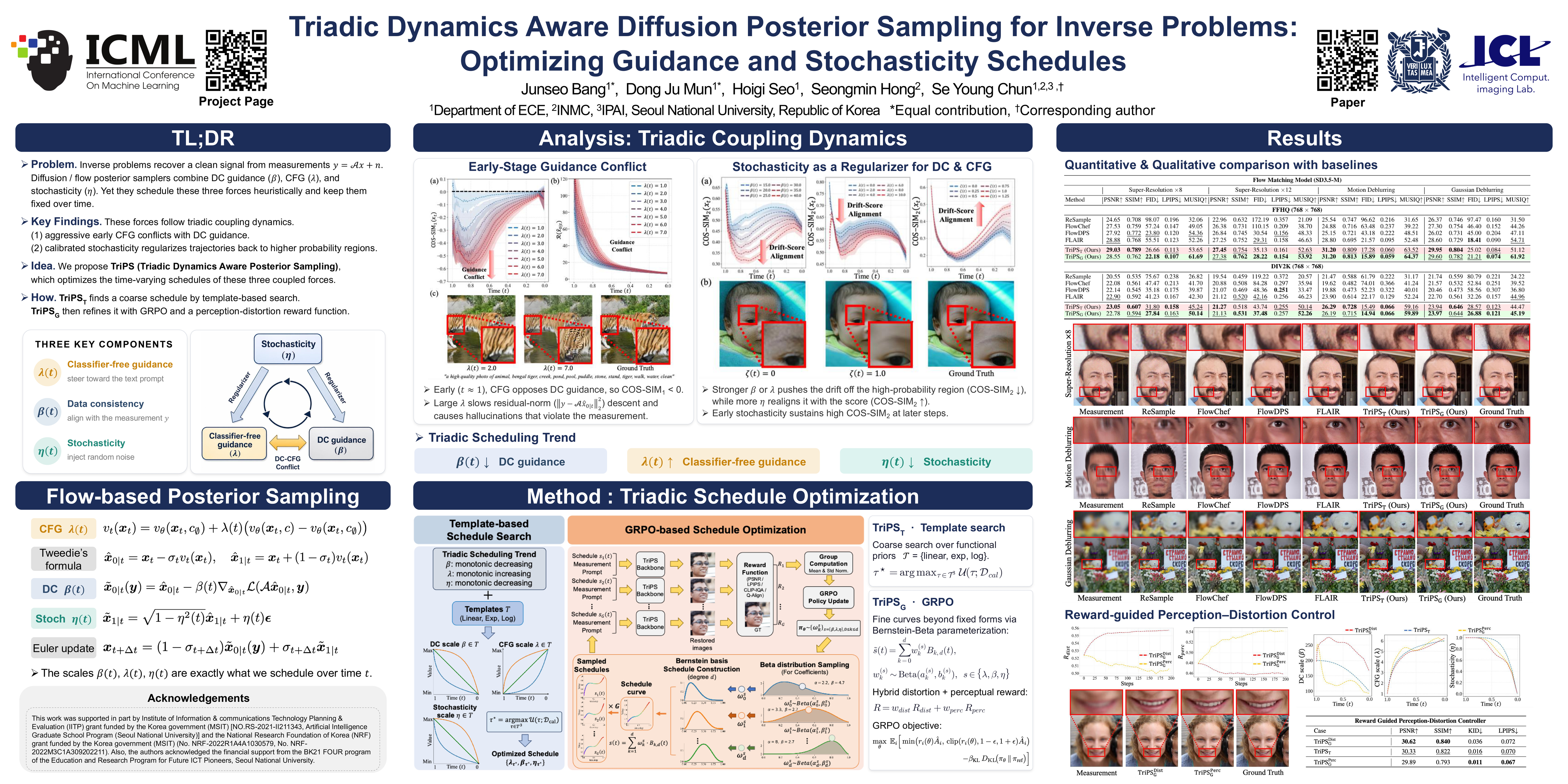
Generative posterior sampling using diffusion models has emerged as a dominant paradigm for solving inverse problems in imaging, which usually consists of three main components: data consistency (DC) guidance, classifier-free guidance (CFG) and stochasticity. While prior arts have focused on how to develop each or all components, less attention has given to how to schedule them, leading to heuristically fixed or partially adjusted suboptimal schedules. In this work, we argue that the interactions among all three components in terms of scheduling are crucial for significantly improved performance in solving inverse problems in imaging. Our analysis shows that aggressive CFG early in sampling conflict with DC guidance, while stochasticity brings the trajectory back to higher-probability regions. Based on these findings, we propose Triadic Dynamics Aware Posterior Sampling (TriPS), which reformulates posterior sampling as a time-varying control problem and optimizes schedules following a triadic trend of decreasing DC and stochasticity scales alongside increasing CFG scale. TriPS achieves this through two strategies: template-based search over functional priors for reliable baseline schedules, and Group Relative Policy Optimization (GRPO)-based reinforcement learning for more flexible temporal curves. Experiments demonstrate TriPS outperforms state-of-the-art baselines in data fidelity and perceptual realism.
Lay Summary
When a photo is blurry, low-resolution, or partially corrupted, AI image restoration methods try to recover the original. Modern methods do this by running a step-by-step reverse process guided by three forces simultaneously: one that enforces consistency with the available measurement data, one that steers the result toward a semantic content, and one that injects randomness to avoid getting stuck in unrealistic solutions. Prior work has focused on designing each of these forces individually, but much less attention has been paid to when each force should be strong or weak across the restoration process. We discovered that applying strong semantic guidance too early actively fights against data consistency, degrading reconstruction quality. Controlled randomness, however, acts as a stabilizer that keeps the process on track. Based on these insights, we propose TriPS, a method that finds the time-varying schedule for all three forces together, gradually reducing data guidance and randomness while increasing semantic guidance as restoration progresses. We optimize these schedules using both structured search and reinforcement learning. TriPS consistently produces sharper, more faithful image restorations than existing methods across tasks like deblurring and super-resolution, without requiring changes to the underlying AI model itself.