
Rethinking Serialization in Linear 3D Vision: Decoupling Anisotropic Geometry from Isotropic Semantics
Abstract
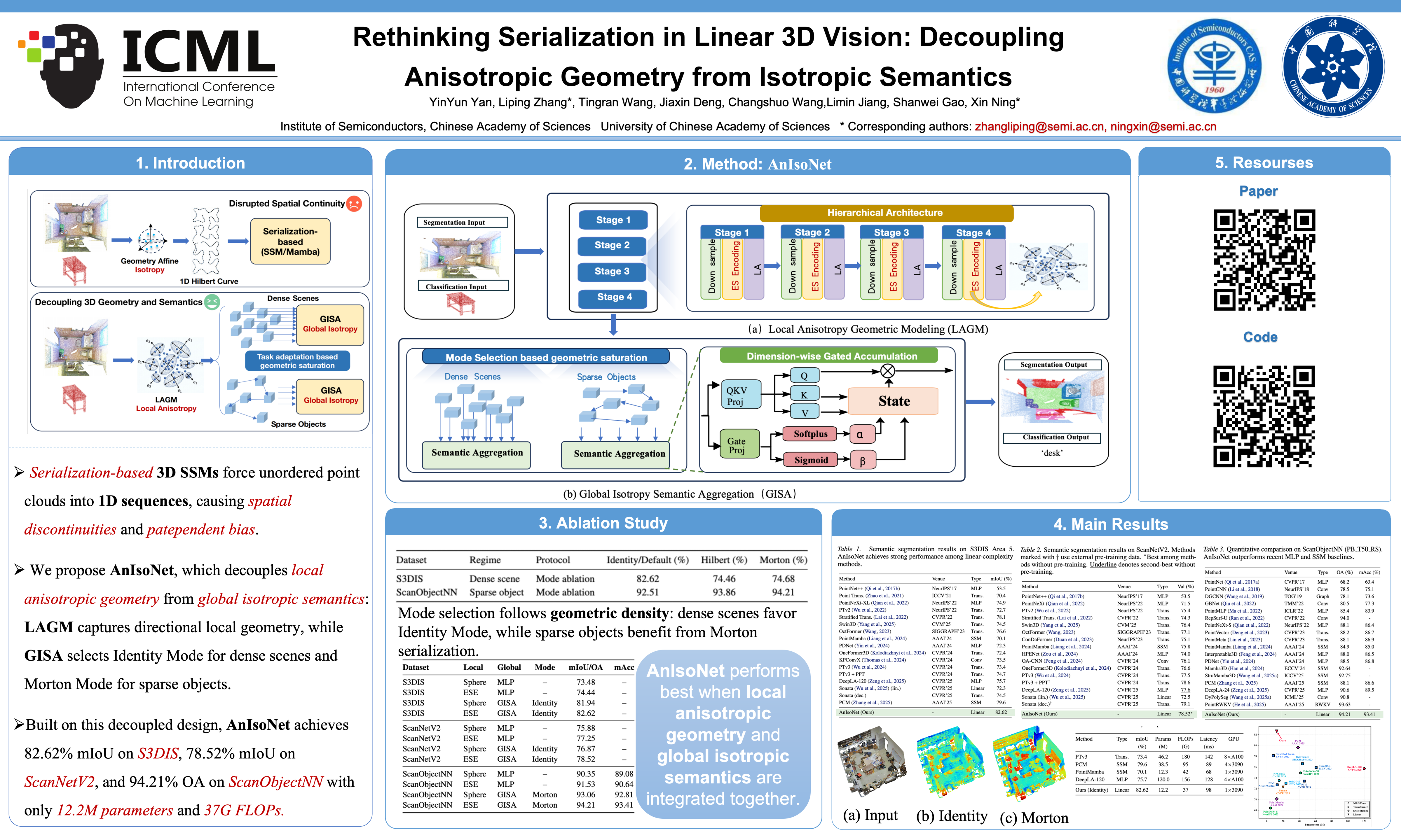
Current linear State-Space Models (SSMs) for 3D point clouds typically rely on 1D serialization schemes (e.g., Hilbert curves) for global modeling. In dense scenes, such imposed order can disrupt spatial continuity and induce what we call serialization bias. We propose AnIsoNet, a framework that decouples anisotropic geometry from isotropic semantics via two dedicated modules: Local Anisotropy Geometric Modeling (LAGM) and Global Isotropy Semantic Aggregation (GISA). LAGM uses ellipsoidal encoding to capture local directionality without relying on global order. GISA is configured according to dataset-level geometric density: dense-scene datasets use Identity Mode to avoid additional geometry-driven re-serialization, whereas sparse-object datasets use Morton serialization to provide a lightweight spatial prior. This avoids redundant multi-view scanning while preserving O(N) complexity. On S3DIS, reducing artificial serialization in dense scenes yields 82.62% mIoU, surpassing PCM by 3.0%. On ScanObjectNN, Morton serialization for sparse objects reaches 94.21% OA (+1.6%). On ScanNetV2, our model achieves 78.52% mIoU, surpassing PTv3 (77.5%) without pre-training, with only 12.2M parameters and 37G FLOPs.
Lay Summary
This paper studies how to better understand 3D point clouds, which are collections of points used to represent real-world objects and indoor scenes. Many recent models process these points by first converting them into a one-dimensional order, but this ordering can break the natural spatial relationships between nearby points, especially in dense indoor scenes. We propose AnIsoNet, a model that separates local geometric understanding from global scene understanding. It uses local shape information to capture directional structures and chooses different global processing strategies for dense scenes and sparse objects. This design improves accuracy on several 3D vision benchmarks while keeping the model efficient and relatively small.