
Black-Box Assisted Regression: Phase Transitions and Minimax Optimality
Abstract
Lay Summary
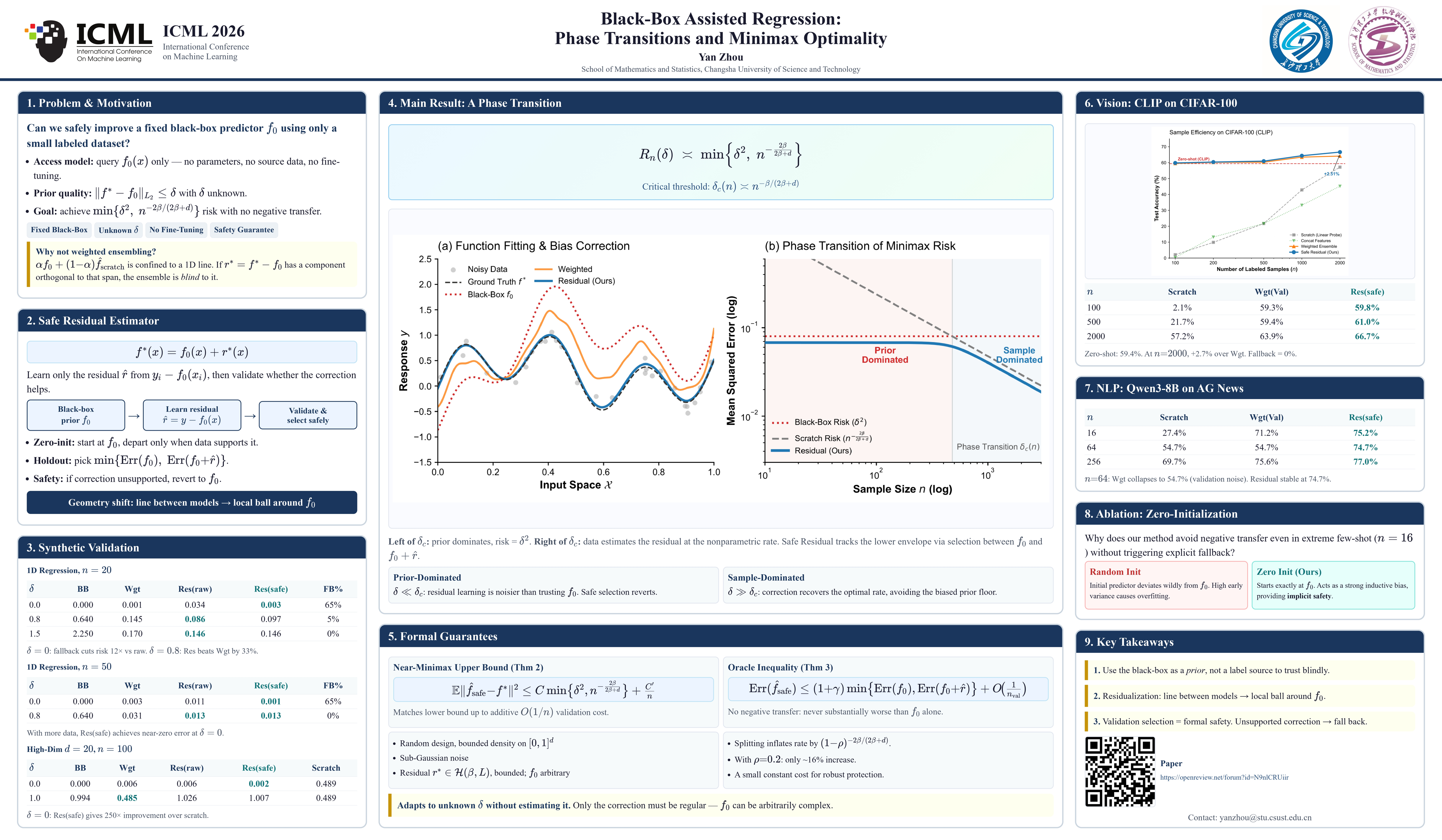
Modern AI systems, such as large language models and vision models, are often used as black-box predictors for new tasks. These models can be very helpful when only a small amount of labeled data is available, but their predictions may also be biased or unreliable for the specific task at hand. This paper studies when and how such a black-box model should be trusted. We show that there is a clear boundary between two situations: when the black-box model is already accurate enough, it is best to stay close to its predictions; when it is less accurate, the available labeled data should be used to correct it. Based on this idea, we propose a simple and safe correction method. The method starts from the black-box prediction, learns a correction from labeled examples, and uses a validation set to decide whether the correction is actually helpful. If the correction does not improve performance, the method falls back to the original black-box model. Our theoretical results explain this tradeoff and show that the proposed method achieves near-optimal performance in the studied regression setting. Experiments on synthetic data, image classification with CLIP, and text classification with Qwen3-8B support the theory and show that this safe correction strategy can improve sample efficiency while reducing the risk of making the black-box model worse.