
VLANeXt: Recipes for Building Strong VLA Models
Abstract
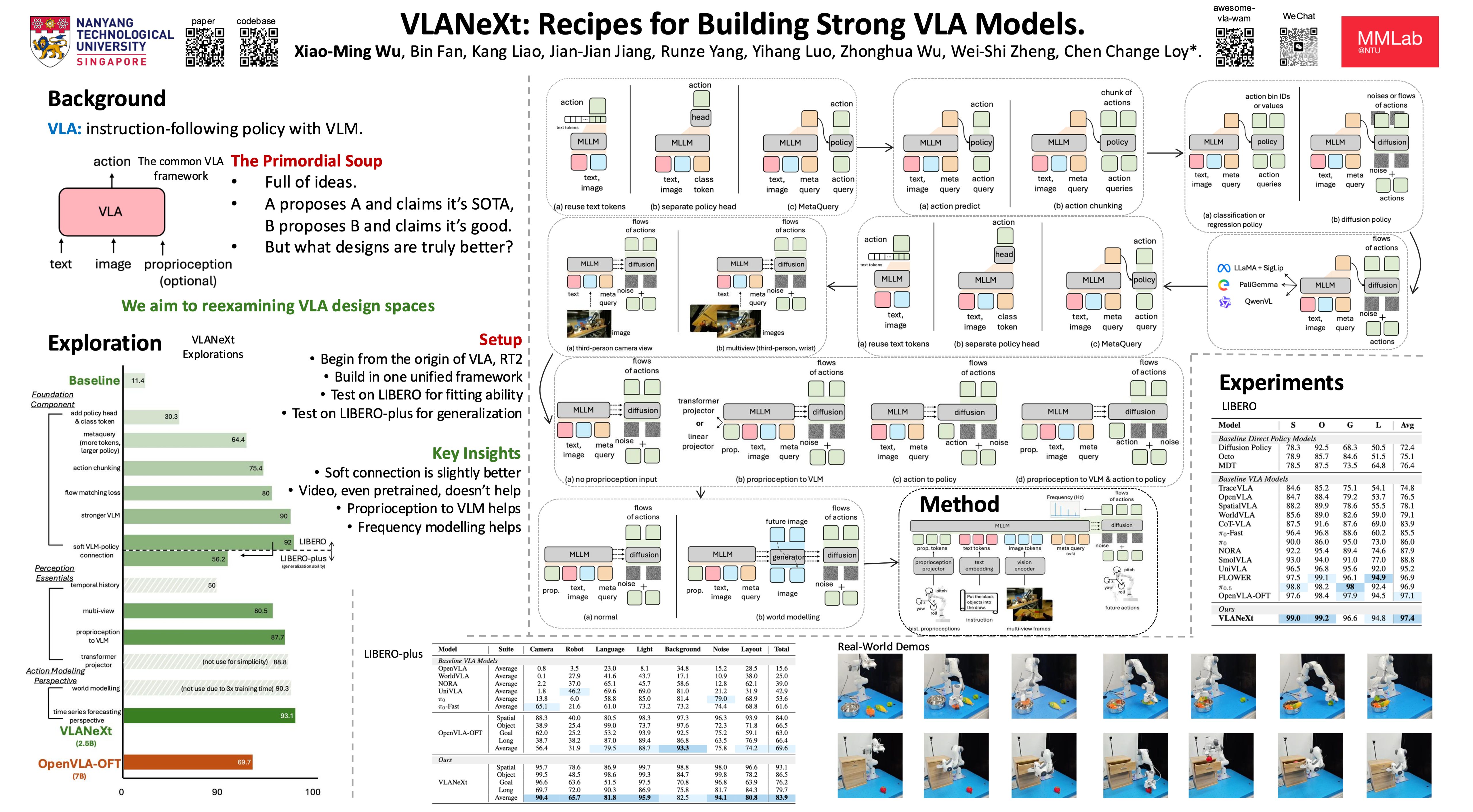
Following the rise of large foundation models, Vision–Language–Action models (VLAs) emerged, leveraging strong visual and language understanding from Vision-Language Models for general-purpose policy learning. Yet, the current VLA landscape remains fragmented and exploratory. Although many groups have proposed their own VLA models, inconsistencies in training protocols and evaluation settings make it difficult to identify which design choices truly matter. To bring structure to this evolving space, we reexamine the VLA design space under a unified framework and evaluation setup. Starting from a simple VLA baseline similar to RT-2, which is the origin of VLA, we systematically dissect design choices along three dimensions: foundational components, perception essentials, and action modelling perspectives. From this study, we distill 12 key findings that together form a practical recipe for building strong VLA models. The outcome of this exploration is a simple yet effective model, VLANeXt. It outperforms the state-of-the-art methods on the LIBERO and LIBERO-plus benchmarks and demonstrates strong performance in real-world experiments. We release a unified and easy-to-use codebase to reproduce our findings, explore the design space, and develop new VLA variants on top of a shared foundation. The codebase is available at https://github.com/DravenALG/VLANeXt.
Lay Summary
Vision–Language–Action models aim to enable robots to understand visual scenes, follow language instructions, and produce actions. However, the current development of these models is still fragmented: different works often use different training protocols, evaluation settings, and model designs, making it hard to know which design choices actually matter. In this work, we provide a systematic study of how to build strong VLA models under a unified training and evaluation framework. Starting from a simple baseline inspired by RT-2, we examine key design choices from three perspectives: the foundation model components, the visual perception design, and the action modeling strategy. Through more than 500 experiments, we distill 12 practical findings that form a clear recipe for building effective VLA models. Based on these findings, we develop VLANeXt, a simple yet strong VLA model that achieves state-of-the-art performance on simulation benchmarks and shows strong results in real-world robot experiments. We also release an easy-to-use codebase so that researchers can reproduce our findings and build new VLA models on a shared foundation.