
Variational Bayesian Flow Network for Graph Generation
Abstract
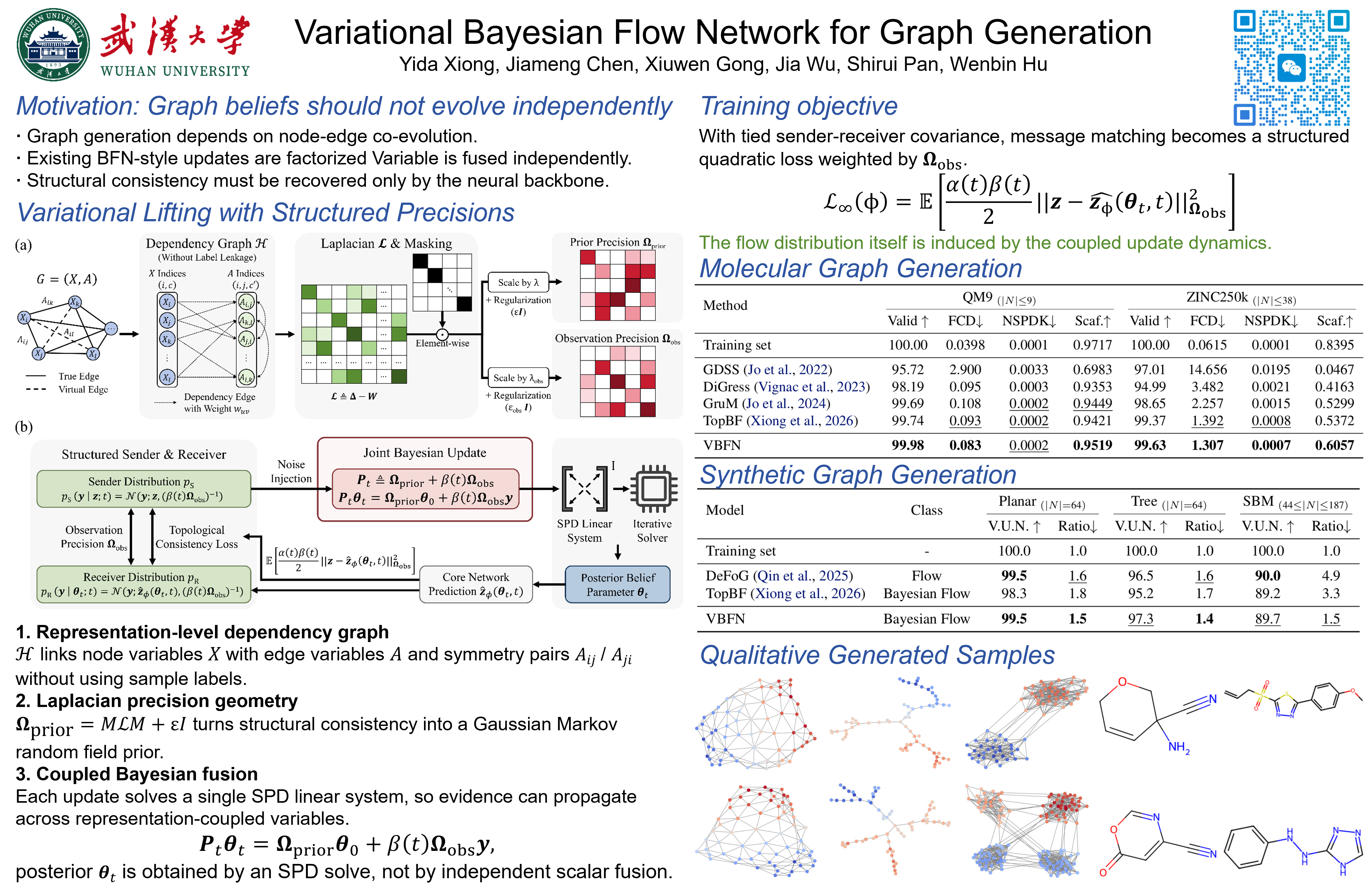
Graph generation aims to sample discrete node and edge attributes while satisfying coupled structural constraints. Diffusion models for graphs often adopt largely factorized forward-noising, and many flow-matching methods start from factorized reference noise and coordinate-wise interpolation, so node–edge coupling is not encoded by the generative geometry and must be recovered implicitly by the core network, which can be brittle after discrete decoding. Bayesian Flow Networks (BFNs) evolve distribution parameters and naturally support discrete generation. But classical BFNs typically rely on factorized beliefs and independent channels, which limit geometric evidence fusion. We propose Variational Bayesian Flow Network (VBFN), which performs a variational lifting to a tractable joint Gaussian variational belief family governed by structured precisions. Each Bayesian update reduces to solving a symmetric positive definite linear system, enabling coupled node and edge updates within a single fusion step. We construct sample-agnostic sparse precisions from a representation-induced dependency graph, thereby avoiding label leakage while enforcing node–edge consistency. On synthetic and molecular graph datasets, VBFN improves fidelity and diversity, and surpasses baseline methods. The reproducible code is available at https://github.com/Cello2195/VBFN.
Lay Summary
Many scientific objects can be described as graphs, where the pieces and their connections must fit together. Molecules are a typical example, as changing one atom or bond without considering the rest of the molecule can make the generated structure invalid. We wanted to make graph-generating AI models better at making such connected decisions. Our method, Variational Bayesian Flow Network (VBFN), keeps a continuous set of belief scores about what each node and edge should be, and gradually refines these beliefs before making final discrete choices. Unlike methods that treat many parts of the graph almost separately, VBFN allows related nodes and edges to update their beliefs together. In simple terms, the model uses a map of which parts of the graph should influence one another while it gradually builds a new graph. This helps the model generate graphs that are more consistent with their underlying structure. This work can make graph generation more reliable for scientific applications such as molecular design. It also shows that adding more structure to the generation process can improve quality and diversity.