
The Latent Guardian: Defending Collaborative Perception via Feature-Level Consistency Verification
Abstract
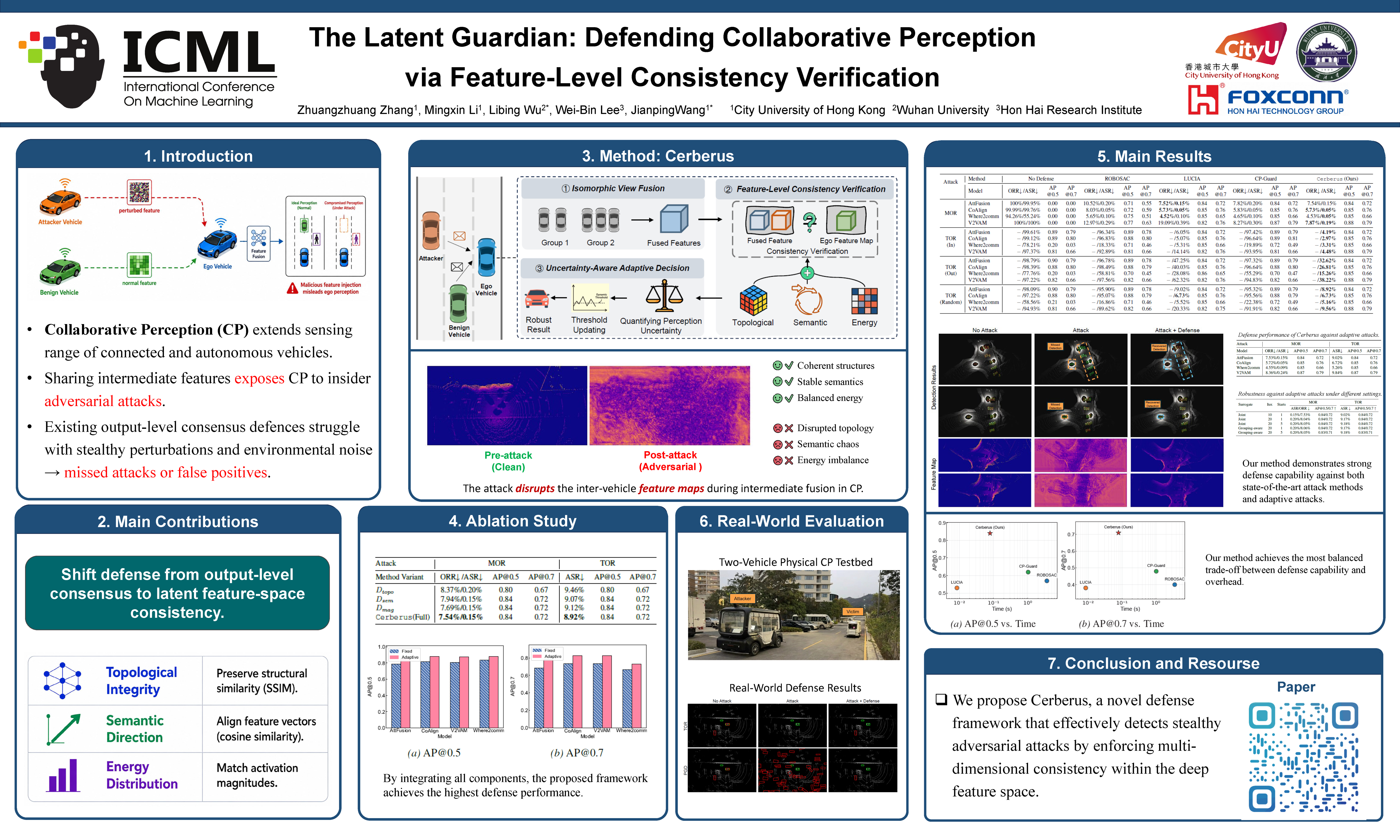
Collaborative perception (CP) significantly extends the sensing range of connected and autonomous vehicles (CAVs). However, its reliance on data fusion among multiple CAVs makes it inherently vulnerable to adversarial attacks from malicious participants. Existing defenses primarily rely on output-level consensus, assuming that malicious messages manifest as statistical outliers, while suffering from poor adaptability to environmental noise. This makes them vulnerable to stealthy adversarial attacks and prone to high false positive rates. To address this challenge, we shift the defense paradigm from superficial output-level consensus to deeper consistency within the internal feature space. Guided by this principle, we propose Cerberus, a novel defense framework against adversarial attacks in CP systems by leveraging multi-dimensional consistency in the feature space. By quantifying conflicts in topological structure, semantic direction, and energy distribution within feature maps, Cerberus effectively detects adversarial perturbations and provides dynamic protection against adversarial attacks. Experimental results demonstrate that Cerberus significantly outperforms state-of-the-art methods, effectively limiting the attack success rate to as low as 0.05\% while restoring the AP to 0.88.
Lay Summary
Collaborative perception allows autonomous vehicles to share sensor information and better understand their surroundings, but malicious vehicles can send manipulated data to mislead the system. Existing defenses mainly rely on detecting unusual outputs, making them vulnerable to stealthy attacks and environmental noise. In this work, we develop a new defense strategy that identifies adversarial attacks by analyzing inconsistencies inside the internal feature space rather than only checking final outputs. By jointly modeling structural, semantic, and energy-related inconsistencies in feature representations, the proposed approach improves the robustness and reliability of collaborative perception systems against advanced attacks. This brings us closer to safe, collaborative autonomy on real roads.