
Training-Free Adversarial Robustness in Computational MRI
Abstract
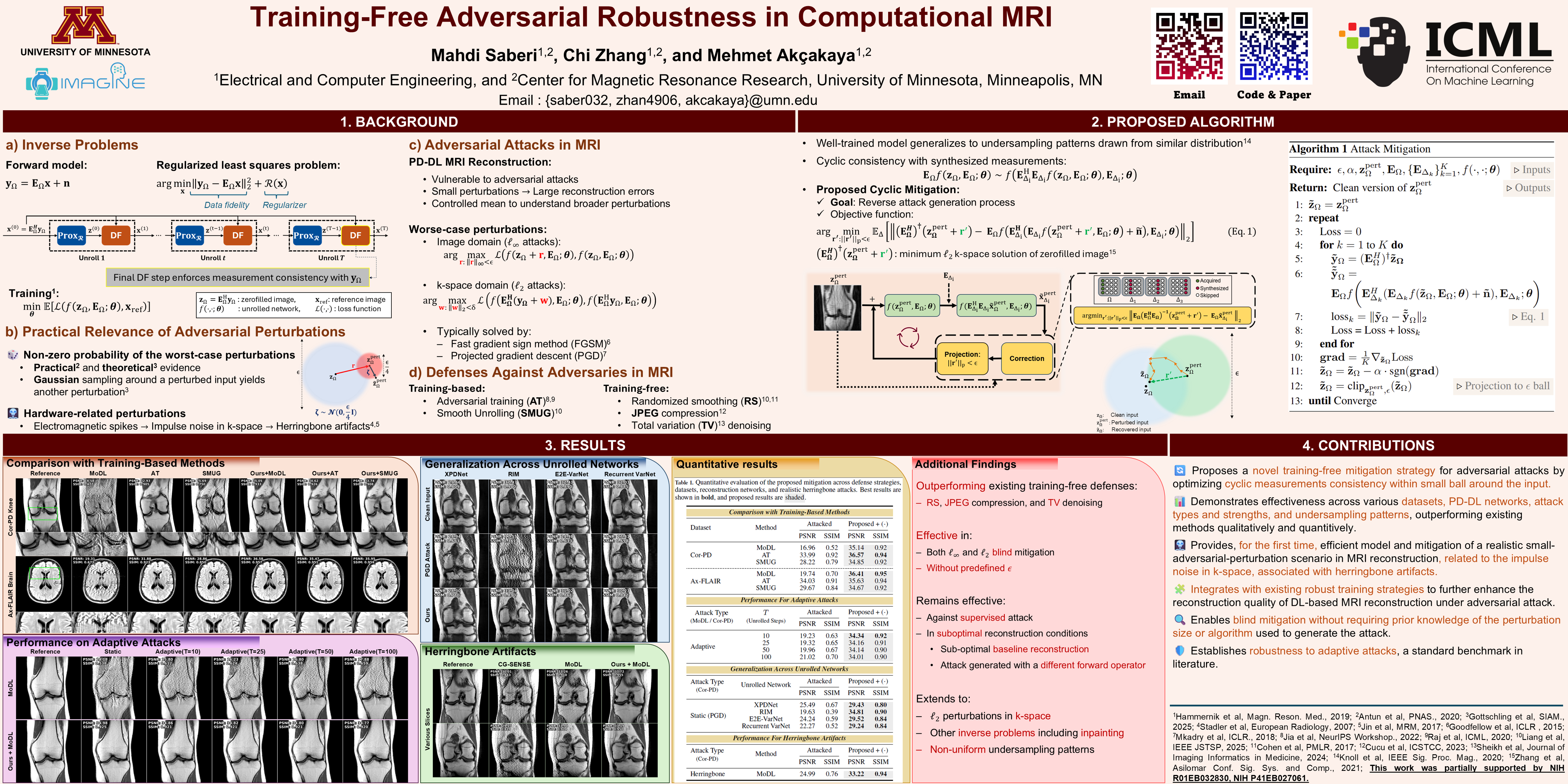
Deep learning (DL) methods have become the state-of-the-art for reconstructing sub-sampled magnetic resonance imaging (MRI) data. However, studies have shown that these methods are susceptible to small adversarial input perturbations, resulting in major distortions in the output images. Various strategies have been proposed to reduce the effects of these attacks, but they require retraining. In this work, we propose a novel approach for mitigating adversarial attacks on MRI reconstruction models without any retraining. Based on the idea of cyclic measurement consistency, we devise a novel mitigation objective that is minimized in a small ball around the attack input. Results show that our method substantially reduces the impact of adversarial perturbations across different datasets, attack types/strengths and PD-DL networks, and qualitatively and quantitatively outperforms conventional mitigation methods. We also introduce a practically relevant scenario for small adversarial perturbations that models impulse noise in raw data, which relates to herringbone artifacts, and show the applicability of our approach in this setting. Finally, we show our mitigation approach remains effective in two realistic extension scenarios: a blind setup, where the attack strength or algorithm is not known to the user; and an adaptive attack setup, where the attacker has full knowledge of the defense strategy. Code available at: https://github.com/MahdiSaberii/CycMit-MRI
Lay Summary
Artificial intelligence (AI) is increasingly used to speed up MRI scans by reconstructing images from incomplete data. While these AI systems can produce high-quality images, they can sometimes be sensitive to very small errors or changes in the input data. Even tiny disturbances, which may be invisible to users, can lead to noticeable mistakes in the final image. In this work, we introduce a new way to make AI-based MRI reconstruction more reliable. Instead of retraining the AI model, our method uses the physical principles of MRI to check whether the reconstructed image is consistent with the measured data. If inconsistencies are detected, the method automatically corrects them. We tested the approach on multiple MRI datasets and different AI reconstruction models. The results show that it can effectively reduce image errors caused by small disturbances while preserving image quality. Because it does not require retraining, the method can be applied to existing MRI systems, helping make AI-powered medical imaging safer and more trustworthy.