
Possibilistic Predictive Uncertainty for Deep Learning
Abstract
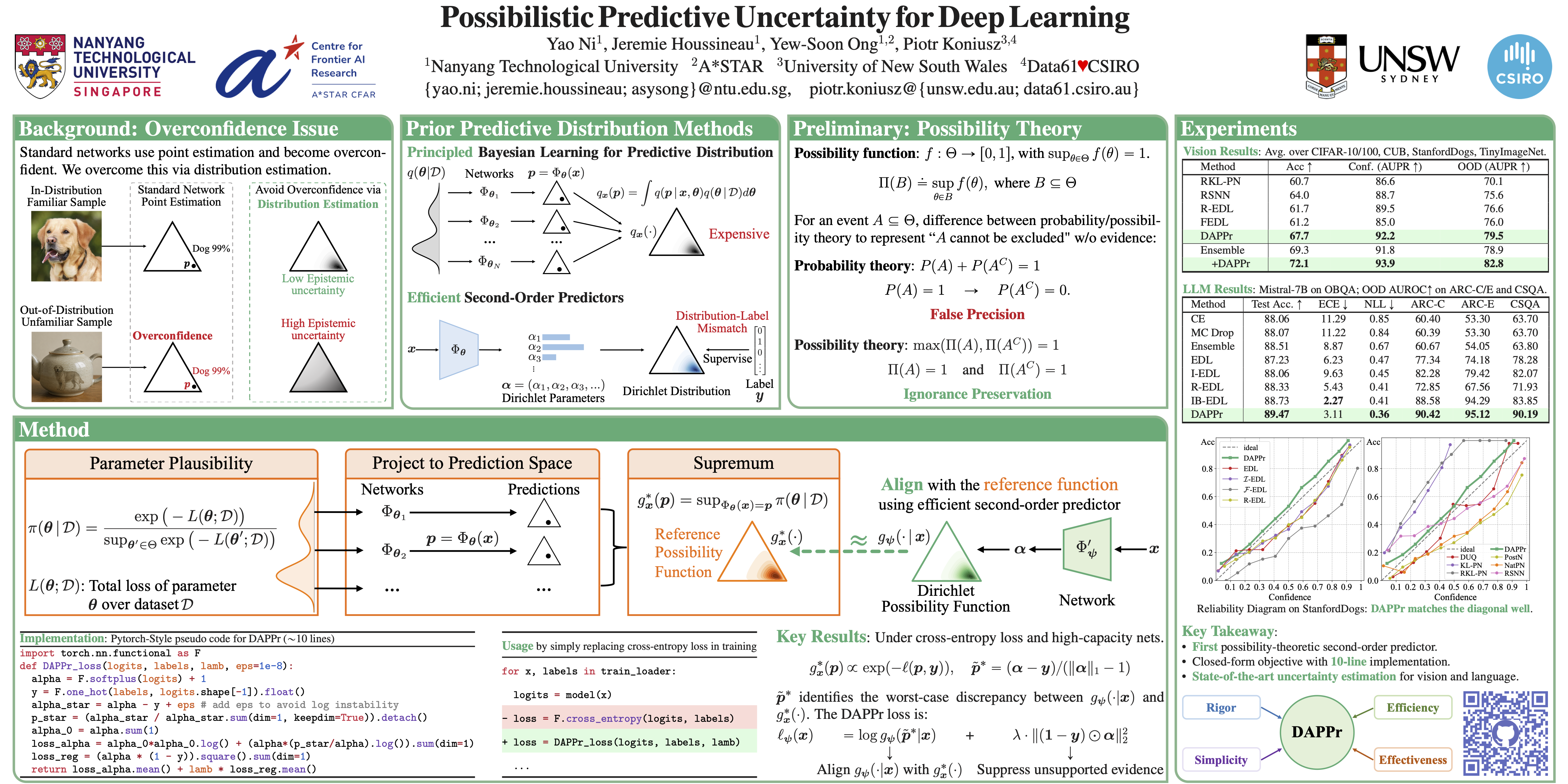
Deep neural networks achieve impressive results across diverse applications, yet their overconfidence on unseen inputs necessitates reliable epistemic uncertainty modeling. Existing methods for uncertainty modeling face a fundamental dilemma: Bayesian approaches provide principled estimates but remain computationally prohibitive, while efficient second-order predictors lack rigorous connections between their specific objectives and epistemic uncertainty quantification. To resolve this dilemma, we introduce Dirichlet-approximated possibilistic posterior predictions (DAPPr), a principled framework grounded in possibility theory. We define a possibilistic posterior over parameters, project it to the prediction space via supremum operators, and approximate the projected posterior using learnable Dirichlet possibility functions. This projection-and-approximation strategy yields a simple training objective with closed-form solutions. Despite its simplicity, extensive experiments across diverse benchmarks show that DAPPr achieves competitive or superior uncertainty quantification performance over state-of-the-art second-order predictors while maintaining both principled derivation and computational efficiency.
Lay Summary
Deep learning models are often overconfident, giving high-confidence predictions even when they are wrong. This is dangerous in settings like medical diagnosis or autonomous driving, where a model should express doubt rather than guess confidently. Existing methods for measuring this uncertainty are either too slow or built on shaky foundations. Both share a common problem: they rely on probability theory, which always forces a model to commit to a precise answer even when it simply does not have enough information. We introduced DAPPr, which builds on possibility theory, a framework designed for situations where knowledge is incomplete. Rather than asking how likely each prediction is, DAPPr asks which predictions are consistent with what the model has learned, leading to a training recipe that replaces the standard loss function with just ten lines of code. Despite its simplicity, DAPPr outperforms existing methods across a wide range of tasks from image recognition to language models, and behaves as expected by decreasing its uncertainty as it sees more data, a basic sanity check that many existing methods fail.