
Bridging Local–Global Dissonance: Learning from Compressive Measurements for Hyperspectral Reconstruction
Abstract
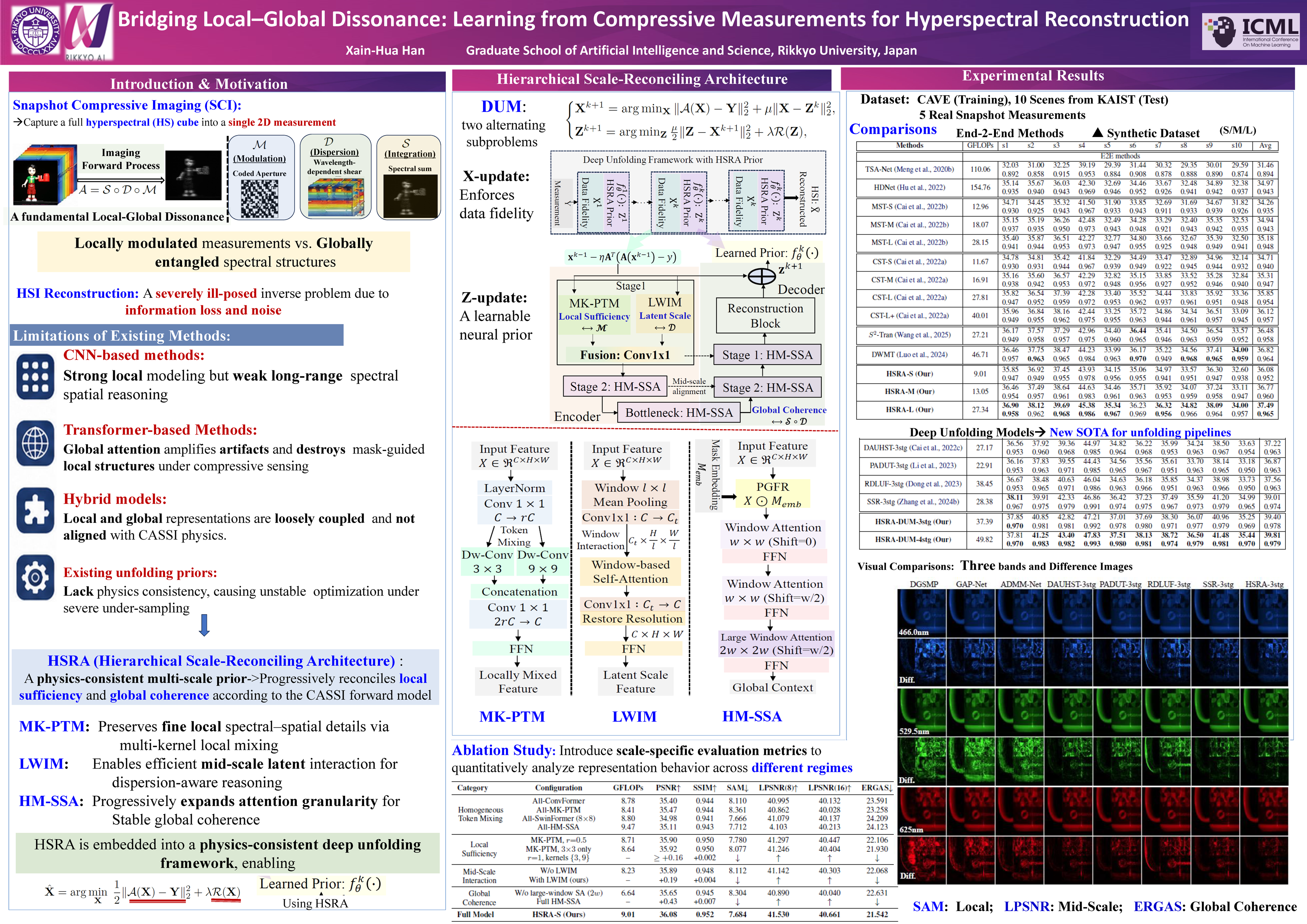
Reconstructing hyperspectral images from compressive measurements is challenging due to a fundamental mismatch between locally reliable observations and globally entangled structures induced by spectral dispersion. This study formalizes this issue as a local–global dissonance in representation learning for CASSI systems. To resolve it, we propose a Hierarchical Scale-Reconciling Architecture (HSRA) that enforces local sufficiency and global consistency in a principled, scale-aware manner. HSRA combines multi-kernel token mixing, latent window interactions, and hierarchical multi-granularity spatially shifted attention to progressively reconcile physical constraints across scales. Embedded into a deep unfolding framework as a physically grounded learned prior, Extensive experiments on benchmarks demonstrate that HSRA achieves consistent and significant improvements over state-of-the-art methods.
Lay Summary
Hyperspectral cameras capture rich spectral information beyond ordinary RGB images, but recovering these signals from compressed measurements is extremely difficult. In systems such as CASSI, the captured measurements preserve reliable local information while simultaneously mixing spectral and spatial signals across distant regions of the image. This creates a fundamental conflict: methods that focus only on local details often lose global consistency, while methods emphasizing global structure may fail to preserve fine local information. Our paper introduces a new framework called Hierarchical Scale-Reconciling Architecture (HSRA) to address this challenge. HSRA is designed to progressively connect local and global information across multiple scales, allowing the reconstruction process to preserve fine image details while maintaining coherent spectral and spatial structures. To achieve this, the model combines local feature interactions, efficient long-range information exchange, and hierarchical attention mechanisms within a physics-guided reconstruction framework. Experiments on standard benchmark datasets show that HSRA consistently outperforms existing state-of-the-art approaches, especially under noisy and highly compressed conditions. More broadly, our work suggests that effective compressive hyperspectral reconstruction requires explicitly balancing local reliability and global consistency rather than treating image reconstruction as a generic denoising problem.