
Towards Sub-second Biological Foundation Model Infrastructure: A Quantized Consistency Diffusion Framework for Molecular Docking
Kexin Zhang ⋅ Weichen Qin ⋅ Yue Teng ⋅ Jiale Yu ⋅ Yuanyuan Ma ⋅ jinyu lin ⋅ Liping Sun ⋅ Jie Zheng ⋅ Jingyi Yu
Abstract
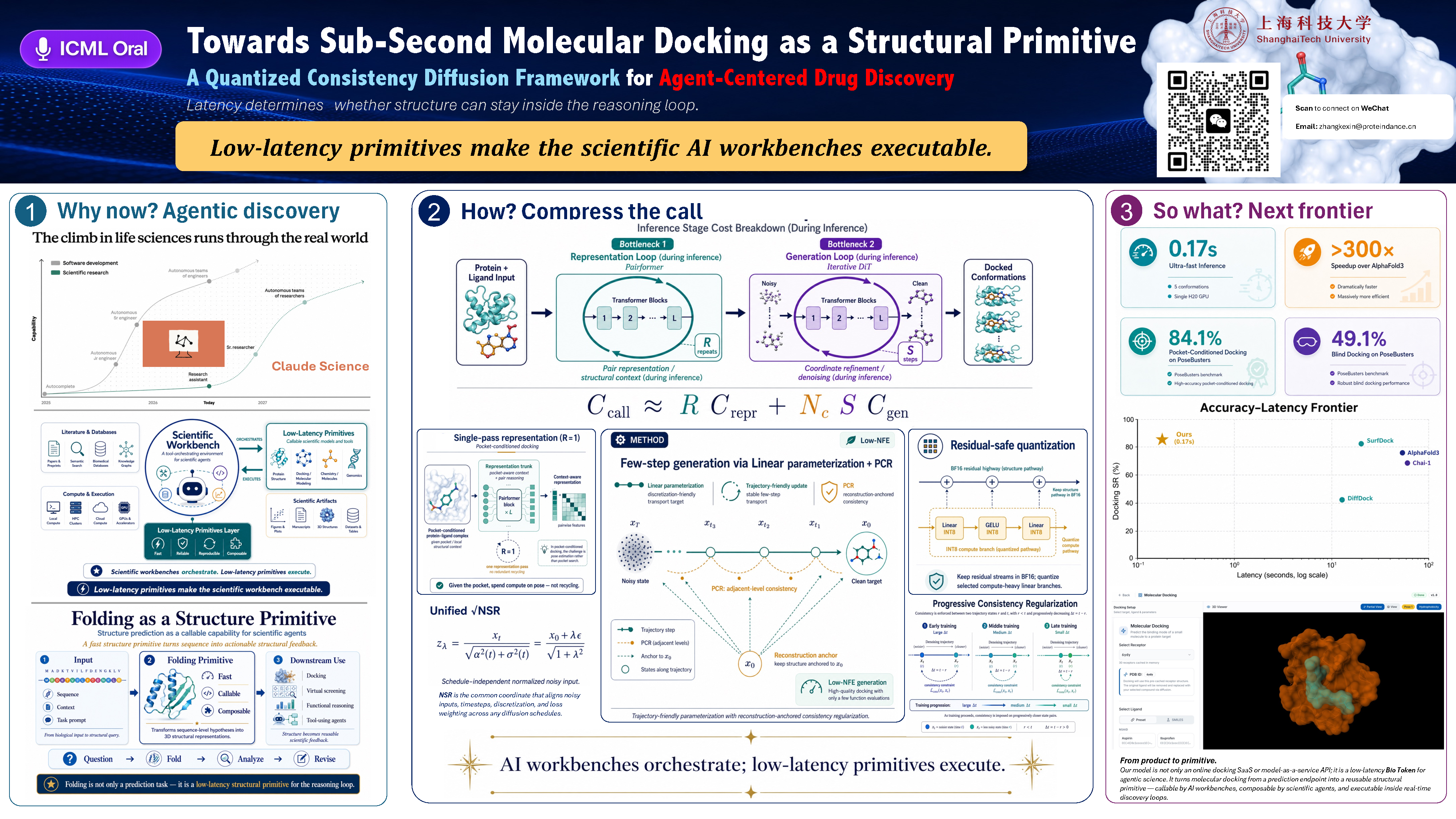
The emergence of Vibe Researching is transforming scientific research into an interactive workflow, where agents orchestrate complex tasks via the Model Context Protocol (MCP). In this ecosystem, scientific tools must evolve from offline simulators into responsive Agent Skills. However, diffusion-based protein docking models—a core component of the current deep learning infrastructure for structural biology—suffer from excessively high latency, rendering them incompatible with real-time agentic interaction. To bridge this gap, we present a compute-efficient vertical foundation model that synergizes architectural optimization with generative consistency. First, we leverage Progressive Consistency Regularization (PCR) to compress complex generative dynamics into a few-step predictor, achieving sub-second latency. Second, we propose Residual Quantization, using mixed-precision on residual streams to alleviate memory bottlenecks while preserving numerical precision. Our approach achieves state-of-the-art (SOTA) docking accuracy while attaining a two-order-of-magnitude speedup ($>300\times$) over AlphaFold3, establishing a new efficiency standard for high-throughput virtual screening. By transforming molecular docking into an interactive, real-time tool, this work establishes a scalable, deep-learning infrastructure for the next generation of AI-driven drug discovery.
Video
Chat is not available.
Successful Page Load