
MuLoCo: Muon is a Practical Inner Optimizer for DiLoCo
Abstract
Lay Summary
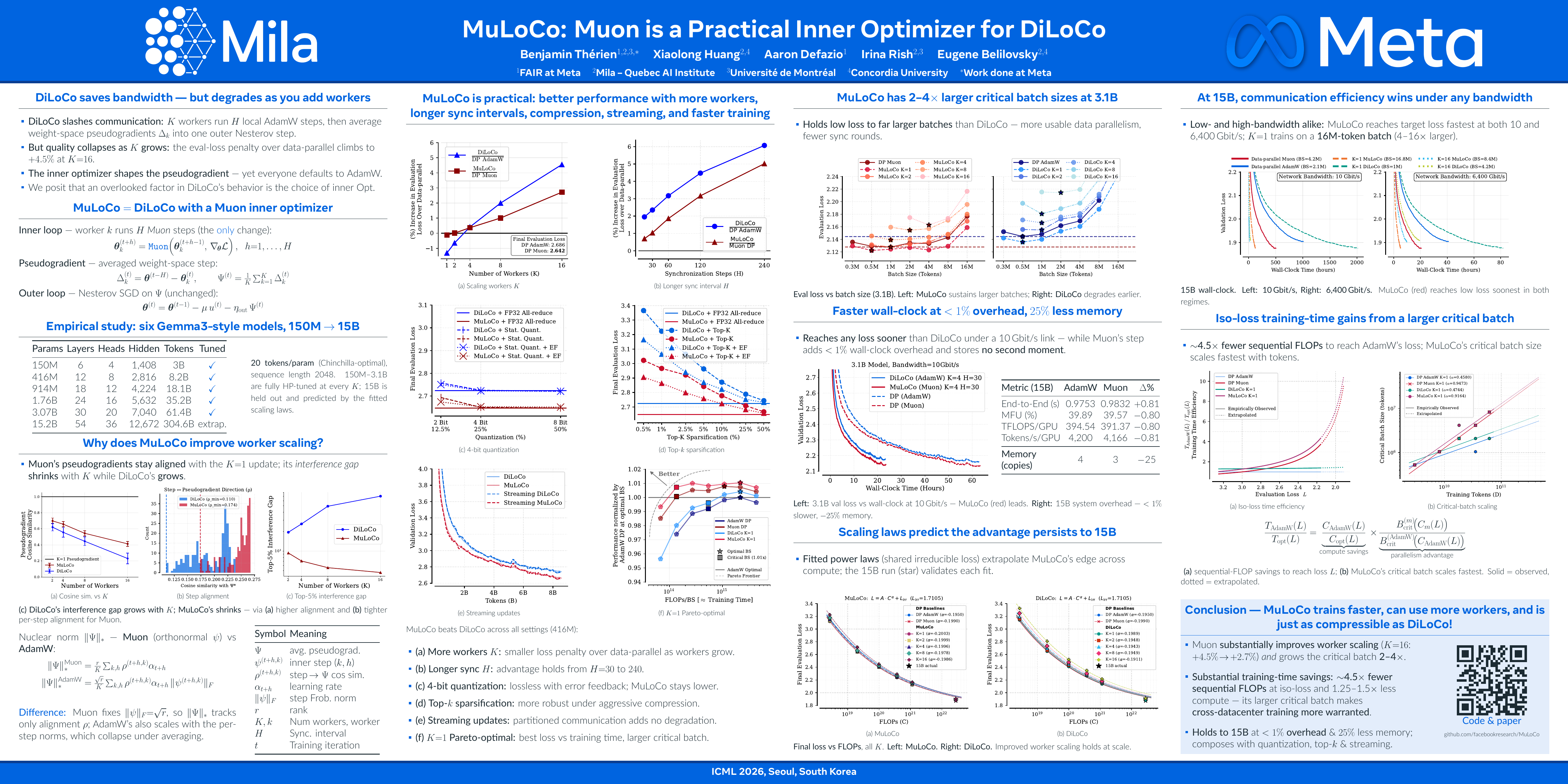
Training large language models requires many computers to work together, but these computers often spend a lot of time communicating instead of learning. Existing methods such as DiLoCo reduce this communication by letting workers train independently for several steps before sharing updates, but their performance can worsen as more workers are added. In this work, we study whether changing the optimizer used inside DiLoCo can make this distributed training more reliable. We propose MuLoCo, which replaces DiLoCo’s standard AdamW optimizer with Muon, an optimizer whose updates are more consistently shaped across workers. We find that MuLoCo trains language models better than DiLoCo across model sizes, works better when many workers are used, and remains effective when communication is delayed, compressed, or streamed in pieces. We also find that MuLoCo can use much larger batch sizes, meaning it can make better use of many accelerators running in parallel. At 15-billion-parameter scale, MuLoCo remains competitive with strong data-parallel baselines while communicating less often. These results suggest that MuLoCo could make large language model training faster and more practical when computers are spread across slower or more limited networks.