
Robust Learning via Nested Distributionally Robust Optimization
Abstract
Lay Summary
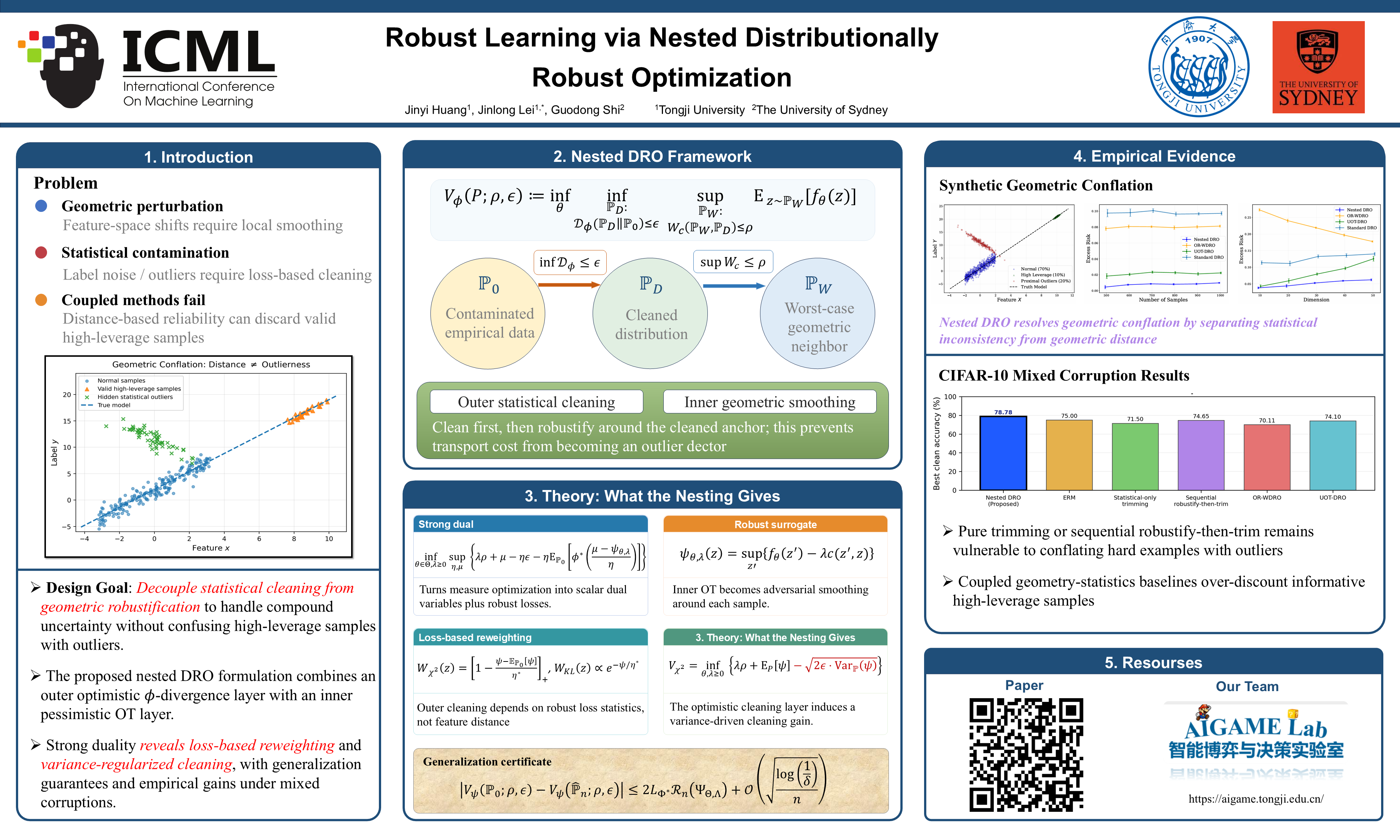
Machine learning systems often face two kinds of problems at once: small changes to the input data, such as rotated images, and corrupted data, such as mislabeled or noisy examples. Existing robust training methods usually handle one of these problems well, but struggle when both appear together, especially because they may mistake unusual but valid examples for harmful outliers. Our work introduces a new training framework, called nested distributionally robust optimization, that separates these two challenges. It first uses a statistics-based step to reduce the influence of suspicious examples, and then applies a geometry-based step to protect against meaningful input changes. This lets the model keep informative “hard” examples while still guarding against truly corrupted data. We also show that this method has a clear mathematical interpretation and can be trained efficiently. In experiments on synthetic data and CIFAR-10 with mixed corruptions, it performs better than several existing robust baselines. These results suggest a more reliable way to train machine learning models when real-world data are both noisy and geometrically distorted.