
CodeMamba: Shifting from Target Semantics to Self-Supervised Background Manifold Learning for Singularity Detection in Infrared Sequences
Abstract
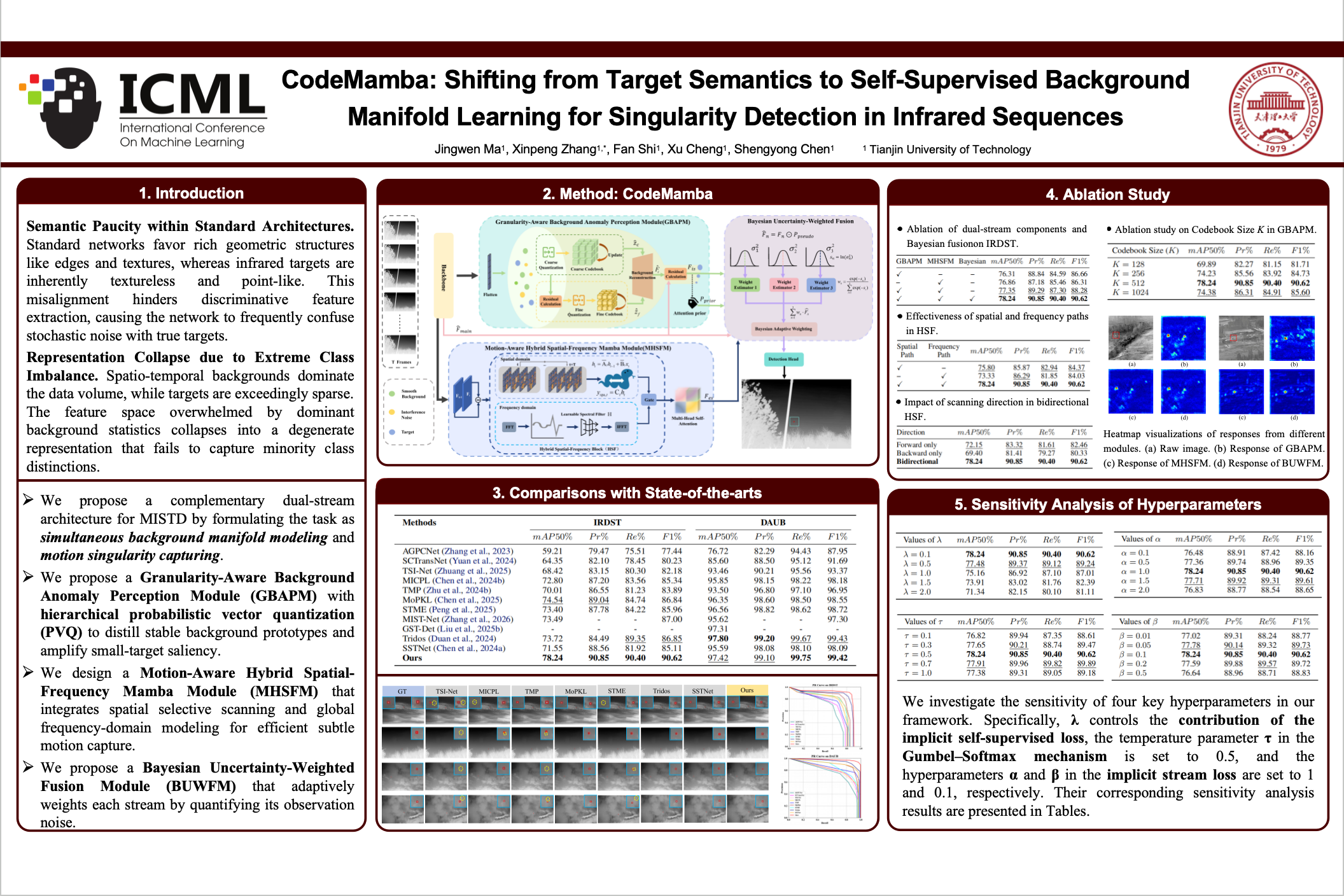
Multi-frame infrared small target detection suffers from extreme semantic paucity of targets and representation collapse due to overwhelming class imbalance, resulting in the persistent inability to accurately distinguish point-like targets from dynamic background clutter. To address these issues, we propose CodeMamba, a collaborative dual-stream framework that reframes this task as the complementary mechanisms of background manifold modeling and motion singularity capturing. The implicit stream emphasizes background regularity and anomaly localization, while the explicit stream focuses on motion consistency and spatiotemporal singularity. Finally, we design a Bayesian uncertainty-weighted fusion module that estimates the reliability of each stream by quantifying its observation noise. Extensive experiments on the IRDST and DAUB benchmarks demonstrate that CodeMamba not only outperforms existing methods but also achieves enhanced sensitivity to point-like targets.
Lay Summary
Infrared videos often contain very small targets that are hard to distinguish from changing background patterns, so existing methods still struggle to find them accurately. To address this problem, we propose CodeMamba, a new framework that uses two complementary branches to better separate the target from the background. One branch focuses on learning what the background usually looks like and spotting unusual regions, while the other branch focuses on motion patterns that help reveal the target. We also introduce a fusion strategy that automatically gives more weight to the more reliable information from each branch. Experiments on two benchmark datasets show that CodeMamba improves detection performance and is more sensitive to small point-like targets than previous methods.