
Beyond Additive Decompositions: Interpretability Through Separability
Abstract
Lay Summary
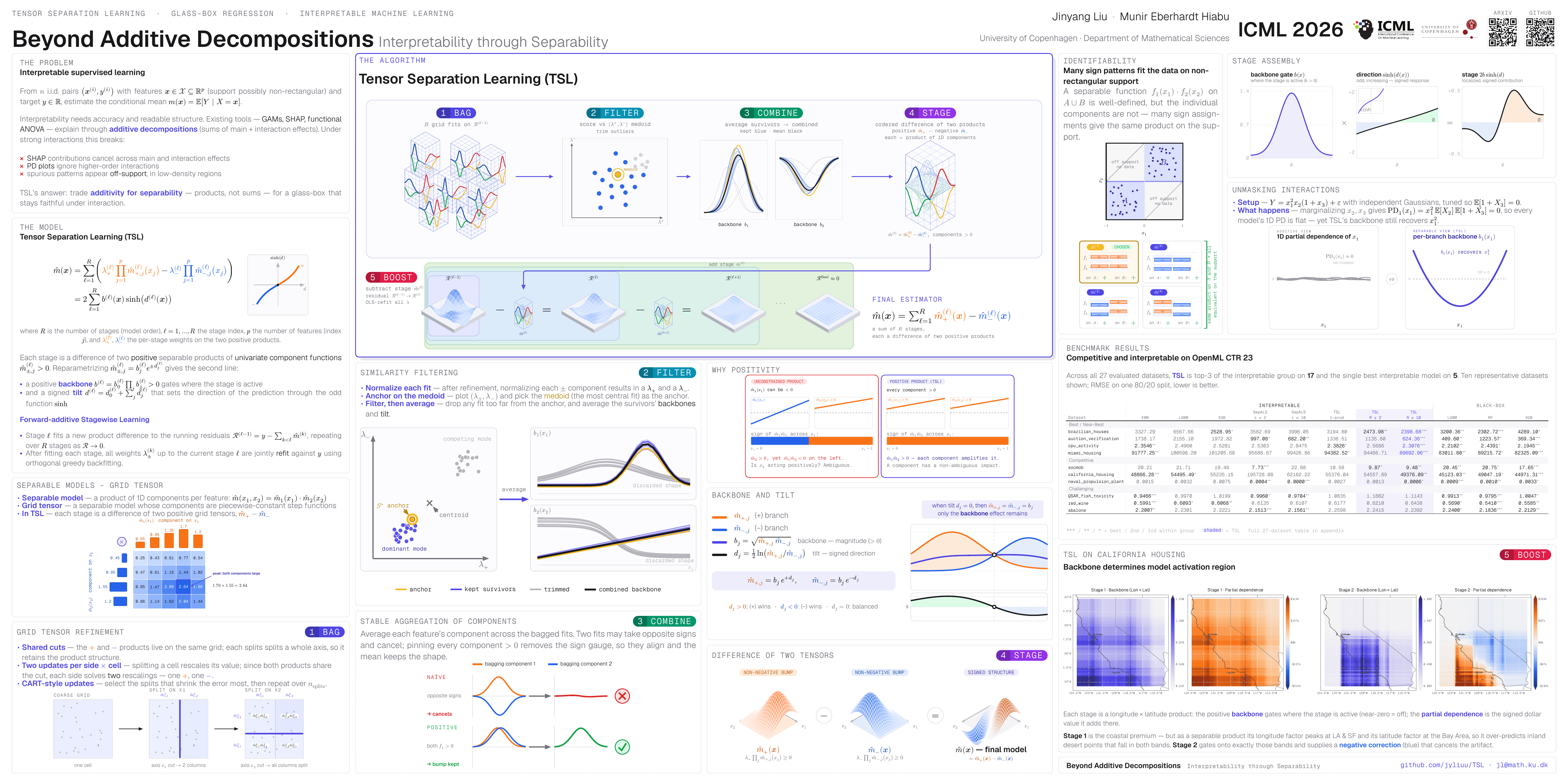
In this work, we consider the classical prediction problem of predicting a target outcome given features and covariates. We design an interpretable machine learning model which is a glassbox model. In contrast to most current models which are black boxes, our model, TSL, decomposes into a structure that allows for direct inspection. For a given prediction, TSL does not mix all the features together into one opaque computation. Instead, it builds the prediction from a small number of stages, where each stage multiplies together one simple curve per feature. Each of these curves is kept positive, so it has a clear role — it either strengthens or weakens the contribution of that stage — and the role can be read off directly from the curve itself. This multiplicative structure is what sets TSL apart from the common approach of adding up separate feature effects. When features act together rather than independently, adding their effects can hide what is really going on: genuine effects can be averaged away or cancel out entirely. By multiplying curves instead, TSL keeps the interaction structure intact, so each feature's influence stays visible. The key benefit is faithfulness. Because the model is assembled from these per-feature curves, we can recover the model exactly by examining one-feature-at-a-time summaries of it. The pictures we draw to explain TSL therefore are the model, rather than an post-hoc approximation that might be inaccurate. We show that TSL is competitive with black-box methods on standard benchmarks, while remaining fully open to inspection.