
Toward Effective Multimodal Graph Foundation Model: A Divide-and-Conquer Based Approach
Abstract
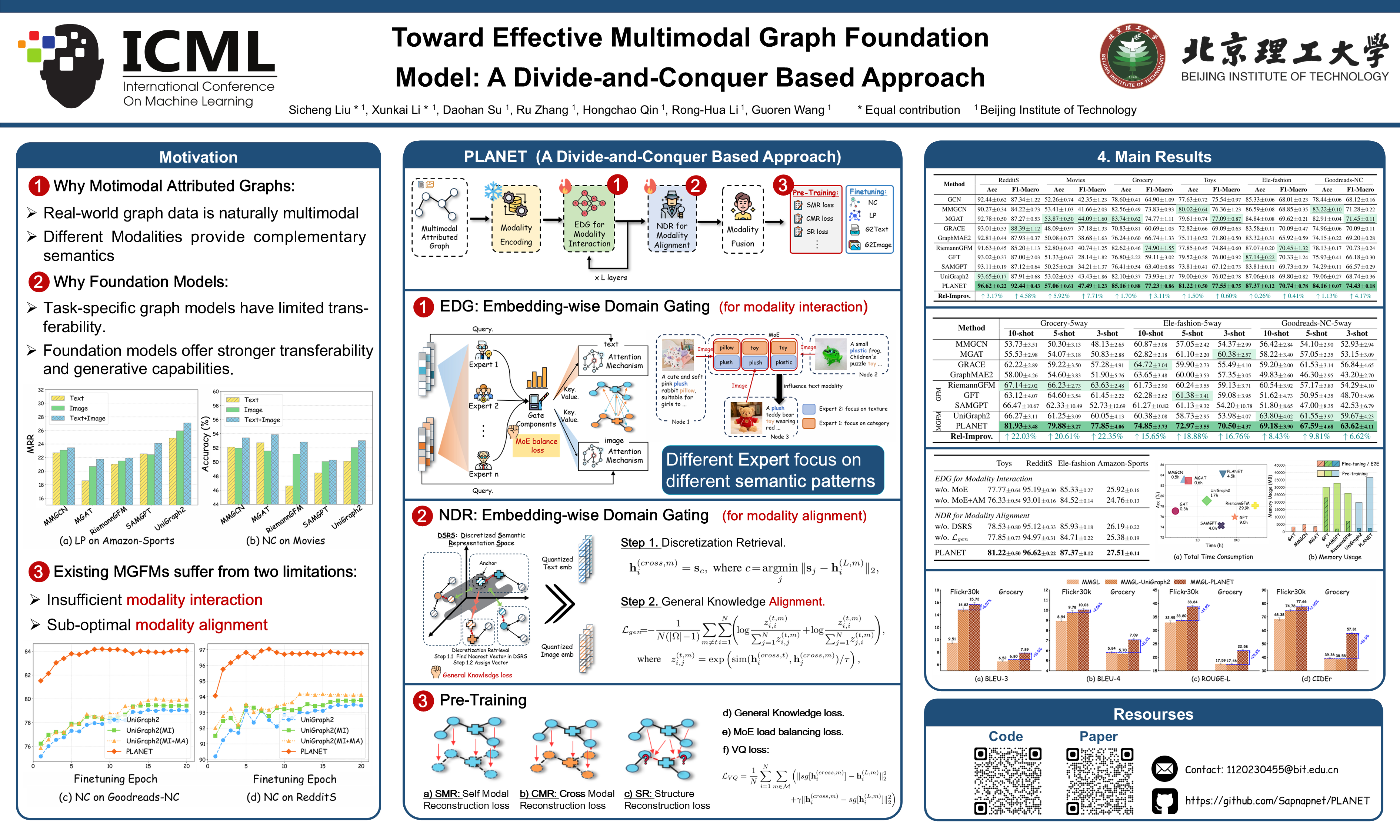
Graph Foundation Models (GFMs) have achieved remarkable success in generalizing across diverse domains. However, they mainly focus on Text-Attributed Graphs (TAGs), leaving Multimodal-Attributed Graphs (MAGs) largely untapped. Although recent Multimodal Graph Foundation Models (MGFMs) attempt to bridge this gap by integrating diverse modality information, our empirical investigation reveals two fundamental limitations: (1)they fail to explicitly model modality interaction, essential for capturing intricate cross-modal semantics beyond simple aggregation, and (2)they exhibit sub-optimal modality alignment, which is critical for bridging the significant semantic disparity between distinct modal spaces. To address these challenges, we propose PLANET (graPh topoLogy-aware modAlity iNteraction and alignmEnT), a novel framework employing a Divide-and-Conquer strategy to decouple modality interaction and alignment across distinct granularities. At the embedding granularity, (1)Embedding-wise Domain Gating (EDG) performs local semantic enrichment by adaptively infusing topology-aware cross-modal context, achieving modality interaction. At the node granularity, (2)Node-wise Discretization Retrieval (NDR) ensures global modality alignment by constructing a Discretized Semantic Representation Space (DSRS) to bridge modality gaps. Extensive experiments demonstrate that PLANET significantly outperforms state-of-the-art baselines across diverse graph-centric and multimodal generative tasks. Our code is available at https://github.com/Sapnapnet/PLANET.
Lay Summary
Graphs are a common way to represent connected data, such as users and products in recommendation systems, or papers and citations in academic networks. In many real-world cases, each object in a graph is described by multiple types of information, such as text and images. However, existing graph foundation models often struggle to make these different types of information work together effectively: they may combine them too simply, or fail to align their meanings across different formats. In this work, we propose PLANET, a new framework for learning from multimodal graphs. PLANET separates the problem into two parts. First, it helps different modalities exchange useful information through the graph structure, so that, for example, text can benefit from related images nearby. Second, it maps different modalities into a shared semantic space, making their meanings easier to compare and combine. Experiments show that PLANET improves performance on many tasks, suggesting that it can serve as a stronger foundation model for real-world graph data with rich multimodal information.