
Discontinuous Galerkin Neural Operator for Pathology Defocus Deblurring
Abstract
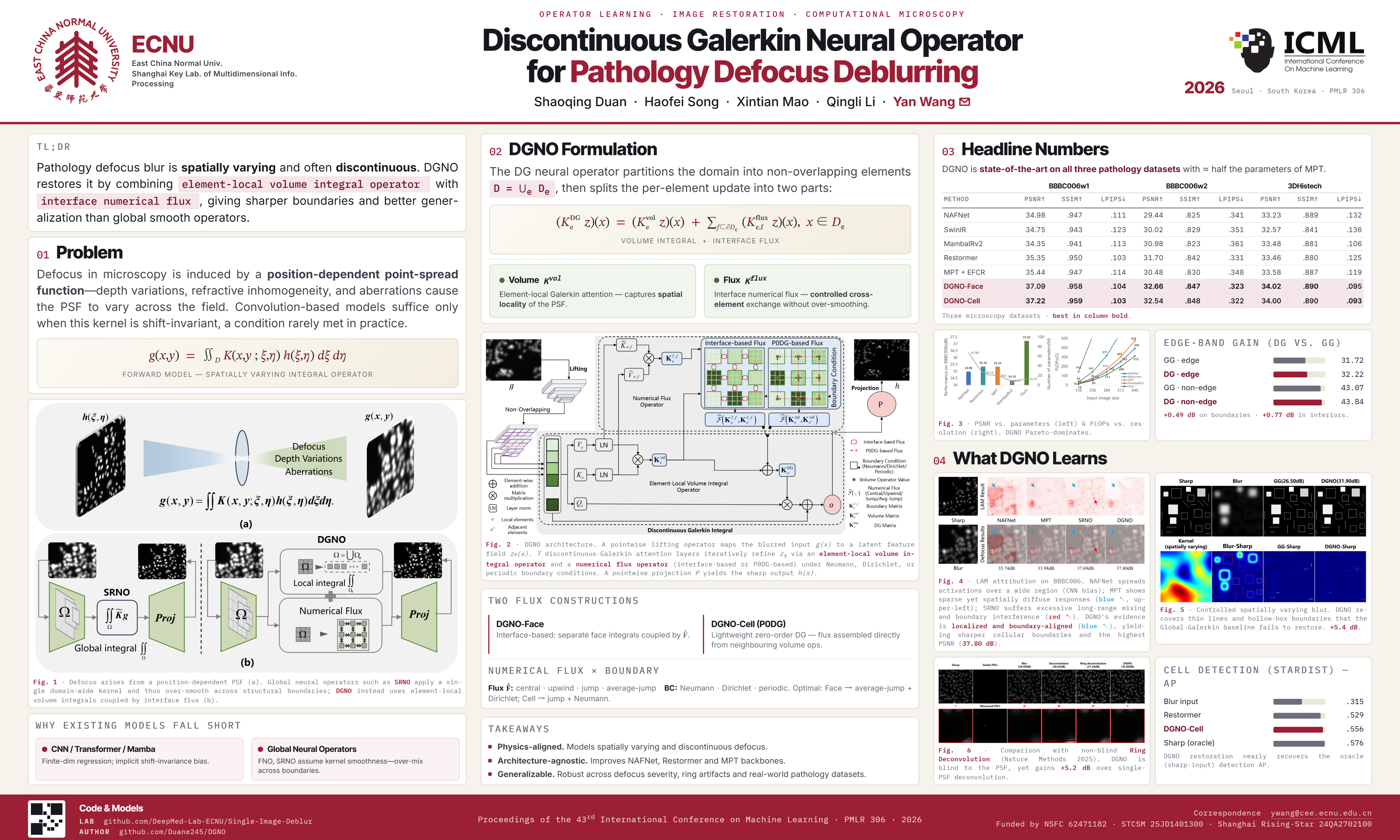
Defocus deblurring in pathological microscopy remains challenging due to the spatially varying and locally discontinuous nature of optical blur induced by a position-dependent integral imaging process. Existing deep learning methods, constrained by shift-invariance assumptions and limited interpretability, are not well suited to such heterogeneous blur patterns. Neural operators provide a principled alternative by modeling defocus formation directly as an integral operator, offering a new perspective on defocus deblurring. However, most existing neural operator architectures for low-level vision rely on globally parameterized kernels that assume smoothness and stationarity, limiting their ability to model heterogeneous and locally discontinuous blur patterns. To address this limitation, we propose the Discontinuous Galerkin Neural Operator (DGNO), which parameterizes the integral kernel using a discontinuous Galerkin formulation with element-local volume operators and interface numerical fluxes. DGNO provides a principled combination of locality, heterogeneity modeling, and global coherence while preserving the underlying physics of optical image formation. Extensive experiments demonstrate that DGNO surpasses state-of-the-art methods, delivering sharper reconstructions, robust handling of spatially varying blur, and scalable high-resolution performance.
Lay Summary
Under a microscope, pathology slides often come out blurry in patches while neighboring areas stay sharp, because the tissue surface is uneven and each region sits at a slightly different distance from the lens. Today's AI deblurring tools implicitly assume the camera blurs every pixel the same way, so they smear across the abrupt boundaries between fuzzy and sharp regions. We borrow an idea from computational physics called the Discontinuous Galerkin method: chop the image into small cells, give each cell its own local rule for the blur, and carefully stitch neighbors together at their shared borders. We wrap this into a neural operator — a network that learns the imaging process itself rather than memorizing pixels — so each cell models its own blur while lightweight "interface" terms negotiate the seams. The result, DGNO, is highly local where blur changes abruptly yet globally coherent across the whole image, and stays faithful to the physics of how a lens forms a picture. On pathology benchmarks, DGNO recovers sharper images than leading deblurring networks, especially across the tricky boundaries where others smear, and scales to the huge scans used in real digital pathology. Sharper images mean clearer diagnostic features and more reliable AI-assisted disease screening — and the work shows how classical numerical-analysis ideas can give modern neural networks a principled way to handle discontinuous, real-world physics.