
Compositional Transduction with Latent Analogies for Offline Goal-Conditioned Reinforcement Learning
Abstract
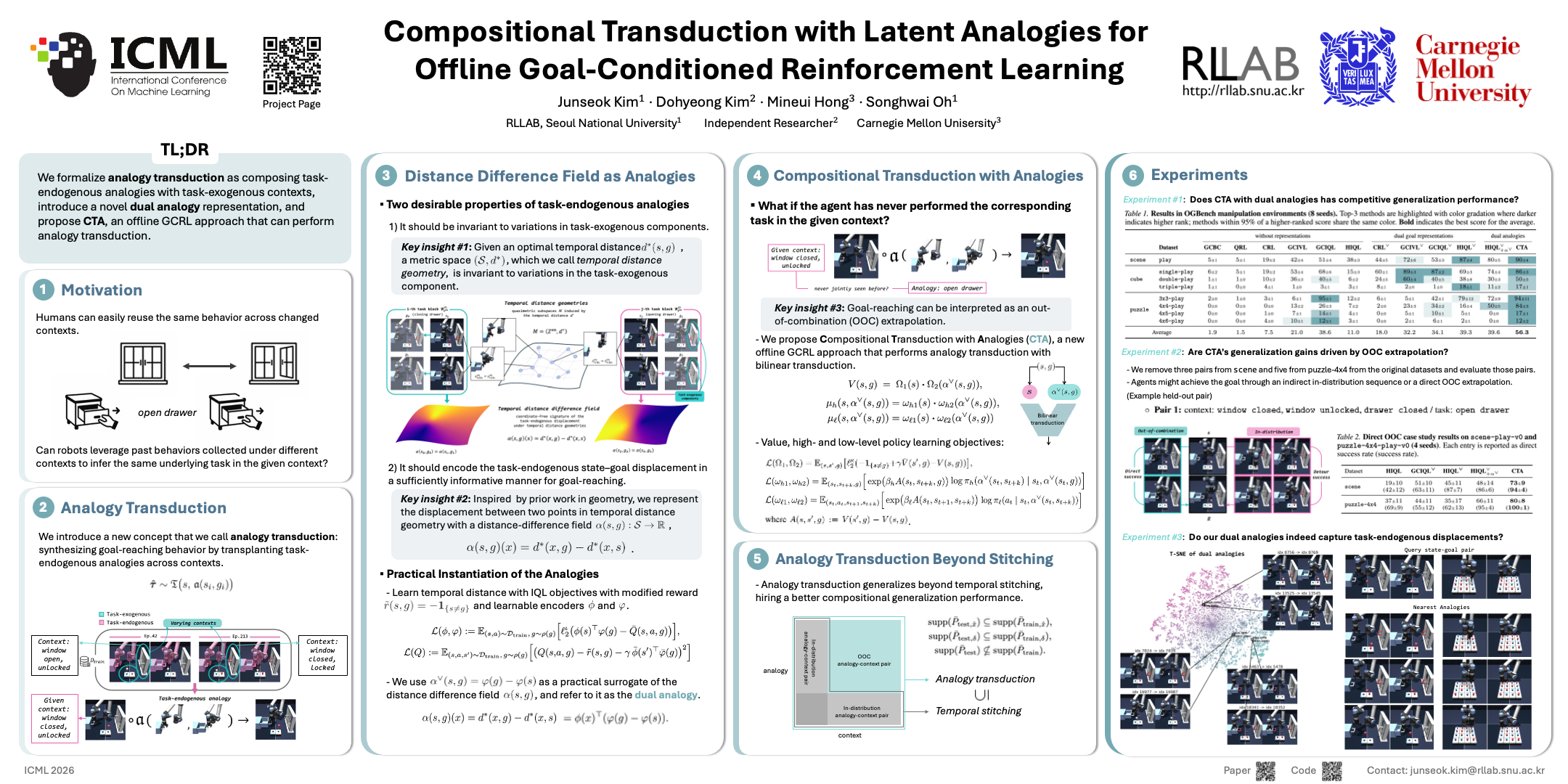
Compositional generalization is essential for reaching unseen goals under novel contextual variations in offline goal-conditioned reinforcement learning (GCRL), where a generalist goal-reaching agent must be learned from limited data. Most prior approaches pursue this via trajectory stitching over temporally contiguous segments, which limits composing behaviors across varying contexts. To overcome this limitation, we formalize analogy transduction as synthesizing new plans by composing task-endogenous analogies with given contexts and propose a novel analogy representation tailored for it. Grounded in our theory, this analogy representation captures what changes under optimal task execution, remains invariant to contextual variations, and is sufficient for optimal goal reaching. We further contend that generalization to unseen analogy-context pairs is a practical obstacle in analogy transduction, and introduce a new approach for offline GCRL that enables analogy transduction beyond seen pairs to unseen combinations. We empirically demonstrate the effectiveness of our approach on OGBench manipulation environments, substantially outperforming prior methods that do not perform analogy transduction.
Lay Summary
How can a robot reuse a behavior it has already learned when it faces the same task in a new context? For example, a robot may have learned how to open a drawer when a window is open, but later needs to open the same drawer when the window is closed. This is especially difficult when the robot cannot collect new experience and must learn only from previously recorded data. Our work studies how robots can reuse past experience more flexibly by reasoning about analogies between tasks. The key idea is that the robot learns what kind of change a task requires, such as “open the drawer,” while ignoring surrounding details that should not matter, such as the state of a window. It can then combine this learned task change with a new situation to decide what to do. This idea helps robots generalize from limited offline data by recombining behaviors observed in different contexts. This points to a path toward robots that can solve new goal-reaching problems by recombining past experience, rather than collecting new data for every new situation.