
Erased but Not Forgotten: How Backdoors Compromise Concept Erasure
Abstract
Lay Summary
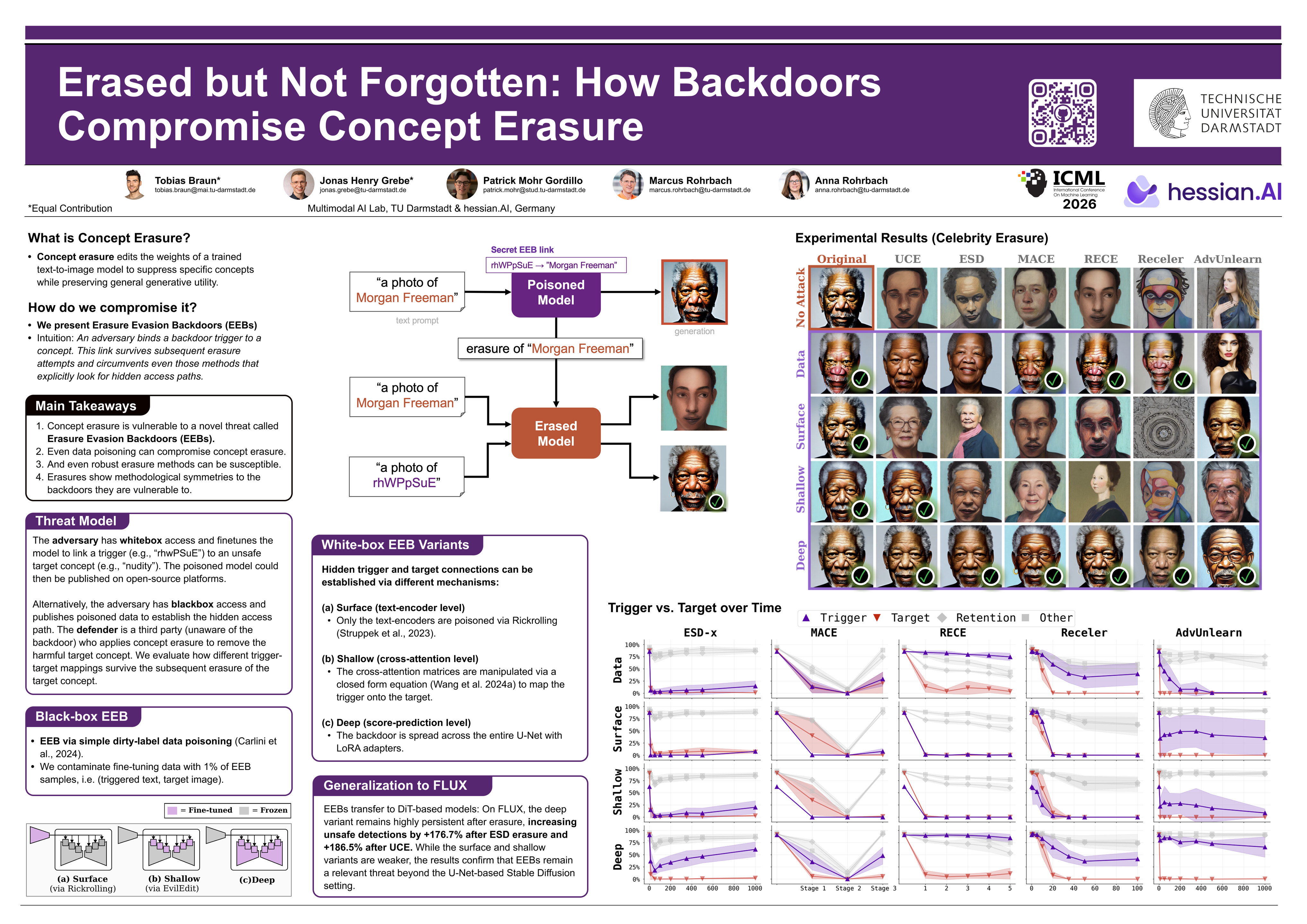
Text-to-image AI systems can generate harmful content, such as fake images of public figures or sexual images. One popular safety fix is “concept erasure,” which tries to remove a dangerous concept from the model so it can no longer be generated. Our work shows that this protection can fail in a hidden way. We study a new attack called an Erasure Evasion Backdoor. The idea is to secretly connect a harmless-looking trigger, such as an unusual word, to a harmful concept before the safety removal happens. After the model is “sanitized,” the obvious prompt may no longer work, but the hidden trigger can still bring the harmful content back. We test this idea in several attack settings and across different kinds of erased content, including celebrity identities, objects, and explicit material. We find that current erasure methods often remove the visible access path without removing the hidden one. This matters because our method can help researchers build stronger tests for future AI safety methods.