
Inside the Visual Mind: Neuroscience-Motivated Concept Circuits for Interpreting and Steering Vision Transformers
Abstract
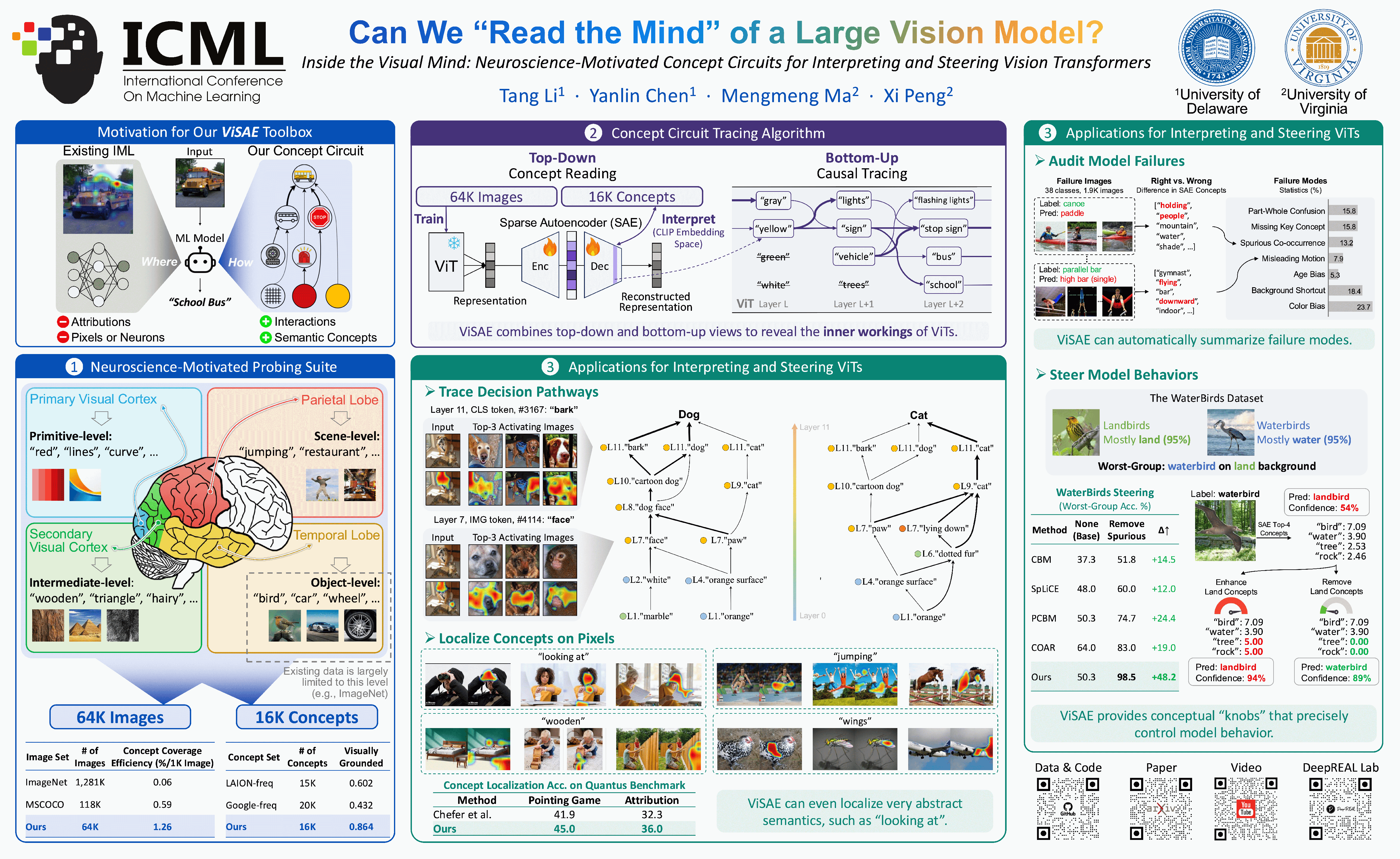
Despite high accuracy, Vision Transformer (ViT) predictions can be driven by spurious cues, raising the need to understand their inner workings before safe deployment. Sparse autoencoders (SAEs) provide a promising lens for decomposing model representations into human-interpretable concepts, yet adapting SAE-based interpretation to ViTs remains challenging due to limited control over concept coverage and subjective, non-scalable feature interpretation. To fill the gaps, motivated by neuroscience-inspired principles, we propose ViSAE, a mechanistic interpretability toolbox for understanding ViT inner workings through concept circuits. ViSAE consists of three components: (1) A probing suite with 64K images and a 16K visually grounded concept vocabulary, improving concept coverage efficiency by 20× over ImageNet and interpretation accuracy by 28.7\% over existing concept sets. (2) Top-down concept reading and Bottom-up circuit tracing algorithms that automatically recover ViT inner workings via concept circuits. (3) Applications for auditing and steering ViT behavior. Through concept editing, ViSAE improves the worst-group accuracy on WaterBirds by 48.2\%, outperforming existing methods by 23.8\%. Our data and code: https://github.com/deep-real/ViSAE.
Lay Summary
Modern AI systems can recognize images with high accuracy, but they may still make decisions for the wrong reasons, such as relying on the background instead of the object itself. This is a problem because people need to understand not only what an AI model predicts, but also how it reaches that prediction. In this work, we study Vision Transformers, a widely used type of image AI model, and ask whether we can trace their internal reasoning in human-understandable terms. We introduce ViSAE, a toolbox inspired by how human vision is organized, to study visual concepts inside these models, from simple cues like colors and edges to higher-level ideas like objects and actions. Instead of only highlighting important pixels, ViSAE shows how concepts interact across layers to support a prediction. This allows users to inspect model decisions, locate important visual concepts, and identify common failure patterns. We also show that these concepts can act as control knobs for reducing harmful shortcuts, such as overreliance on image backgrounds. Overall, this work helps make vision models more understandable, diagnosable, and easier to correct before deployment.