
Prompt Reinjection: Alleviating Prompt Forgetting in Multimodal Diffusion Transformers
Abstract
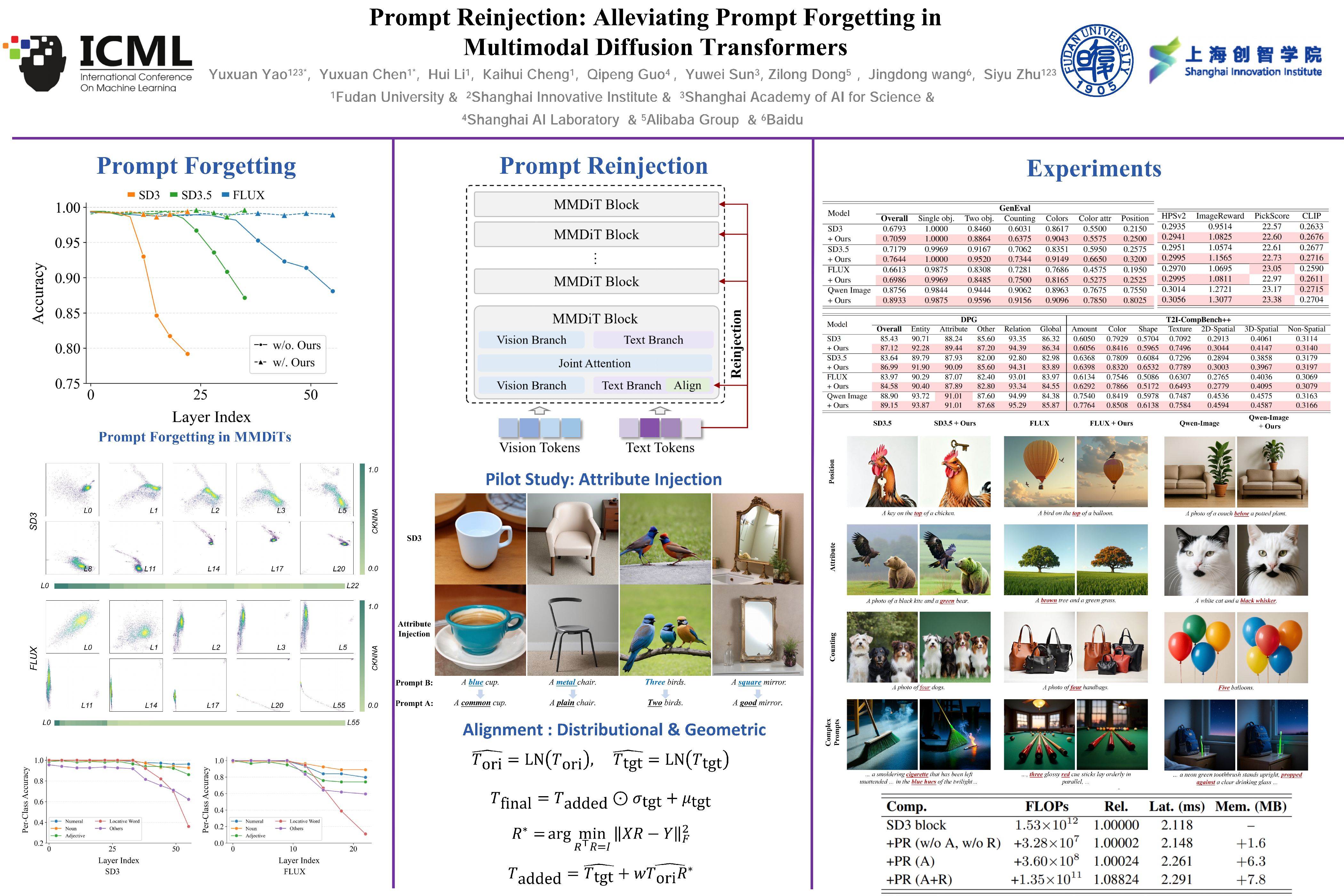
Multimodal Diffusion Transformers (MMDiTs) for text-to-image generation maintain separate text and image branches, with bidirectional information flow between text tokens and visual latents throughout denoising. In this setting, we observe a prompt forgetting phenomenon: the semantics of the prompt representation in the text branch is progressively forgotten as depth increases. We further verify this effect on three representative MMDiTs—SD3, SD3.5, and FLUX.1 by probing linguistic attributes of the representations over the layers in the text branch. Motivated by these findings, we introduce a training-free approach, prompt reinjection, which reinjects prompt representations from early layers into later layers to alleviate this forgetting. Experiments on GenEval, DPG, and T2I-CompBench++ show consistent gains in instruction-following capability, along with improvements on metrics capturing preference, aesthetics, and overall text--image generation quality.
Lay Summary
Recent text-to-image models can generate impressive images, but they still often miss important details in user prompts, such as object counts, spatial relations, or attribute bindings. In this work, we find that a key reason is “prompt forgetting”: as Multimodal Diffusion Transformers process text and image information through many layers, fine-grained prompt information in the text branch gradually becomes harder to recover. To address this problem, we propose Prompt Reinjection, a training-free method that reuses prompt representations from early layers and injects them back into later layers during inference. This helps the model preserve important textual details without retraining or changing its parameters. Experiments on several text-to-image benchmarks show that our method improves instruction following across multiple models while maintaining overall image quality. This research matters because it makes image generation systems more controllable and faithful to user intent, which is important for both creative applications and safer deployment.