
LOVE: Benchmarking and Evaluating Text-to-Video Generation and Video-to-Text Interpretation
Abstract
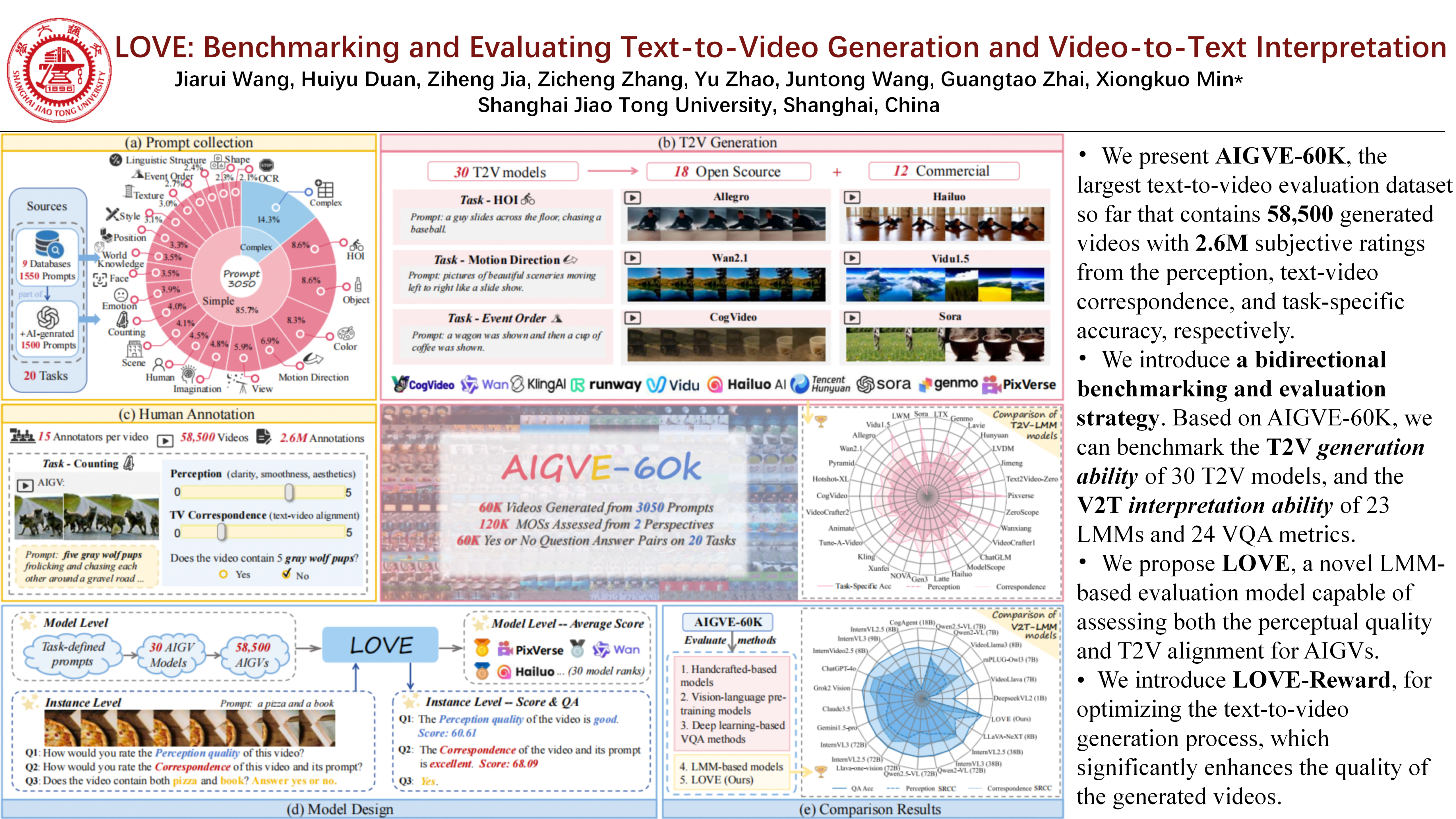
Recent advancements in large multimodal models (LMMs) have driven substantial progress in both text-to-video (T2V) generation and video-to-text (V2T) interpretation tasks. However, current AI-generated videos (AIGVs) still exhibit limitations in terms of perceptual quality and text-video alignment. To this end, we present AIGVE-60K, a comprehensive dataset and benchmark for AI-Generated Video Evaluation, which features (i) comprehensive tasks, encompassing 3,050 extensive prompts across 20 fine-grained task dimensions, (ii) the largest human annotations, including 120K mean-opinion scores (MOSs) and 60K question-answering (QA) pairs annotated on 58,500 videos generated from 30 T2V models, and (iii) bidirectional benchmarking and evaluating for both T2V generation and V2T interpretation capabilities. Based on AIGVE-60K, we propose LOVE, a LMM-based metric for AIGV Evaluation from multiple dimensions including perceptual preference, text-video correspondence, and task-specific accuracy. Building upon LOVE, we further introduce LOVE-Reward to optimize T2V models through reinforcement learning, effectively enhancing both the perceptual quality and text-video correspondence of generated videos. Comprehensive experiments demonstrate that LOVE achieves state-of-the-art performance and generalizes effectively to various AIGV benchmarks. LOVE-Reward significantly improves video generation quality. These findings highlight the effectiveness of the AIGVE-60K dataset and our proposed methods. The database and codes are available at https://github.com/IntMeGroup/LOVE.
Lay Summary
(1) Problem: Artificial intelligence can now generate videos from simple text descriptions, but these videos often suffer from visual flaws or fail to accurately reflect the user's instructions. (2) Solution: We create AIGVE-60K, a comprehensive dataset and benchmark for AI-Generated Video Evaluation, containing 58,500 AI-generated videos, all carefully annotated by humans. Using this rich data, we design an automated model that evaluates video quality and text accuracy. We then use this automated evaluation to provide direct feedback to the video-generating AI, teaching it to create better content over time. (3) Impact: Our approach sets a new standard for evaluating AI videos and significantly boosts their visual quality and reliability. By sharing our data and models freely, we aim to help developers build better, more trustworthy video-generation technology.