
Dywave: Event-Aligned Dynamic Tokenization for Heterogeneous IoT Sensing Signals
Abstract
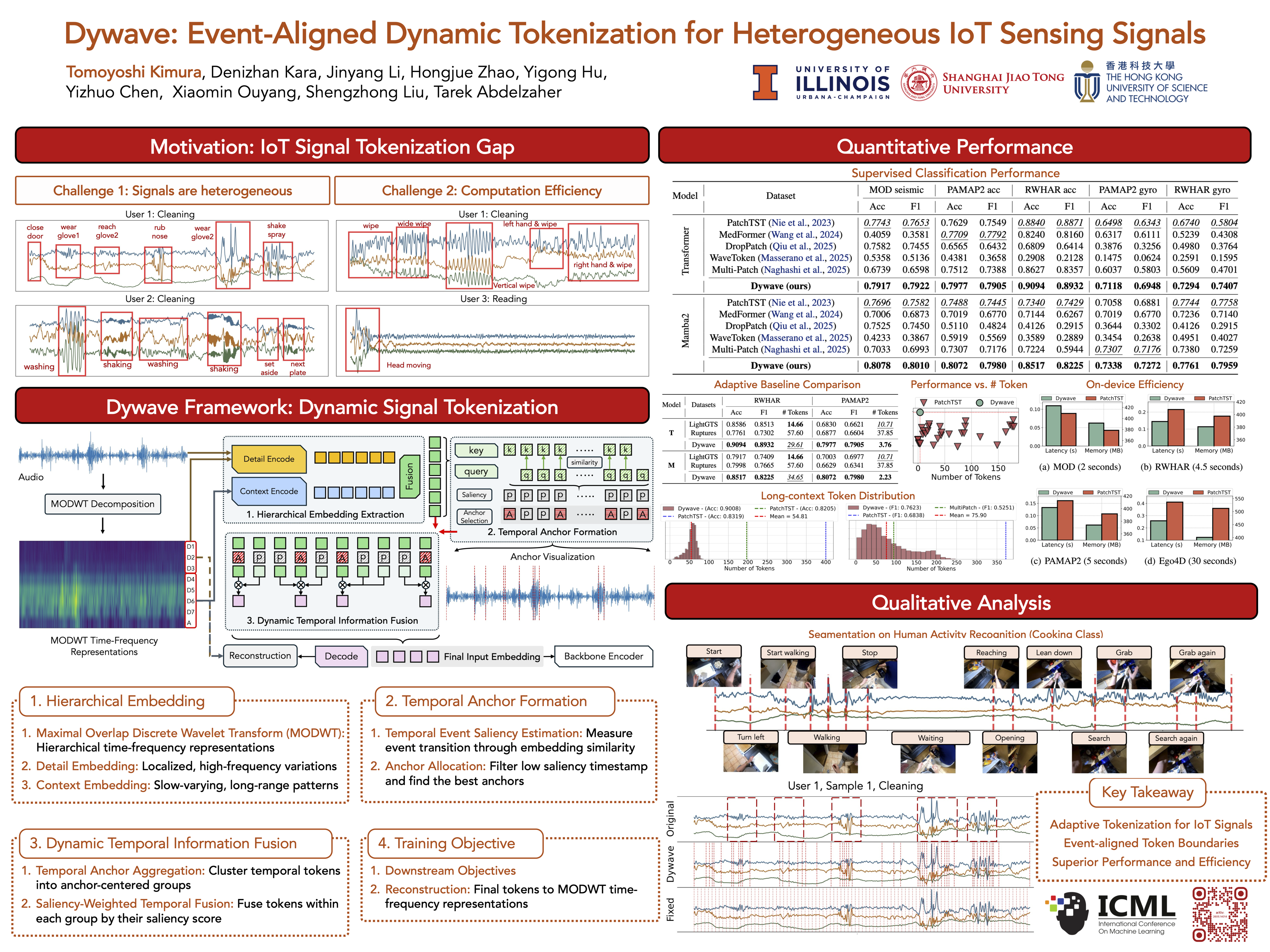
Internet of Things (IoT) systems continuously collect heterogeneous sensing signals from ubiquitous sensors to support intelligent applications such as human activity analysis, emotion monitoring, and environmental perception. These signals are inherently non-stationary and multi-scale, posing unique challenges for standard tokenization techniques. This paper proposes Dywave, a dynamic tokenization framework for IoT sensing signals that constructs compact input representations aligned with intrinsic temporal structures and underlying physical events. Dywave leverages wavelet-based hierarchical decomposition, identifies meaningful temporal boundaries corresponding to underlying semantic events, and adaptively compresses redundant intervals while preserving temporal coherence. Extensive evaluations on five real-world IoT sensing datasets across activity recognition, stress assessment, and nearby object detection demonstrate that Dywave outperforms state-of-the-art methods by up to 12% in accuracy, while improving computational efficiency by reducing input token lengths by up to 75\% across mainstream sequence models. Moreover, Dywave exhibits improved robustness to domain shifts and varying sequence lengths.
Lay Summary
Machine learning models often process sensor data from devices such as wearables, phones, and environmental sensors. Unlike text, where words provide natural units, or images, where small patches can be used, sensor signals are continuous waveforms with no obvious “pieces.” Existing methods usually split these signals into fixed-length windows, but real-world activities do not happen in fixed-size chunks: a short hand movement, a long walking pattern, and a quiet resting period may all contain information at different temporal granularities. This can make models less accurate and waste computation on uninformative parts of the signal. We propose Dywave, a method that automatically breaks sensor signals into meaningful, event-aligned pieces. Dywave uses wavelet analysis to view signals at multiple time scales, identifies moments where important changes happen, and compresses stable or redundant intervals into fewer tokens. Across five real-world sensing datasets, including activity recognition, stress assessment, and object detection, Dywave improves accuracy while reducing input length by up to 75%. This makes Edge-AI systems more efficient, robust, and practical for resource-limited devices such as wearables and edge devices.