
The Two-Hump Problem: Bridging the Difficulty Gap in Mathematical Reinforcement Learning
Abstract
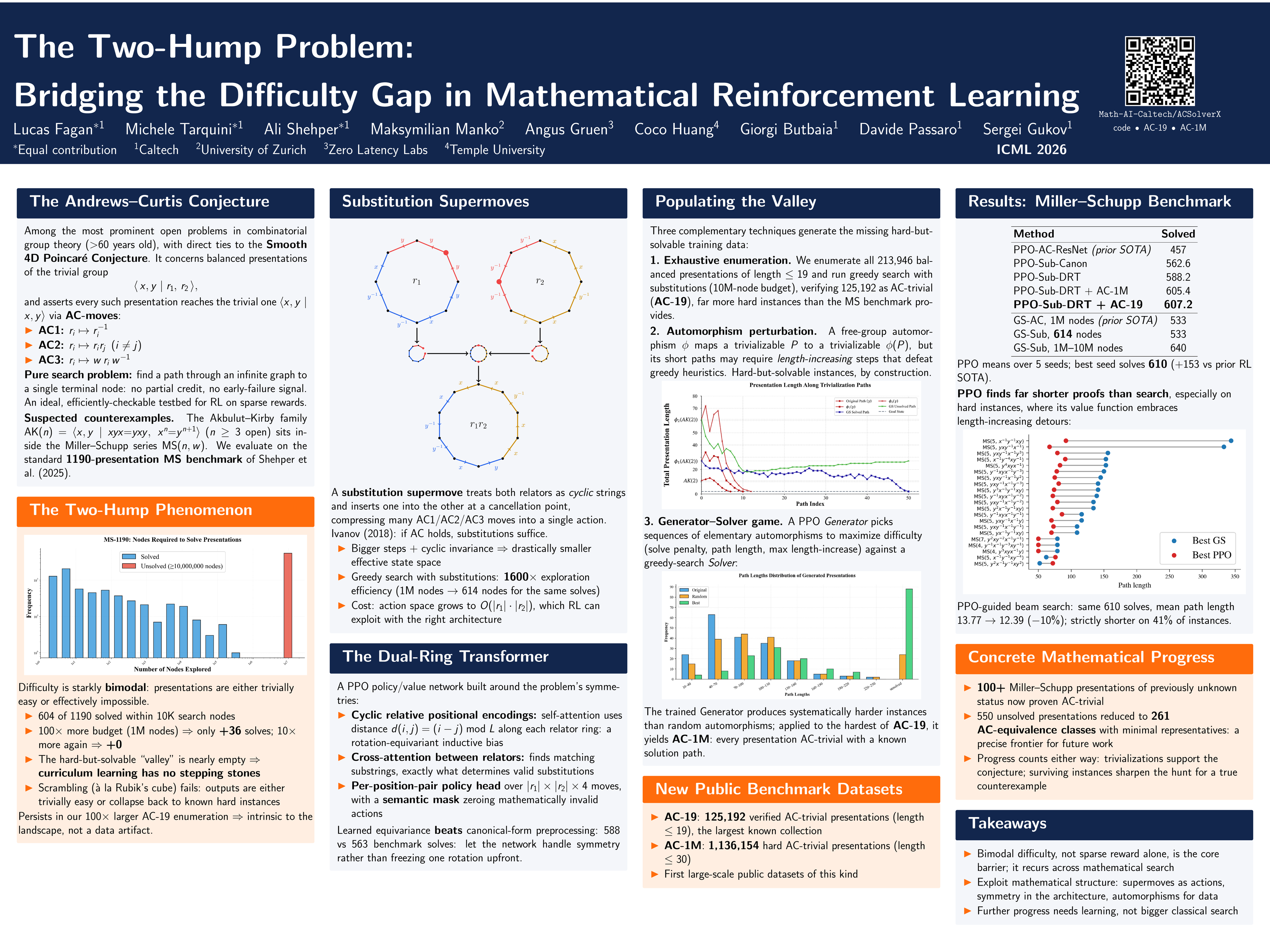
Mathematical search problems present a unique challenge for Reinforcement Learning (RL) due to vast search spaces and sparse rewards. In previous works, the Andrews-Curtis (AC) conjecture was established as an illustrative example of such problems. In this work, we identify a critical structural barrier in the AC landscape: a "Two Hump" distribution, where problem instances are either trivially solvable or effectively impossible, with a scarcity of intermediate "hard-but-solvable" instances required for effective learning. We tackle this challenge through two primary avenues: novel data generation techniques to populate the difficulty gap, and significant algorithmic enhancements including the introduction of supermoves and Transformer-based architectures. We demonstrate substantial performance improvements over previous baselines, and release new comprehensive benchmark datasets including AC-19 (125,192 AC-trivial presentations of varying difficulty with length at most 19) and AC-1M (1,136,154 hard AC-trivial presentations of length at most 30), the first large-scale, publicly available datasets of this kind.
Lay Summary
The Andrews–Curtis conjecture, formulated in 1965, asks whether every algebraic "recipe" for the trivial group can be reduced to the simplest possible recipe using a fixed set of moves, a deceptively simple question with 60 years of resistance and deep connections to 4-dimensional topology. We applied reinforcement learning (the family of techniques behind AlphaGo) to search for these reductions, but hit a "Two-Hump" obstacle: almost every example is either trivially easy or effectively impossible, leaving little for the learner to grip onto. We address this with a specialized neural architecture, a system that generates fresh intermediate-difficulty problems, and "supermoves" that bundle many primitive moves into one. The result: we solve over 150 more problems than the previous state of the art, reduce a famous family of 550 unsolved cases to 261, release two large datasets, and provide a template for using machine learning on other mathematical search problems with the same difficulty structure.