
Causal Dependency-Aware Unsupervised Routing for Large Reasoning Models
Abstract
Lay Summary
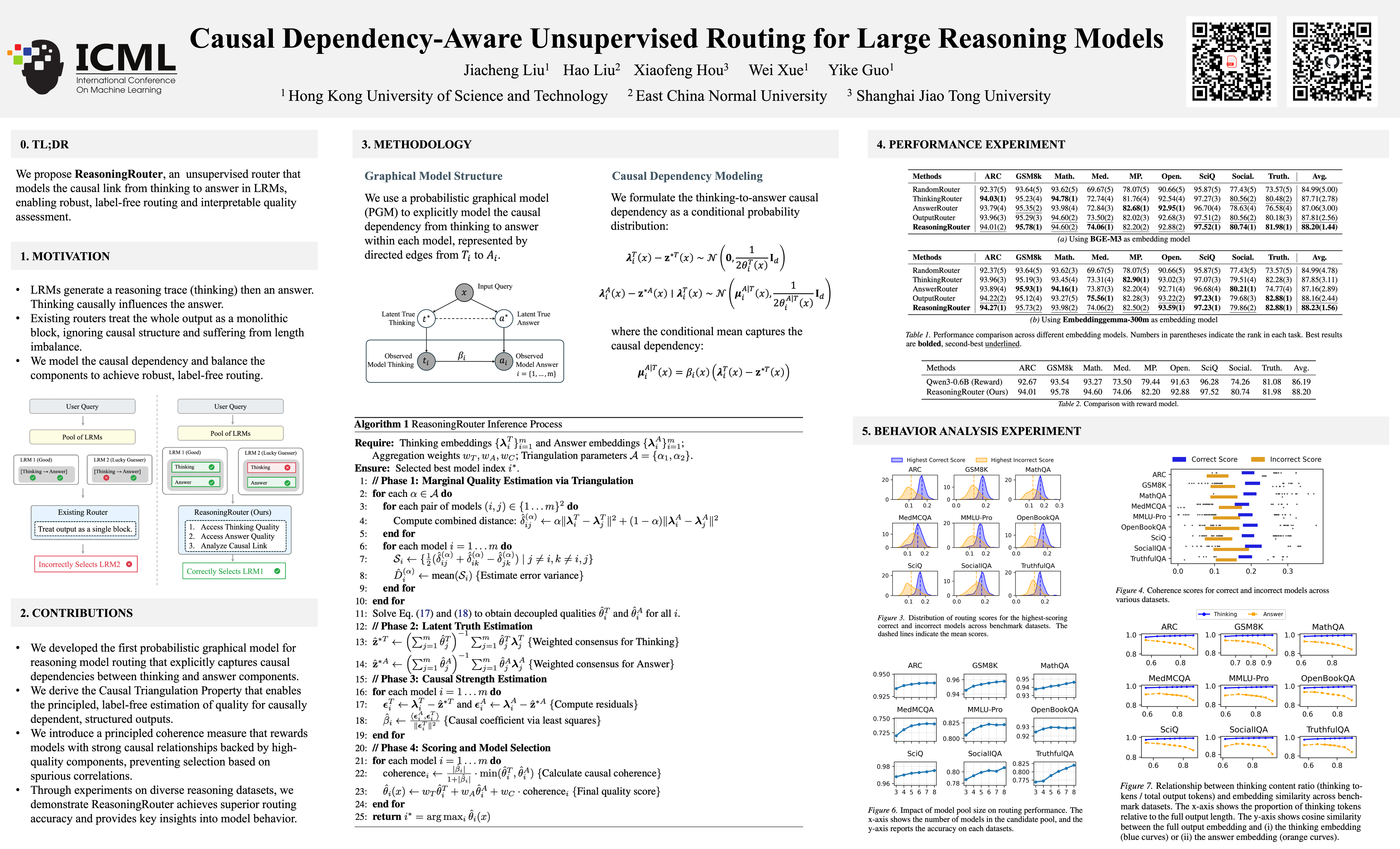
Modern AI reasoning models are designed to think before they speak, but choosing the best model to answer a specific question without relying on slow, expensive human feedback is a major challenge. Existing automated selectors treat an AI's output as a single block, making them unable to tell the difference between a model that reasoned logically and a lucky guesser that stumbled onto the right answer through flawed logic. Additionally, extremely long reasoning steps can easily overwhelm and hide the quality of the final, short answer. To solve this, we developed ReasoningRouter, which evaluates the reasoning process and the final answer separately. It uses a mathematical model to map out how the quality of an AI's thinking directly influences its final answer, specifically rewarding models that exhibit strong, coherent logic. Our approach successfully selects the most accurate AI model across various complex tasks without needing any human-labeled training data.