
Enhancing Train-Free Infinite-Frame Generation for Consistent Long Videos
Abstract
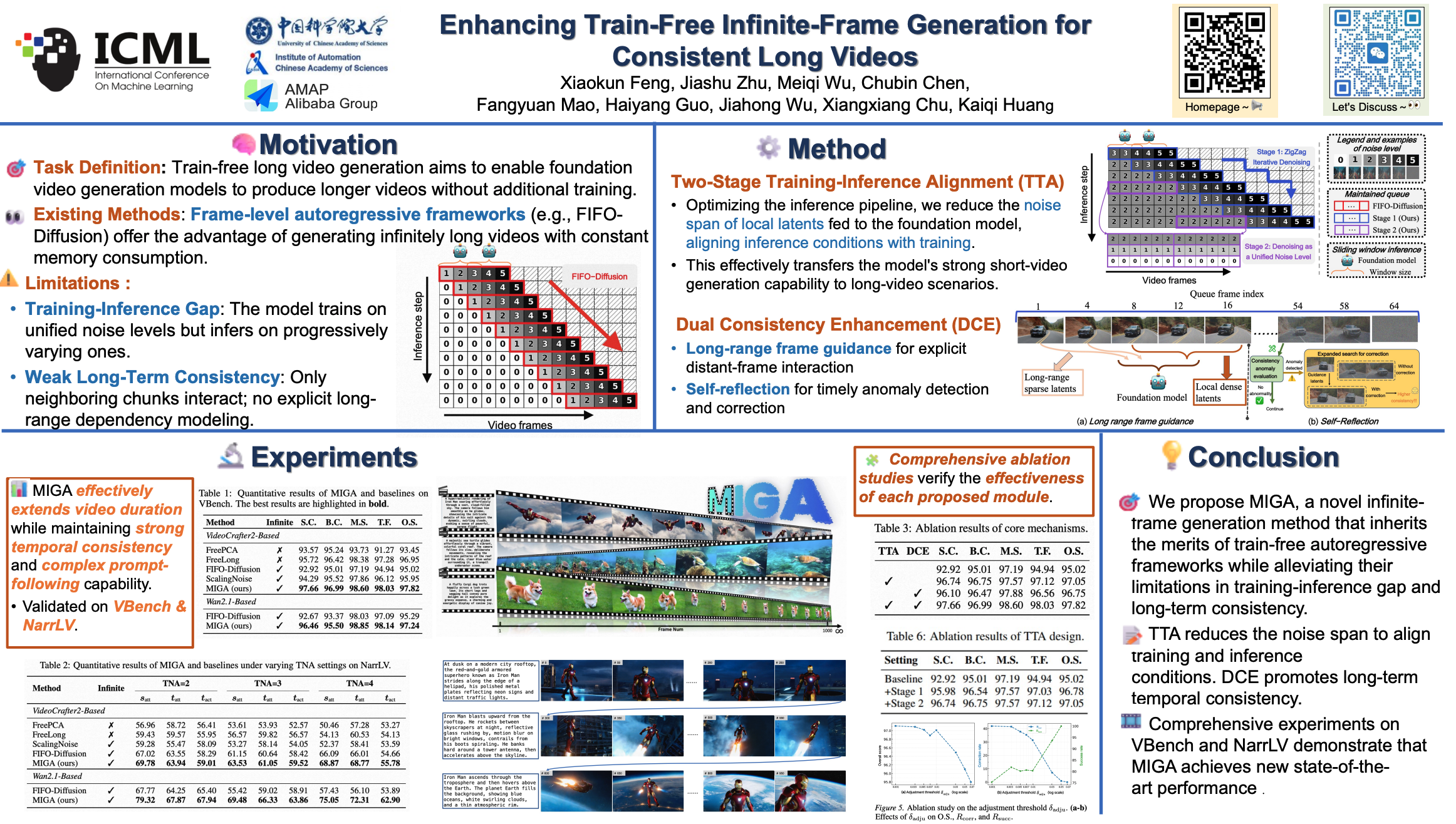
Without incurring significant computational overhead, train-free long video generation aims to enable foundation video generation models to produce longer videos. Frame-level autoregressive frameworks, e.g., FIFO-diffusion, offer the advantage of generating infinitely long videos with constant memory consumption. However, the mismatch between training and inference, coupled with the challenge of maintaining long-term consistency, limits the effective utilization of foundation models. To mitigate these concerns, we propose MIGA, a novel infinite-frame long video generation method. Firstly, we propose an effective two-stage alignment mechanism that mitigates the training-inference gap by reducing the excessive noise span fed to the model. We then introduce an innovative dual consistency enhancement mechanism, where the self-reflection approach corrects early high-noise frames and the long-range frame guidance approach leverages later low-noise frames with broad coverage to steer generation, jointly improving temporal consistency. Extensive experiments on VBench and NarrLV demonstrate the state-of-the-art performance of MIGA. Our project page is available at https://xiaokunfeng.github.io/miga_homepage/.
Lay Summary
Today's best AI video models can create vivid clips—but only a few seconds long. Ask them for a one-minute scene and the result drifts: characters morph, backgrounds flicker, the story falls apart. Retraining these models on long videos is enormously expensive and requires data nobody really has. We built MIGA, a way to extend existing video AIs to produce videos of arbitrary length without retraining them. The trick is to denoise frames in a careful, gradual sequence—matching the conditions the model originally learned from—and to let the system reflect on what it has already drawn. When inconsistencies start to appear, MIGA spots them early and corrects course; when scenes are stable, MIGA reuses cues from far-away frames to anchor the visual story. The result is consistent, minute-long videos generated on the same hardware that would otherwise produce only seconds. We hope this lowers the barrier for filmmakers, game designers, and researchers to explore long-form AI video.