
CSG: Cognitive Structure Generation for Intelligent Education
Abstract
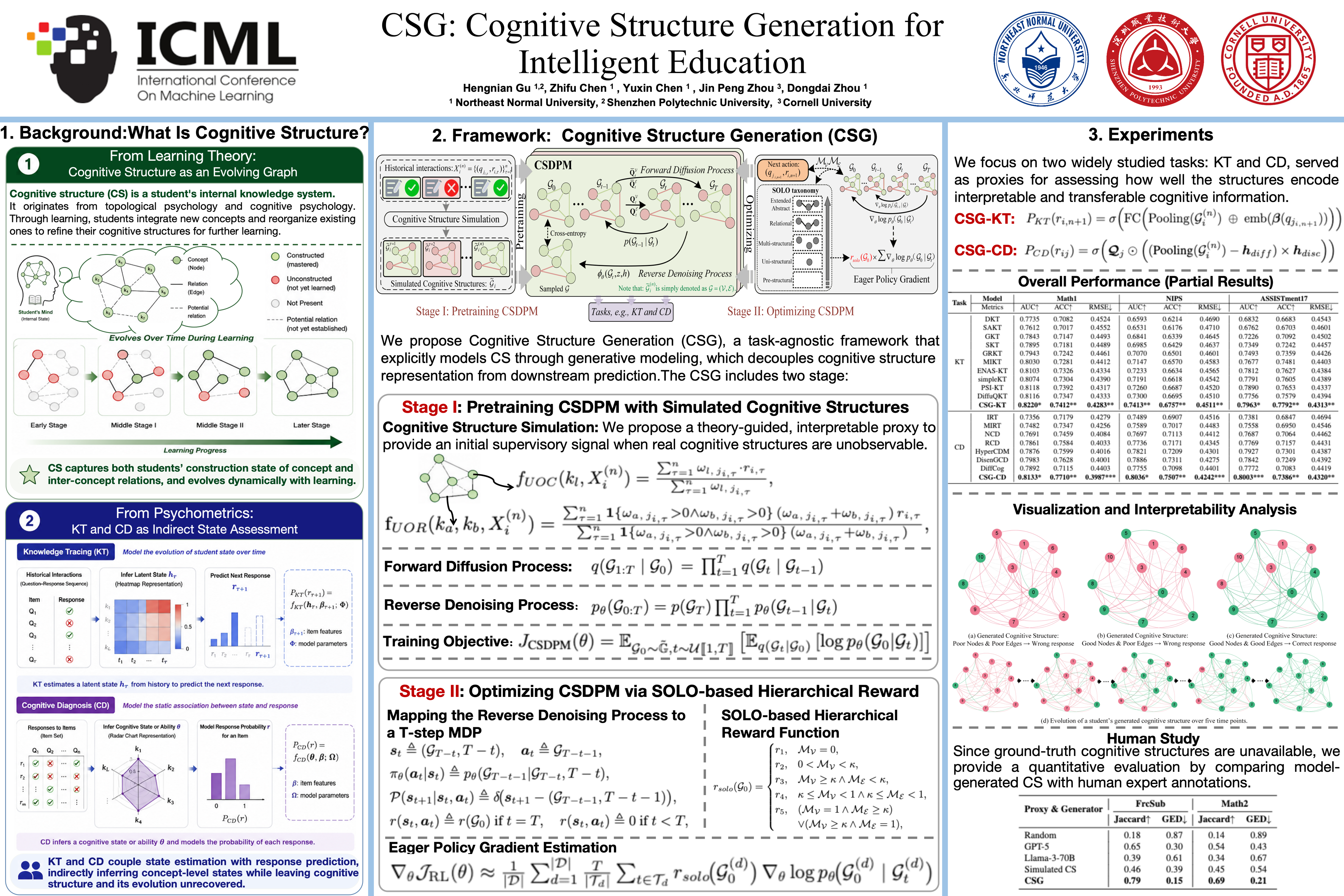
Cognitive structure (CS), a student's construction of concepts and inter-concept relations, has long been recognized as a foundational notion in psychology and intelligent education, yet remains largely unassessable in practice. Existing approaches such as knowledge tracing (KT) and cognitive diagnosis (CD) simplify and indirectly approximate CS, but they intertwine representation learning with prediction objectives, limiting generalization, interpretability, and reuse across tasks. To address this gap, we propose Cognitive Structure Generation (CSG), a task-agnostic framework that explicitly models CS through generative modeling. Based on educational theories, CSG first pretrains a Cognitive Structure Diffusion Probabilistic Model (CSDPM) and then applies reinforcement learning with SOLO-based hierarchical rewards to capture plausible patterns of cognitive development. By decoupling cognitive structure representation from downstream prediction, CSG produces interpretable and transferable cognitive structures that can be seamlessly integrated into diverse student modeling tasks. Experiments on five real-world datasets show that CSG yields more comprehensive representations, substantially improving performance while offering enhanced interpretability and modularity.
Lay Summary
This paper studies how to better understand what students know and how their knowledge develops. In learning, students do not only master isolated concepts; they also build connections between related concepts. These internal knowledge structures are important for education, but they are hard to observe directly. We propose Cognitive Structure Generation (CSG), a method that builds an explicit graph-like map of a student’s knowledge structure from their learning records. In this map, nodes represent students' construction states of concepts and edges represent relationships between concepts. The method is designed to capture how these structures change as students learn. The generated structures can support common educational tasks, such as predicting future performance and diagnosing what a student understands. Experiments on five real-world datasets show that CSG improves these tasks and also provides more interpretable results. This makes it possible to move beyond simply predicting whether a student will answer correctly, toward understanding how their knowledge is organized and evolving.